
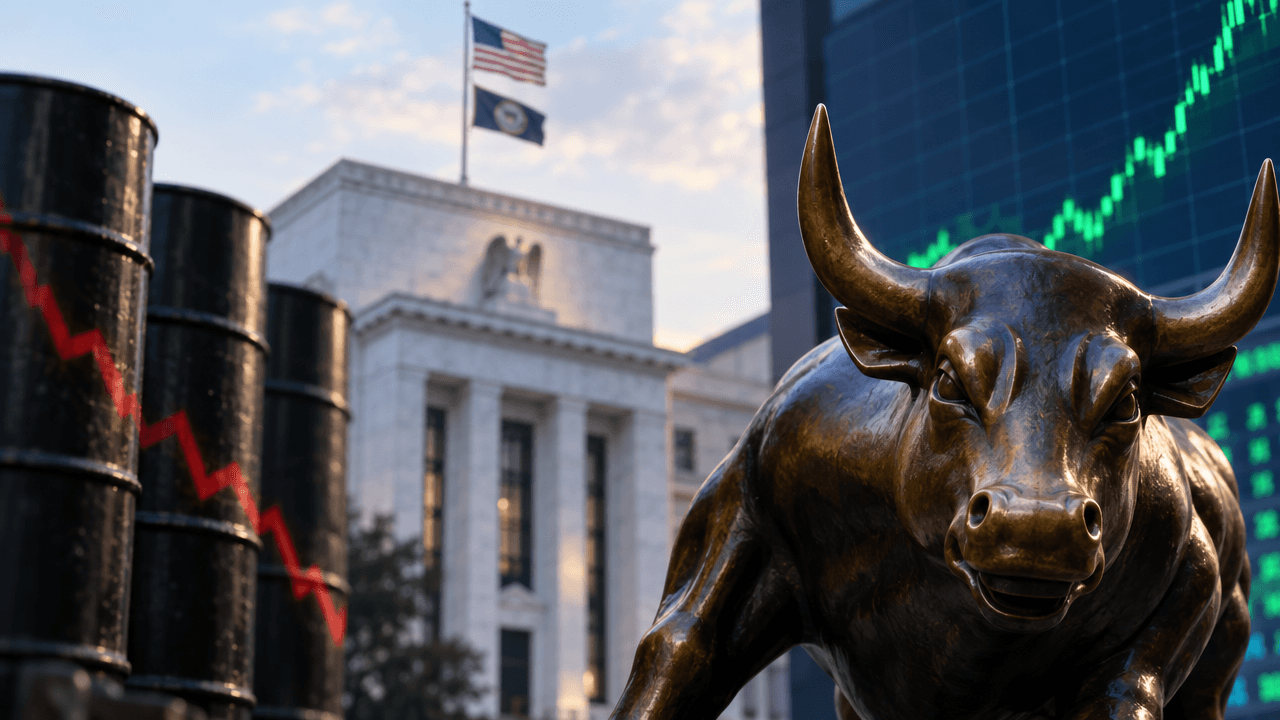
Risk appetite picked up in overnight trading as U.S. stock-index futures edged higher, helped by softer oil prices and a perceived dovish tone from the Federal Reserve’s leadership.[1][4][15] For traders, the move reflects a familiar pattern: when energy costs ease and rate-hike anxiety cools, equity futures often catch a bid while the dollar and yields lose some momentum.[4][11][15] Understanding the drivers behind this shift is essential for positioning in both live and simulated markets.
Market Snapshot: Futures, Oil, And Fed Tone
U.S. stock-index futures were modestly higher in Asian hours, following a period of volatility driven by concerns over inflation and rising yields.[1][4][15] Gains were not explosive, but the change in direction stood out after recent sessions where higher rates and elevated oil prices had pressured risk assets.[4][11]
Oil prices, which had been trending higher on supply risks, saw a sharp pullback, with Brent crude dropping around 2.6% to settle just below the US$103 per barrel mark in the prior session.[3][5][11] U.S. benchmark West Texas Intermediate (WTI) similarly fell more than 3%, closing near US$89 per barrel.[5][11] The slide was linked to signs that Middle East supply disruptions were easing, including reports that crude flows and pipeline capacity were being restored.[5][8][11]
At the same time, Treasury yields paused after reaching multi-year highs, as softer economic data and central-bank commentary eased expectations of aggressive near-term tightening.[4][11][15] This combination—steady or lower yields, falling oil, and firmer futures—signals a short-term improvement in risk sentiment, even if underlying macro risks remain.
Why Lower Oil Prices Matter For Risk Assets
Oil is more than just a commodity; it is a proxy for both growth expectations and cost pressures. When prices fall because supply improves rather than demand collapses, markets often interpret the move as a net positive for risk assets.[3][5][11] Cheaper energy can support profit margins, especially in sectors with high fuel or transport costs, and reduces headline inflation pressure.
Recent declines in Brent and WTI were tied to renewed attention on increased crude shipments from the Middle East and signs that capacity previously disrupted by geopolitical events was coming back online.[5][8][11] This supply-led adjustment tempers fears that oil will re-accelerate inflation, which in turn reduces pressure on central banks to tighten policy aggressively.[3][5][11]
For equity traders, lower oil often translates into stronger performance for consumer and interest-rate-sensitive sectors, as the market starts to price in more benign input costs and potentially less restrictive monetary policy. In index futures, that can show up as broad-based gains, with cyclical names outperforming defensive sectors on days when energy falls and yields slip.
The Dovish Signal From The Fed And Rate Expectations
The other key driver of the overnight move was commentary from New York Fed President John Williams, a key voice on the Federal Open Market Committee (FOMC).[1][2][9] Williams reiterated that the Fed sees “no need for urgency” in raising rates again after the September hike, and that only one more increase this year may be needed if the economy evolves as expected.[1][2][10]
His remarks effectively pushed back against market expectations for an October rate hike, with futures pricing the probability of another move sharply lower after his speech.[2][10] Some estimates showed the implied odds of an October hike dropping from roughly three-quarters to about half, as traders shifted their focus toward a potential move later in the year instead.[2][10]
Williams emphasized that the September rate increase has given the Fed time to gather more information before deciding on the next step, underscoring a data-dependent and measured approach rather than a rush to tighten.[1][2][10] By describing policy as modestly restrictive and noting that additional hikes may not be urgently required, he reinforced a dovish tilt relative to recent hawkish market narratives.[1][2][9]
For currency and rate traders, such commentary can weigh on the dollar and bring some relief to longer-dated yields, as discount rates and front-end rate expectations adjust.[4][9][15] For equity futures, it tends to support risk-on positioning as the perceived probability of a near-term policy shock declines.
Trading Implications For Simulated And Live Markets
For traders using SimFi platforms, this kind of news flow offers a real-time case study in cross-asset dynamics. When oil sells off on supply relief and a key Fed official sounds less urgent on future hikes, several linked market reactions are worth monitoring.
First, index futures often respond quickly to changes in rate expectations, particularly in growth- and tech-heavy benchmarks that are sensitive to discount rate shifts. Second, sector rotation can intensify, with energy stocks underperforming on lower crude while rate-sensitive sectors and consumer names potentially gain. Third, volatility may compress in the near term if markets judge that tail risk from policy surprises has abated.
Simulated trading environments allow participants to test strategies around such events without capital at risk. For example, traders can:
1. Back-test how equity futures typically react to dovish Fed remarks combined with a move lower in oil. 2. Explore spread trades between energy sectors and broader indices when crude experiences a supply-driven drop. 3. Practice managing risk when market narratives shift abruptly from “higher for longer” to “wait and see” on rates.
The goal is not to predict every move, but to understand how these macro drivers interact and how positions could be adjusted in response.
Key Takeaways For Active Traders
Several practical lessons emerge from the current setup:
1. Watch the interplay between commodities and central-bank guidance. Oil moving lower on improved supply while a key Fed official signals patience is a supportive backdrop for risk, but only as long as growth data does not deteriorate sharply. 2. Focus on probabilities, not headlines. Williams’ comments did not rule out further hikes, but they shifted the timing and odds as reflected in rate futures. Those probability shifts often matter more than the words alone.[2][10] 3. Monitor cross-asset confirmation. The combination of rising equity futures, softer yields, and falling oil provides a stronger signal than any single market move. When multiple assets align, narrative conviction in the market tends to increase.[3][4][11][15] 4. Use simulated trading to rehearse responses to macro news. Practicing entries, exits, and risk controls in a SimFi environment can sharpen decision-making when similar patterns appear in live markets.
Conclusion
The move higher in U.S. futures as oil declines and Fed commentary turns more dovish highlights how quickly macro narratives can shift, even without a formal policy decision.[1][4][15] Lower energy prices ease inflation concerns, while a patient Fed stance reduces the perceived risk of abrupt tightening, together offering a more supportive short-term backdrop for risk assets.[3][5][10][11]
For traders, the key is not simply reacting to the latest headline, but understanding the underlying mechanisms: how supply-driven commodity moves influence inflation expectations, how central-bank communication reshapes rate probabilities, and how those factors feed into cross-asset pricing. Whether in live markets or simulated environments, building a framework that connects these dots is essential to navigating days like this with discipline and confidence.