
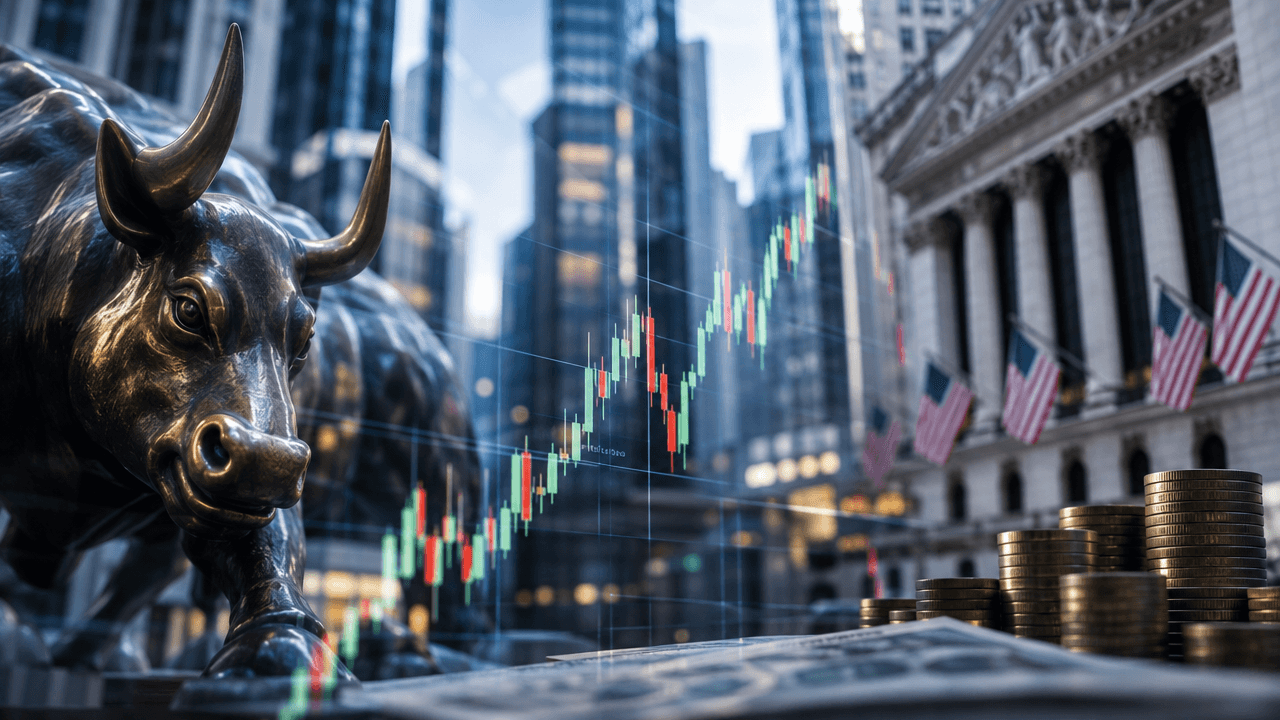
U.S. equity futures are trading in a tight orbit around interest-rate expectations and broader risk sentiment, even as headline index levels show the S&P 500, Dow, and Nasdaq advancing in the latest session.[1][4] With cash markets closed over the weekend, the next leg in futures is likely to depend less on earnings headlines and more on how traders reprice the path of Federal Reserve policy, Treasury yields, the dollar, and high-beta assets such as crypto.[2][10]
Rates Are Still Driving The Story
The recent move higher in U.S. index futures has come alongside episodes of easing pressure in bond yields, underscoring how sensitive equity valuations remain to the cost of capital.[2][10] When yields fall, the present value of future cash flows rises, supporting higher equity prices—particularly for growth and tech-heavy indices like the Nasdaq 100.[2][11] Conversely, any renewed spike in yields can quickly weigh on futures as traders mark down valuation multiples and rotate towards more defensive exposures.[6][8]
For traders, the key dynamic to understand is that index futures often price in macro expectations before cash markets reopen. If new information prompts traders to revise their rate outlook—whether via Fed commentary, data surprises, or moves in global yields—that repricing appears first in futures markets.[2][11] This makes overnight moves in S&P 500, Dow, and Nasdaq futures a live proxy for how the market is digesting the evolving rate narrative.[2][15]
Treasury Yields, Fed Expectations, And Equity Beta
Across recent sessions, U.S. equity futures have tended to firm when bond yields pull back, sometimes driven by softer energy prices or shifts in inflation expectations.[10][12] A retreat in oil, for example, can lower perceived inflation pressure, reduce the probability of additional tightening, and bring yields down—all of which boosts risk appetite in index futures.[10][12] The move is rarely uniform: high-duration assets such as megacap tech and growth stocks normally benefit the most, which shows up in stronger gains for Nasdaq futures relative to the Dow.[2][11]
Fed expectations matter just as much as the current level of yields. If traders lean toward a more dovish trajectory—earlier rate cuts or a lower terminal rate—futures typically price in higher equity levels as discount rates fall.[2][10] On the other hand, any hawkish surprise, such as a stronger data print that pushes back the expected timing of cuts, tends to trigger an immediate adjustment in futures, often before the broader cash market has time to react.[6][8]
For both live and simulated trading, this rate-to-futures transmission provides a clear framework: - Monitor implied probabilities in Fed funds futures and key Treasury benchmarks as leading indicators of equity futures direction. - Expect sectors with higher earnings duration (tech, communication services) to show outsized sensitivity. - Use index futures as a real-time barometer of how quickly the market is repricing policy expectations.
Dollar Momentum And Crypto Risk Sentiment
Beyond rates, dollar momentum and crypto performance have become important secondary drivers of U.S. equity futures, particularly in risk-on and risk-off swings.[10][11] A stronger dollar often tightens global financial conditions, weighs on multinational earnings translations, and can dampen demand for risk assets, including equities.[6][8] When the dollar weakens, it typically supports commodity-linked plays and improves the backdrop for U.S. companies with significant overseas revenue, which can add a tailwind to futures.[10][11]
Crypto markets add another layer of risk sentiment. Strong, broad-based rallies in major coins tend to reflect an aggressive appetite for risk, which can spill over into high-beta equities and index futures.[10][12] Conversely, sharp drawdowns in crypto frequently coincide with volatility spikes and de-risking in other asset classes. For traders, this does not mean equity futures are mechanically tied to every crypto move, but it does mean that crypto can serve as an additional sentiment gauge, especially during thin liquidity windows such as overnight and weekend trading.[10][12]
For U.S. equity futures, the combination of dollar moves and crypto risk-on/risk-off impulses can either reinforce or partially offset the signal coming from rates. A session with modest yield declines but an aggressive risk-on turn in crypto, for instance, may generate stronger futures gains than rates alone would suggest.[10][11]
Implications For Active Traders And Simulated Strategies
When cash markets are closed, index futures become the primary expression of market views on macro and risk sentiment, and they often lead the tone for the next trading week.[2][11] For active traders and participants on SimFi platforms, this creates a rich environment to test and refine strategies that link macro indicators to equity index behavior.
Several practical approaches stand out: 1. Rate-sensitive playbook: Build scenarios around different yield paths—rally, range, or spike—and map expected responses in S&P 500, Dow, and Nasdaq futures, with particular focus on growth versus value exposure.[2][11] 2. Cross-asset sentiment overlay: Combine signals from Treasury yields, the dollar index, and major crypto benchmarks to construct a composite risk sentiment score, then backtest how changes in that score correlate with intraday futures moves.[10][12] 3. Volatility-aware positioning: Use implied volatility measures alongside macro drivers to size positions more dynamically, reducing exposure when both yields and sentiment point toward instability.[6][8]
Simulated environments are well suited to explore these relationships without capital at risk. Traders can iterate through macro regimes—hawkish Fed, dovish pivot, high inflation, disinflation—and measure how rate and sentiment shocks propagate into futures pricing over different time horizons.[2][10]
Conclusion: Navigating Rate-tied Futures
With the S&P 500, Dow, and Nasdaq recently registering higher index levels, the immediate direction of U.S. equity futures over weekends and overnight sessions remains anchored to how markets reprice rates and risk appetite rather than to cash-market price action itself.[1][4] Treasury yields, Fed expectations, dollar trends, and crypto sentiment now operate as interconnected drivers of futures, offering traders multiple lenses through which to interpret and anticipate moves.[2][10]
For both real and simulated trading, the edge lies in treating futures as part of a macro ecosystem rather than in isolation. By systematically tracking rate expectations, yield curves, currency dynamics, and high-beta risk signals, traders can build more resilient frameworks for navigating the next leg in U.S. equity futures—whether the market leans into a risk-on extension or braces for a rate-driven reversal.[2][11]