
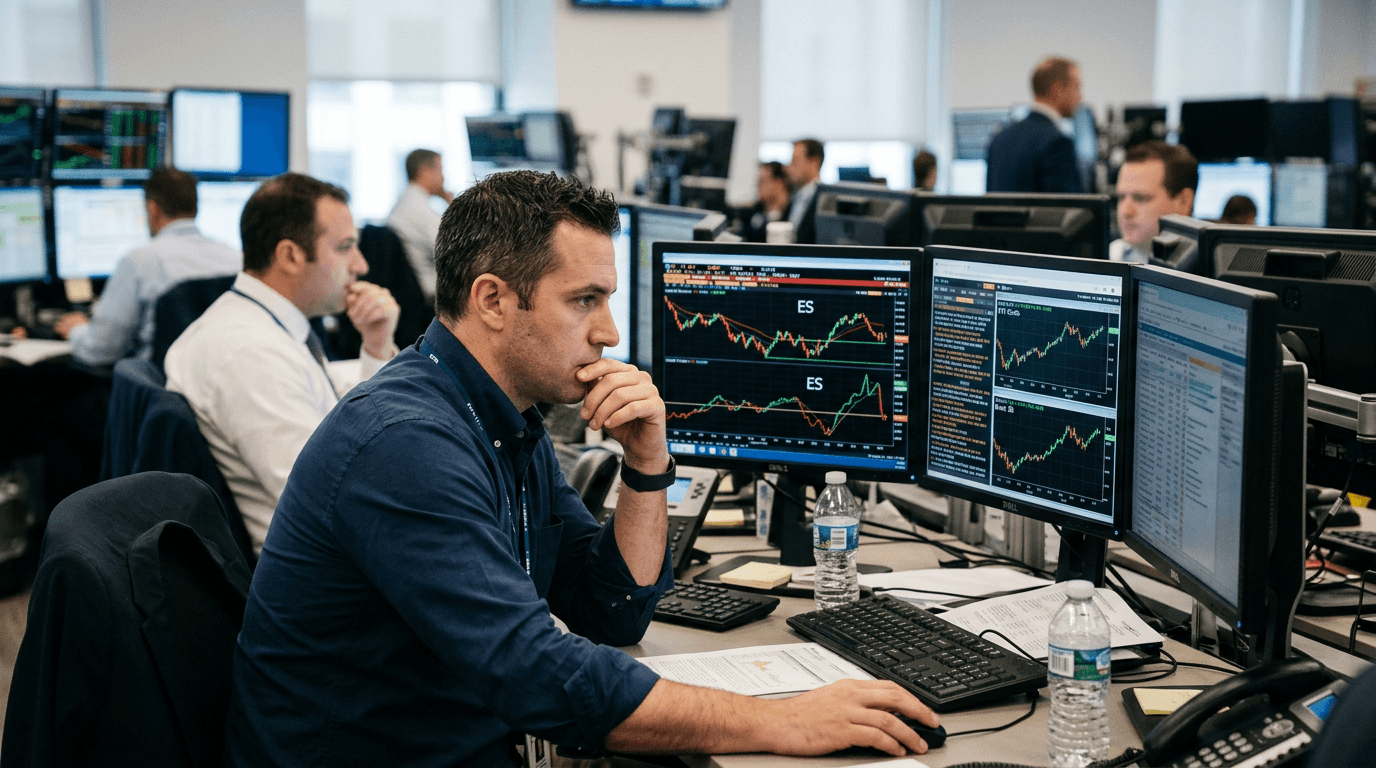
U.S. stock futures are treading water while oil prices push higher, a combination that speaks volumes about where traders see the biggest risks right now: policy signals from the Federal Reserve and the inflation implications of firmer energy markets[4][5][10][12]. With index futures essentially flat and WTI crude trading in the mid‑$80s per barrel alongside Brent near the low‑$90s, the market is in “wait-and-see” mode rather than outright risk-on or risk-off territory[4][5][15].
Market Snapshot: Futures Flat, Oil Firmer
Major U.S. equity index futures are little changed, reflecting a cautious stance ahead of upcoming Fed communications and economic data[4][5][10]. This kind of price action often appears when positioning is already substantial and traders prefer not to add risk until they have more clarity on the policy path. At the same time, front‑month WTI crude near $86.5 and Brent around $92.3, both up close to 1.5–1.9%, highlight a renewed bid in energy markets that contrasts with the muted tone in equities.
Recent market reports show oil supported by persistent uncertainty around key shipping lanes and ongoing geopolitical tensions, particularly in and around the Strait of Hormuz, which keep a risk premium embedded in prices[12][15]. Higher crude has historically been a catalyst for inflation concerns, and that relationship is very much back in focus as traders weigh how far the Fed is willing to go to keep price growth under control[12][13]. The result is a delicate balance: if stronger oil feeds inflation expectations, the Fed may lean more hawkish, which in turn would cap equity upside.
Why The Fed Matters For Equities And Energy
The Federal Reserve’s dual mandate—maximum employment and stable prices—means its decisions hinge on how growth and inflation evolve over the next several quarters, not just the next data print. Equity futures sitting near unchanged suggest traders see limited edge in making big directional bets until they better understand whether the Fed will signal a longer period of restrictive rates or open the door to eventual easing[4][5][11]. This is especially true when valuations are rich and earnings expectations already price in reasonably healthy growth.
Energy prices complicate that calculus. Oil is a key input into headline inflation measures, and sustained prices in the mid‑$80s to low‑$90s per barrel tend to translate into higher transportation, production, and eventually consumer costs[12][13]. While the Fed focuses more on “core” inflation that excludes food and energy, it cannot ignore the way persistent energy strength can seep into broader price dynamics via higher wages, shipping costs, and manufacturing expenses[12]. Traders know that a renewed rise in inflation expectations could delay rate cuts or prompt more hawkish messaging, which helps explain why equity futures are flat even as oil climbs.
For traders, the key is to think in scenarios rather than single outcomes. If Fed guidance turns more hawkish in response to firmer energy and sticky inflation, rate-sensitive sectors like growth tech, small caps, and highly leveraged companies may underperform. If, instead, the Fed emphasizes progress on underlying inflation and signals confidence that energy-related pressures are manageable, the market could rotate back toward risk assets, with cyclicals and financials potentially benefiting from a “higher for longer but contained” narrative.
OIL’S MOVE: SUPPLY RISKS AND DEMAND SIGNALS
Crude’s grind higher is not happening in isolation. Supply dynamics, from OPEC+ production discipline to disruptions or perceived risks in key export routes, continue to shape the forward curve and volatility in oil markets[12][15]. Reports of persistent uncertainty around Hormuz and the broader Middle East keep traders wary of potential supply shocks, even when actual physical flows remain relatively stable[12][15]. That uncertainty helps explain why prices can rise quickly on relatively modest headlines, as risk premia expand.
On the demand side, the picture is more nuanced. Slower growth in some advanced economies is offset by resilience in U.S. consumption and continued demand from emerging markets. When traders see oil moving higher despite only moderate global growth, they often interpret it as a sign that supply constraints and risk premia are doing more of the work than a genuine demand surge. That distinction matters: a demand‑driven rally in oil can be a bullish signal for cyclicals and industrials, whereas a supply‑driven spike tends to be more problematic for equities via the inflation and margin channels.
For equity traders, monitoring the relationship between oil and sectors such as airlines, logistics, consumer discretionary, and energy producers becomes critical. Rising crude typically pressures margin‑sensitive businesses with limited pricing power, while integrated energy companies and oilfield services names can benefit from higher realized prices and increased capital spending. Understanding where a portfolio is net exposed to oil risk—long or short—is an essential step in navigating sessions like this.
Implications For Traders Using Simulated Finance
For traders on a SimFi platform such as E8 Markets, today’s backdrop is an ideal environment to stress‑test strategies without real‑world capital at risk. A flat equity futures tape combined with a firming oil complex offers a clean canvas to explore cross‑asset relationships, volatility regimes, and event‑driven trading around central bank communication. Simulated trading allows participants to build and refine playbooks for Fed days, energy rallies, and macro inflection points before deploying them in live markets.
One practical approach is to design scenarios around different Fed outcomes: more hawkish than expected, in‑line, or more dovish. Traders can simulate how index futures, sector ETFs, and energy names respond in each case, adjusting for various oil price paths and term structures. Another valuable exercise is correlation testing—examining how equity indices historically behave when oil moves by more than 2% in a session and whether that relationship changes depending on the macro context (e.g., rising vs falling rates)[12][13]. Over time, this type of systematic practice helps traders recognize patterns and avoid overreacting to headlines.
Risk management is another area where SimFi can add significant value. Traders can build rules around position sizing ahead of major Fed events, such as capping exposure, tightening stops, or temporarily reducing leverage. In a simulated environment, those rules can be evaluated against different volatility conditions, allowing traders to refine them before they face the psychological pressures of live trading. The goal is to move from reactive decision‑making to disciplined execution anchored in tested frameworks.
Key Takeaways For The Session Ahead
First, flat U.S. stock futures alongside higher oil prices signal caution rather than conviction. Traders are waiting for clearer Fed guidance before committing to risk, mindful that firmer energy may complicate the inflation backdrop[4][5][10][12]. Second, the Fed’s messaging around inflation, growth, and financial conditions will be the decisive catalyst in turning today’s quiet futures action into either a risk‑on or risk‑off move[11][12]. Third, oil’s strength reflects a mix of supply risk and geopolitical uncertainty more than a simple demand boom, which carries different implications for equity sectors and inflation expectations[12][15].
Finally, for traders using simulated finance platforms, this environment is a valuable training ground. It offers the chance to develop and test strategies for navigating central bank uncertainty, energy‑driven inflation risks, and cross‑asset correlations without real‑money consequences. By approaching the day with a structured playbook—clear scenarios, defined risk limits, and a focus on learning—traders can turn a seemingly quiet futures session into a meaningful step forward in their development.