
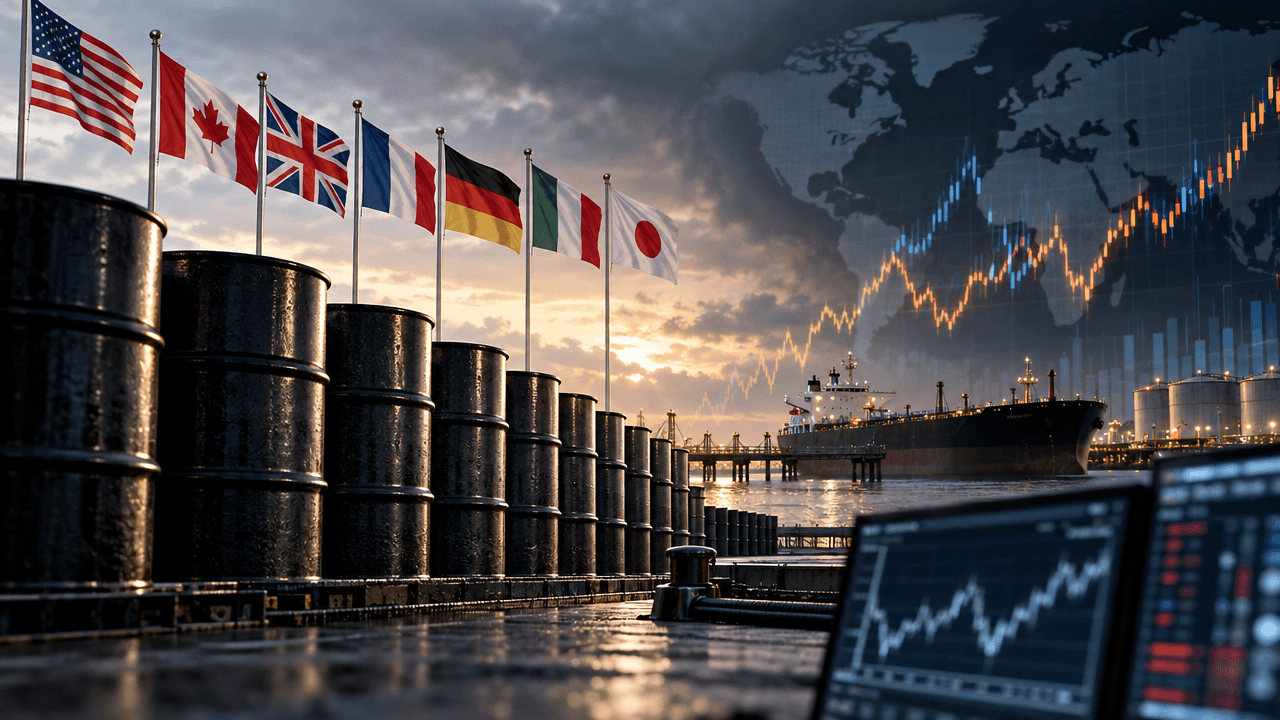
Global energy markets have been handed a fresh shock as G7 governments move to release up to 100 million barrels of crude oil and diesel from strategic reserves in a bid to ease tight supplies and surging fuel costs[4][7][12]. In immediate reaction, benchmark crude prices dropped sharply, with futures falling roughly 4.19% to around $91.42, underscoring how sensitive markets remain to policy-driven supply changes[5][12]. For traders, this is a textbook example of how government intervention can rapidly alter price dynamics, volatility, and correlations across oil, FX, and inflation-linked assets.
What The G7 Just Announced
The Group of Seven — the United States, Canada, the United Kingdom, Germany, France, Italy and Japan — has agreed on a coordinated release of 100 million barrels of diesel and crude oil from emergency stockpiles over about four months[7][12]. The goal is to inject additional supply into a strained market where diesel and refined products have been trading at significant premiums, driven by geopolitical conflicts and supply chain disruptions[6][9].
The release will be coordinated through the International Energy Agency (IEA), continuing a pattern of multilateral action that began with a record 400-million-barrel reserve deployment earlier this year[4][11][12]. Under the plan, a “frontloaded” wave of diesel will be pushed into the market within the first 20 days, reflecting policymakers’ concern over near-term fuel availability for transport, industry and heating[4][8][12]. While each G7 member will decide its individual contribution, the aggregate volume is designed to send a clear signal that major economies are prepared to use their strategic buffers to calm energy markets[4][13].
Why This Matters For Oil, Fx And Inflation
The initial 4%+ drop in crude futures to roughly $91 per barrel highlights how quickly prices can adjust when traders re-price supply expectations[5][10][12]. A planned release of 100 million barrels equates to roughly 830,000 barrels per day over four months if spread evenly, a non-trivial increment relative to global demand[5][8]. Even if the physical impact is modest compared with total consumption, the psychological effect on positioning and sentiment can be just as important.
For commodity-linked currencies such as the Canadian dollar or Norwegian krone, the announcement injects fresh volatility by altering the expected revenue stream from energy exports and the terms of trade[5][10]. Lower oil prices can weigh on those currencies, while importers like Japan or the euro area may see some relief in their energy bills, potentially stabilizing their FX profiles. At the same time, lower fuel prices can soften near-term inflation expectations, influencing bond yields and shaping market views on future central bank policy, especially in economies where core inflation has been heavily driven by energy costs[1][3][9].
Energy-related equities and futures are also likely to reassess margins and cash flows as diesel cracks, refinery spreads and shipping costs adjust to the new supply outlook[2][6][10]. Companies with high exposure to refining and distribution may temporarily benefit from improved availability, but producers could face pressure on realized prices if the release meaningfully dampens benchmarks. For traders, the key is not just the headline volume, but how quickly and where those barrels actually enter the market.
Implications For Active Traders
From a trading perspective, coordinated reserve releases tend to generate short, sharp moves followed by a period of reassessment as market participants gauge whether the action meaningfully changes underlying fundamentals. The immediate drop in crude prices suggests some long positioning was caught offside, leading to rapid de-risking and increased intraday volatility[5][10][12]. In such environments, liquidity can become uneven: spreads widen in fast markets and slippage increases, especially around key futures expiry dates.
For directional traders, the central question is whether this release marks a turning point in the supply–demand balance or a temporary reprieve. That requires tracking not only G7 flows but also OPEC+ production decisions, US shale output, and any further disruptions in Europe or the Middle East[6][9]. Spread traders should monitor term structure (contango vs backwardation) and refining margins: diesel-heavy releases can compress product spreads, alter crack relationships, and create new relative-value opportunities between crude, diesel and gasoline futures[2][6].
Risk management becomes paramount. Sudden policy announcements can trigger gap moves and stop-outs if positions are oversized or leverage is excessive. Traders should reassess position sizing, diversify across instruments instead of concentrating risk in a single contract, and consider using options to express views where volatility is elevated but direction is uncertain. Events like this also reinforce the importance of having a clear playbook for government interventions — including predefined rules for reducing exposure when headline risk spikes.
Using Simulated Finance To Stress Test Your Strategy
For traders using a SimFi environment like E8 Markets, the G7 reserve release is an ideal scenario to practice event-driven trading without capital risk. By recreating conditions around the announcement — a sharp downward move in crude, widening spreads, and increased correlation shifts between oil, FX and equity indices — traders can test how their strategies perform when markets are driven by policy rather than purely by data.
Simulated trading allows you to model multiple paths: one where the release successfully anchors prices and volatility fades, and another where the effect proves short-lived and crude rebounds as underlying shortages persist. You can experiment with different responses: cutting risk quickly, fading the initial move, or using options structures to capture volatility. Crucially, you can track how your decision-making changes under time pressure, refine execution rules, and build discipline around news-driven markets — skills that translate directly to live trading.
Key Takeaways
1) Policy can move markets fast Government decisions on strategic reserves can trigger abrupt price swings, as seen in the 4%+ drop in crude futures on the G7 headline[5][10][12]. Being prepared for such interventions is as important as tracking standard economic data.
2) Volume and timing matter more than headlines The market will focus on how quickly the 100 million barrels are released, where they land, and whether diesel flows relieve the most acute bottlenecks[4][5][8]. Traders should follow implementation details, not just the initial announcement.
3) Think in cross-asset terms Oil, FX, rates and equity sectors will all respond differently to the same policy shock[1][3][9]. Building a holistic view of correlations and transmission channels helps identify both risk concentrations and hedging opportunities.
4) Use simulation to harden your playbook Practicing this scenario in a SimFi environment lets you stress test entries, exits, and risk limits against real-world volatility patterns. The aim is to develop rules you can trust when the next policy-driven energy shock hits.
Ultimately, the G7’s decision to release up to 100 million barrels of oil and diesel is a reminder that energy markets sit at the intersection of geopolitics, macroeconomics and trading psychology[4][7][12]. Whether this move delivers lasting relief or just a temporary pause in the energy squeeze, traders who understand the mechanics of strategic reserve actions — and who rehearse their responses in a simulated setting — will be better positioned to navigate the next wave of volatility with confidence and discipline.