
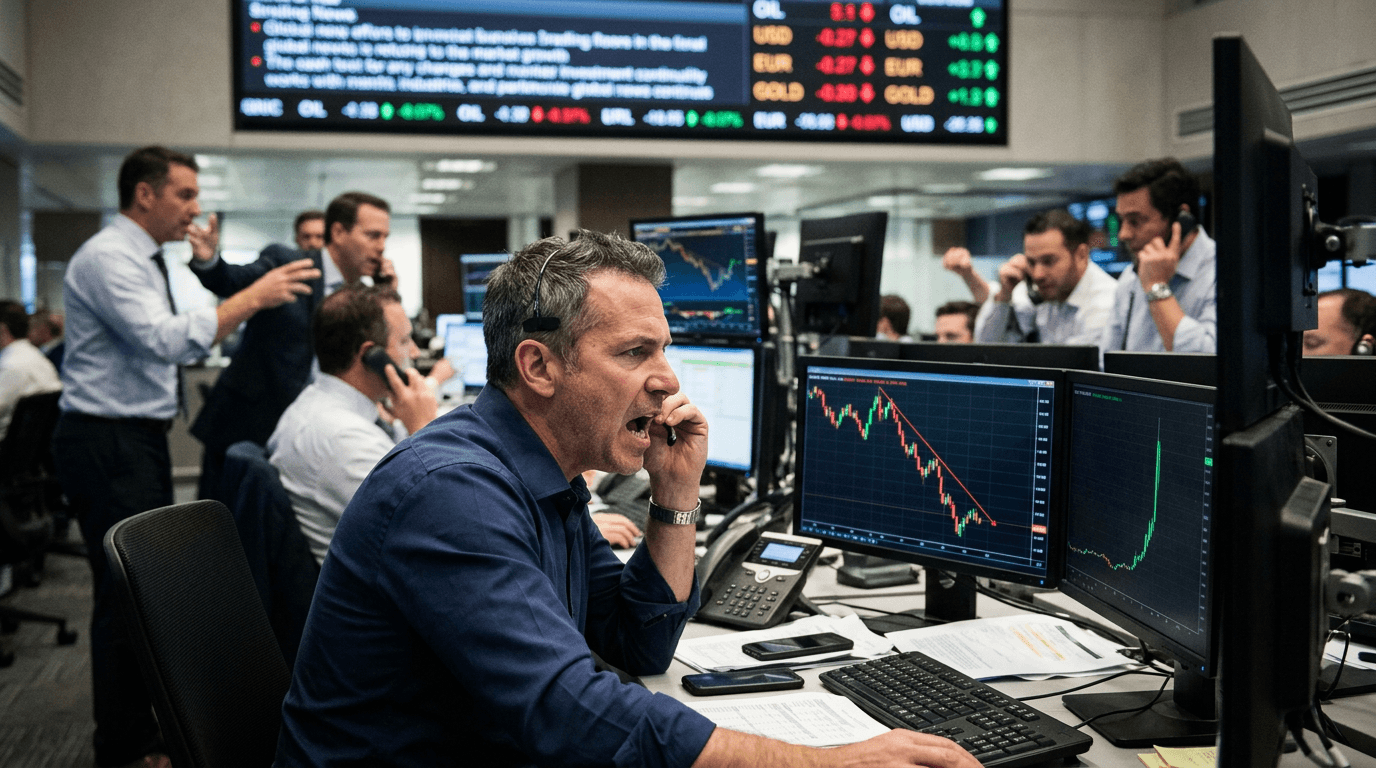
The assassination of Iran's Supreme Leader Ayatollah Ali Khamenei on February 28, 2026, through a U.S.-Israel strike known as Operation Epic Fury has sent shockwaves through global financial markets, triggering the classic risk-off response that benefits safe-haven assets like the U.S. Dollar.[1] As geopolitical tensions escalate in the Middle East and Iran's newly appointed Supreme Leader Ayatollah Mojtaba Khamenei faces both internal challenges and external threats, currency and commodity markets are experiencing significant volatility.[1] For traders and investors monitoring forex and energy markets, understanding how this geopolitical shock translates into asset price movements is critical for navigating the uncertain weeks ahead.
The Assassination And Its Immediate Market Impact
The death of Ayatollah Ali Khamenei, along with 40 top Iranian officials in the targeted strike on a Tehran compound, represents one of the most significant geopolitical events in recent memory.[1] The power vacuum was quickly filled on March 8, 2026, when Iran's Assembly of Experts elected Mojtaba Khamenei, the late Supreme Leader's son, as his successor.[1] However, the transition has occurred amid active military conflict, with reports suggesting that Mojtaba Khamenei himself may have been wounded in the ongoing war.[1] This backdrop of political instability combined with military escalation creates precisely the conditions that drive investors toward safe-haven assets, with the U.S. Dollar emerging as the primary beneficiary of risk-off sentiment.
When geopolitical uncertainty spikes, traders and institutional investors typically reduce exposure to emerging market currencies and riskier assets, rotating into currencies perceived as stable and backed by strong institutional frameworks. The USD's role as the world's reserve currency and its deep, liquid markets make it the default destination for capital fleeing uncertainty in regions like the Middle East.
Safe-haven Demand Reshapes Currency Flows
The surge in safe-haven demand for the U.S. Dollar reflects a fundamental flight-to-quality trade that occurs whenever geopolitical risk escalates. Analysts have noted that for every 10% rise in oil prices driven by Middle East tensions, the USD typically appreciates by 0.5 to 1% against major currency pairs. This relationship exists because oil price increases driven by geopolitical risk create a dual effect: they boost inflation expectations globally while simultaneously prompting risk-averse behavior that favors the dollar.
The mechanism works on multiple levels. First, higher oil prices increase import costs for oil-dependent economies, weakening their currencies as investors anticipate slower economic growth and central bank policy challenges. Second, the dollar strengthens as international investors seek to hedge geopolitical exposure in the only currency that offers true safe-haven characteristics at scale. Third, the petrodollar system means that higher oil prices transacted in dollars create additional demand for the currency itself.
In the context of the Iran situation, the EURUSD pair has come under particular pressure. The euro, representing a more fragmented monetary union with its own structural vulnerabilities, naturally underperforms against the dollar during periods of elevated geopolitical risk. European growth is also more sensitive to energy price shocks given the continent's historical reliance on Middle Eastern and Russian energy supplies.
Crude Oil Prices As The Transmission Mechanism
The spike in crude oil prices represents the crucial transmission mechanism through which the Iran crisis impacts currency markets. Supply disruption fears, whether real or anticipated, push oil higher, which then creates the inflation and risk-aversion dynamics that support the dollar. Energy markets price in the possibility of further regional escalation, supply line disruptions, and military action that could disrupt global crude exports.
For forex traders, watching crude oil price movements provides a leading indicator of potential dollar strength. A sustained move higher in oil prices typically precedes or accompanies USD strength against the euro and other risk currencies. This relationship is not mechanical but reflects the underlying economic reality that geopolitical shocks affecting energy supply are inherently dollar-positive.
Positioning For Market Volatility
Traders and portfolio managers should recognize that the current environment presents both challenges and opportunities. The elevated geopolitical risk means higher volatility across multiple asset classes, particularly currencies and commodities. Risk management becomes paramount, with position sizing and hedging strategies taking on increased importance.
For those positioned in the currency market, several scenarios merit consideration. A continued escalation in the Middle East conflict would likely support further dollar strength and higher oil prices. Conversely, any signs of de-escalation or diplomatic resolution could trigger sharp reversals as investors reassess risk premia. The transition of power in Iran to Mojtaba Khamenei, described by analysts as potentially more hardline than his predecessor, suggests that tensions may remain elevated rather than dissipate quickly.
Traders with exposure to emerging market currencies, the euro, or commodity-dependent economies should evaluate their risk tolerance carefully. The current environment rewards caution and favors long USD positions, particularly against currencies of countries vulnerable to energy price shocks or geopolitical contagion.
Forward Outlook And Key Monitoring Points
The situation in Iran remains fluid and deeply uncertain. Mojtaba Khamenei's leadership amid ongoing conflict creates an unpredictable dynamic that could shift market sentiment rapidly in either direction. Monitoring reports of Iranian military actions, Israeli or American responses, and statements from Iran's new leadership will be essential for understanding how risk sentiment evolves.
The broader lesson for market participants is that geopolitical shocks remain powerful drivers of capital flows and currency movements. The U.S. Dollar's strength during this crisis underscores its enduring role as the ultimate safe-haven asset, while the pressure on other currencies highlights how quickly investor sentiment can shift when uncertainty strikes. For those trading forex or managing international portfolios, staying alert to geopolitical developments and their market transmission channels remains more important than ever.