
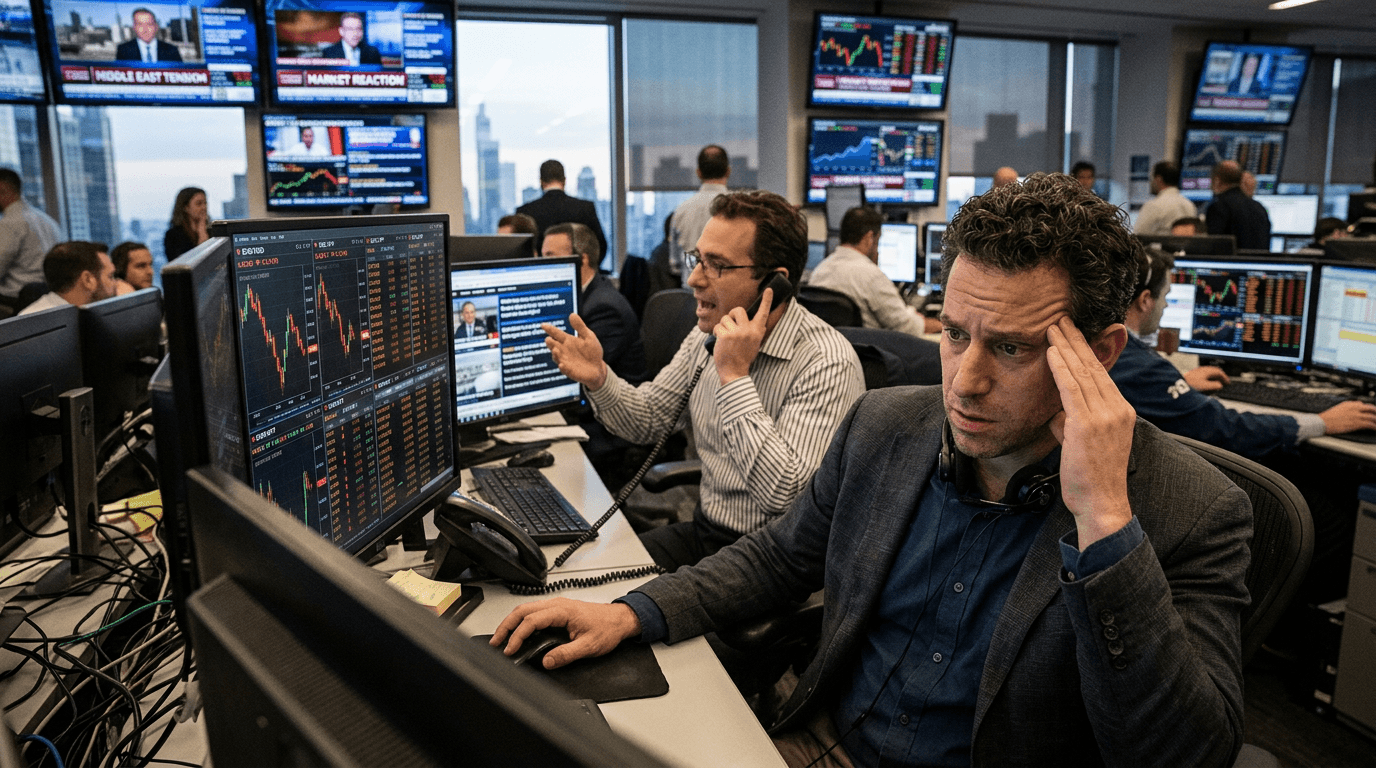
Geopolitical tensions between the United States and Iran are once again reminding markets that politics can move prices just as quickly as earnings or economic data.[2][7] Wall Street’s latest session closed lower, with risk assets under pressure as investors reassessed exposure to equities, cyclical sectors, and leveraged positions in light of a more uncertain global backdrop.[6][9]
Markets React To Escalating Us-iran Tensions
When geopolitical headlines turn hostile, the first response is often a broad “risk-off” move: investors rotate out of equities and into perceived safe havens such as government bonds, gold, and defensive sectors.[7][11][13] That pattern has appeared across recent sessions, where renewed US‑Iran tensions pushed major US indices off recent highs and sparked profit‑taking in more volatile names.[6][10][12]
The Middle East remains a critical hub for global energy supply and shipping routes, which means any hint of disruption in the Strait of Hormuz or regional production can quickly translate into an oil risk premium.[2][3][13] Higher oil prices feed directly into inflation expectations and corporate cost structures, which is why broader equity benchmarks often trade lower when energy markets price in conflict risk.[6][9][11]
Risk-off Ripple Effects In Futures And Fx
Moves in cash equities rarely stay contained to a single asset class. A risk‑off tone on Wall Street tends to spill into index futures, volatility futures, and risk‑sensitive FX pairs as investors look for ways to hedge overnight and event risk.[1][6][15] In practice, that can mean heavier selling in S&P 500 and Nasdaq futures, coupled with higher demand for volatility products and options hedges.[6][9]
Foreign exchange markets react through changes in risk sentiment and carry trades. High‑beta currencies tied to commodities or emerging markets often weaken as investors unwind leveraged positions and reduce exposure to geopolitical hotspots.[2][3][13] At the same time, traditional safe‑haven currencies and reserve assets can see inflows, although the current backdrop is complicated by a softer dollar trend.[1][3]
For simulated traders working with futures and FX on platforms like E8 Markets, these dynamics create a rich environment for testing hedging strategies. A trader might model how an equity sell‑off affects equity index futures, then design offsetting positions in FX or volatility instruments to explore different risk‑management approaches without real‑world capital at stake.[1][6]
Crypto And Dollar: Countercurrents In A Risk-off Day
One of the more interesting features of the current environment is the strength of the crypto bid even as traditional risk assets wobble.[1][11] In previous cycles, risk‑off episodes pushed investors away from speculative assets, but recent flows suggest some participants view major cryptocurrencies as diversifiers or even alternative refuges when geopolitical risk is concentrated in fiat systems and energy markets.[1][8]
At the same time, the dollar backdrop is weaker than in many past crises, which changes the usual playbook for FX and cross‑asset correlations.[1][3] A softer dollar can cushion some of the downside in US assets and support commodity and crypto prices, even while risk‑off sentiment pressures cyclical equities and high‑beta currencies.[2][11][13] For traders, this mix of forces highlights the importance of tracking correlations in real time rather than relying solely on historical patterns.
In a simulated environment, this is an opportunity to stress‑test multi‑asset portfolios under scenarios where crypto rallies alongside falling equities, or where the dollar does not behave as a classic safe haven.[1][8] Building and reviewing such scenarios helps traders understand how non‑linear relationships can emerge when geopolitical and macro narratives collide.
How Simulated Traders Can Navigate Geopolitical Volatility
Geopolitical risk is, by definition, hard to forecast. Traders cannot predict headlines, but they can prepare frameworks for how to respond when they arrive. A practical starting point in SimFi is to map out transmission channels: oil to inflation, inflation to central bank expectations, and expectations to equity, bond, and FX pricing.[2][11][13] This top‑down view supports more coherent trade ideas.
Next, traders can design playbooks for different volatility regimes. For example, a mild flare‑up might justify tighter stops and reduced position sizes, while a full‑scale escalation could call for higher cash allocations and a focus on relative‑value or market‑neutral strategies.[4][7][11] In simulation, these regimes can be back‑tested across historical conflict periods to gauge how strategies might perform without risking capital.
Risk management should be at the core of any geopolitical trading plan. That includes defining maximum loss thresholds, using options or futures for hedging, and avoiding concentrated exposure to single risk factors such as energy or regional banks.[6][9][10] Simulated trading makes it possible to experiment with these protections, learn from mistakes, and refine rules before applying them in live markets.
Key Takeaways For Risk Management
First, treat geopolitical events as catalysts for reassessing correlation structures rather than automatic signals to buy or sell a single asset. Oil, equities, FX, rates, and crypto can all respond differently depending on the details of the shock and the prevailing macro environment.[2][11][13]
Second, separate directional views from risk‑control decisions. Even if a trader believes tensions will ultimately ease, the path can be volatile, and simulated scenarios should incorporate adverse moves, gaps, and liquidity squeezes.[4][6][7] This mindset encourages position sizing and diversification that can withstand unexpected developments.
Third, use SimFi tools to practice translating headlines into structured trade theses. For example: “If US‑Iran tensions persist and oil stays elevated, then inflation expectations rise, rate‑cut hopes fade, and growth sectors underperform.”[2][6][11] From that thesis, traders can build multi‑asset positions and track how closely real‑time markets follow the scenario.
Conclusion
Geopolitical tensions weighing on Wall Street are a timely reminder that markets are shaped not only by earnings and data, but also by uncertainty, sentiment, and risk premiums.[2][6][9] For traders, this environment is challenging—but also instructive. Simulated finance platforms offer a powerful way to dissect cross‑asset reactions, stress‑test portfolios, and build disciplined frameworks for navigating future geopolitical shocks.[1][11][13] The goal is not to predict every headline, but to be structurally prepared for whatever the next one brings.