
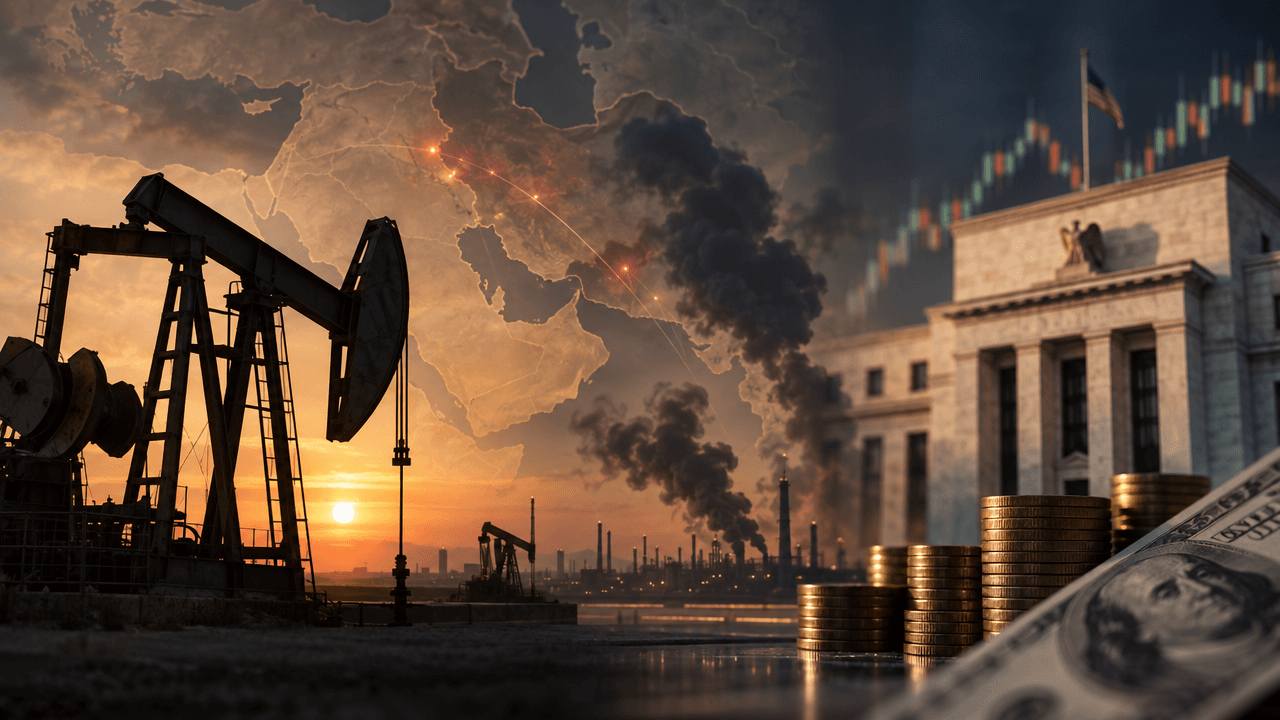
Oil markets are once again at the center of the macro narrative, with elevated crude prices and heightened geopolitical tension around key shipping routes keeping inflation risks alive even as growth data moderates. Concerns about potential disruption in the Strait of Hormuz and tensions involving Iran have helped push Brent toward the psychologically important $100 per barrel area, reinforcing the idea that the energy complex can still derail the disinflation story and complicate expectations for Federal Reserve easing.
Geopolitical Energy Shocks: An Inflationary Supply Shock
Not all geopolitical shocks have the same impact on inflation, but those that directly disrupt energy supply tend to be both inflationary and growth-negative.[2][3][11] Research on past episodes such as the Gulf War and the Russia–Ukraine conflict shows that “geopolitical energy shocks” are characterized by simultaneous spikes in geopolitical risk indices and oil prices.[3][7][13] These shocks behave like adverse supply shocks: they raise production costs across the economy and push consumer prices higher even as output slows.[2][3][10]
Quantitatively, central bank research suggests that geopolitical energy shocks can lift inflation by a few tenths of a percentage point, with the effect amplifying if the shock is persistent or triggers broader risk repricing.[2][11][15] Importantly, these episodes often generate no clear winners: both energy-importing and energy-exporting economies tend to suffer, as precautionary inventory building, trade disruptions and higher financing costs weigh on activity.[10][15] For markets, the key takeaway is that energy-linked geopolitical risk is not just a headline risk; it is a structural driver of both inflation expectations and growth forecasts.[6][14][15]
How Higher Energy Prices Feed Through To Inflation
Elevated crude prices are only the first step in the inflation transmission mechanism; refiners, transport networks and end users all absorb and pass on higher costs over time.[4][5][9] Diesel prices are particularly important because they are embedded in freight, agriculture and construction, making them a broad tax on the real economy when they rise sharply.[4][9][15] Recent commentary from energy agencies highlights how diesel prices in transport and agriculture have nearly doubled versus pre-war levels in some regions, driven by higher crude, refinery damage and reduced exports from key producers.[4][5]
These cost pressures feed directly into the energy component of consumer price indices, lifting headline inflation even if core measures remain more stable in the short term.[5][14][15] At the same time, firms facing higher transport and input costs often raise prices or cut investment, reinforcing both inflation and downside risks to growth.[6][9][10] Shipping disruptions, insurance premia on risky routes, and volatility in maritime trade can intensify these effects, creating a feedback loop between energy markets, supply chains and price dynamics.[6][9][14]
For traders, the lesson is that inflation is not just about wages and domestic demand. Monitoring refined products, freight rates, and shipping bottlenecks can provide early signals about how quickly energy shocks may translate into broader price pressures.[4][6][9]
Central Banks, Bonds And Inflation Expectations
Central banks have become more sensitive to geopolitical energy shocks because they can re-accelerate headline inflation just as policymakers consider easing policy.[1][6][14] Analyses of US financial markets show that geopolitical shocks which lift oil prices tend to tighten financial conditions, amplify inflation concerns and weigh on growth, creating a complex backdrop for monetary decisions.[1][7][10] Higher energy costs act as a negative supply shock, eroding real incomes and potentially requiring tighter policy to prevent inflation expectations from becoming unanchored.[15]
Recent risk briefings note that while higher energy prices have not yet triggered a major resurgence in core inflation, markets are increasingly pricing the possibility that central banks keep rates higher for longer if energy costs stay elevated.[14][15] That can flatten or invert yield curves further, push real yields higher and support inflation-linked instruments such as breakevens and inflation swaps.[1][6][14] Equity valuations, particularly for rate-sensitive sectors like growth tech and real estate, may come under pressure if expectations for rapid Fed easing are pared back.
Practically, macro traders should focus on the interplay between energy curves, inflation expectations and the path implied by rates futures. Watching how front-end yields and breakeven inflation respond to oil price moves can help identify whether markets are treating a shock as transitory or as a regime shift.[1][6][14]
Commodities, Currencies And Risk Assets
Geopolitical energy shocks tend to create clear sector and cross-asset divergences. Commodity producers, energy services and some parts of industrials can benefit from higher realized prices, while energy-importing sectors and regions face margin compression.[6][10][14] Commodity-linked currencies such as those of major oil and resource exporters often outperform in relative terms when energy prices spike, supported by improved terms of trade and current-account dynamics.[6][10] However, the same shocks can also raise global risk aversion, strengthen the US dollar as a safe haven and weigh on emerging-market assets that rely on imported energy.[6][14][15]
In equities, higher energy prices and inflation uncertainty can drive rotation away from long-duration growth assets toward value, defensives and sectors with pricing power.[6][8][12] Credit markets may see wider spreads for cyclical borrowers if investors worry that higher rates and input costs will pressure balance sheets.[6][15] Volatility in energy markets themselves—visible in options skew and term structures—often becomes a key barometer of broader risk sentiment.
For traders, mapping exposure to energy risk across portfolios is essential. That includes direct positions in crude and refined products, but also indirect exposure via industrials, transport, airlines, and emerging-market debt and FX.[6][9][14]
Practical Takeaways For Traders And Simfi Participants
Geopolitical and energy risks are hard to forecast, but their market impact can be modeled and rehearsed. Simulated finance environments like those offered by platforms such as E8 Markets allow traders to stress-test strategies against scenarios of higher oil prices, delayed central bank easing and shifting sector leadership, without capital at risk. This can sharpen decision-making when similar patterns emerge in live markets.
Several practical action points stand out
1. Track key energy indicators: spot and futures curves for crude and diesel, refinery utilization, and shipping route disruption reports.[4][6][9] 2. Link energy moves to macro pricing: monitor breakeven inflation, rates futures, and FX responses to gauge how markets interpret each shock.[1][6][14] 3. Use scenario analysis: build playbooks for moderate, severe and de-escalation outcomes, including assumptions for growth, inflation and central bank reaction functions.[8][12][15] 4. Diversify risk: avoid concentrated exposure to sectors that are simultaneously energy-intensive and rate-sensitive, and consider hedging with commodities or inflation-linked instruments.[6][10][14]
SimFi environments are well suited to practicing these steps repeatedly, helping traders develop disciplined responses rather than reactive ones when headlines hit.
Conclusion: The Inflation Narrative Is Still At Risk
Even after significant progress on disinflation, geopolitical and energy risks remain a live threat to the inflation outlook and to the path of monetary policy. Episodes that disrupt key routes like the Strait of Hormuz can propagate quickly from crude prices to diesel, freight and consumer costs, acting as a tax on global growth while rekindling inflation anxieties.[4][5][15] For markets, that means renewed focus on energy headlines, inflation expectations and central bank signaling will be critical in the months ahead.[6][14][15]
For traders and investors—whether operating with real capital or in simulated environments—the priority is to integrate geopolitical energy risk into macro analysis, risk management and scenario planning. Doing so can turn a source of uncertainty into a structured set of trading opportunities, while avoiding being caught off guard by the next energy-driven twist in the inflation story.[6][8][10]