
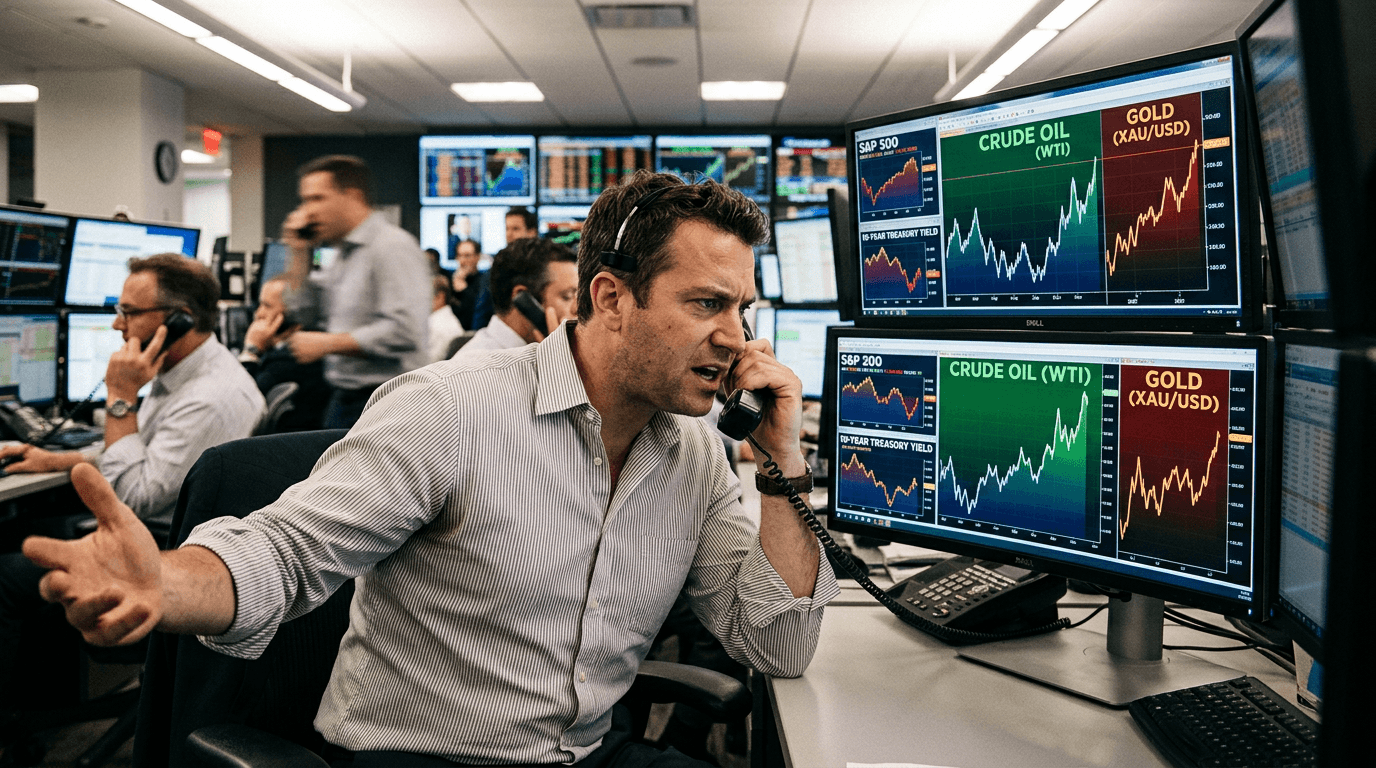
The latest round of U.S. strikes on Iranian targets has jolted global markets, sending oil sharply higher and reigniting demand for safe‑haven assets like gold and the U.S. dollar. The move has revived fears of disruption in one of the world’s most critical energy chokepoints and forced traders to rapidly re‑price inflation, interest rate, and risk scenarios across asset classes.[1][7][8]
Market Reaction: Oil And Safe-haven Surge
Oil was the immediate focal point. Crude prices spiked in early trading, with benchmark contracts jumping by mid‑ to high‑single‑digit percentages as traders rushed to price in the risk of supply disruption.[6][8] Recent episodes of U.S.–Iran escalation have already shown how sensitive oil is to Hormuz headlines, with Brent and WTI contracts rising 2–3% on prior strike news and briefly reclaiming the $100 per barrel area.[1][2][6][7] This latest strike reinforced the market’s perception that the geopolitical risk premium in energy is back in play.
The key concern is the Strait of Hormuz, through which roughly a fifth of global oil flows. Strikes on Iranian military assets near strategic locations have periodically triggered worries about shipping safety, insurance costs, and potential blockages.[1][7][8] Even without an actual disruption, the mere probability of interference can push futures curves higher as refiners, airlines, and industrial users scramble to secure supply at known prices rather than risk further spikes.
Gold and other safe‑haven assets also caught a strong bid. Renewed geopolitical tension tends to send investors toward assets perceived as stores of value when tail risks rise, and gold has historically been one of the primary beneficiaries. At the same time, the U.S. dollar strengthened on safe‑haven flows, as global investors sought liquidity and perceived stability in the world’s reserve currency during a risk‑off episode.
Inflation Fears And The Rate-cut Debate
A rapid move higher in crude doesn’t just affect energy markets; it feeds straight into macro thinking. Higher oil prices lift headline inflation, and if they persist, they can spill over into transportation, manufacturing, and eventually consumer prices. Analysts have already warned that the prolonged rise in crude is adding “second‑round effects” to broader inflation pressures, nudging some central banks into a more hawkish stance.[1]
For rate markets, the narrative is straightforward but powerful: more expensive energy may mean stickier inflation, which in turn could delay or slow planned rate cuts. Even if central banks look through short‑term price spikes, they cannot ignore sustained energy‑driven pressure on inflation expectations. As a result, traders have been re‑pricing the timing and depth of future easing cycles, with market‑implied paths shifting toward “higher for longer” whenever energy volatility flares.
This dynamic supports the U.S. dollar in two ways. First, higher relative yields make dollar assets more attractive to global investors. Second, geopolitical stress amplifies the dollar’s safe‑haven role, as institutions prefer deep, liquid markets when uncertainty rises. Together, these forces can weigh on risk‑sensitive currencies linked to commodities, tourism, or carry trades, especially in emerging markets.
Risk Sentiment: Equities, Fx, And Volatility
Equity markets reacted in classic risk‑off fashion. Asian indices led the move lower as investors marked down growth prospects, factoring in higher input costs, potential demand drag from tighter financial conditions, and a general increase in uncertainty around global trade and security. Energy‑intensive sectors such as airlines, transportation, and certain industrials tend to suffer disproportionately when oil spikes, while integrated energy producers and some commodity exporters may benefit.
In FX, the move toward safe havens can extend beyond the dollar. Historically, the Japanese yen and Swiss franc have acted as shock absorbers in periods of geopolitical tension, while high‑beta currencies and those with large external financing needs tend to weaken. The interplay between commodity currencies and crude is more nuanced: exporters may gain from higher prices, but if risk aversion is strong enough, broad dollar strength and falling equity markets can still pressure them.
Volatility typically rises across assets in such episodes. Implied volatility in oil options tends to spike as traders hedge the chance of further escalation, while equity and FX vol pick up as risk scenarios widen. For active traders, this environment offers opportunity but demands disciplined risk management: intraday moves can be large, and correlations can change quickly as the narrative evolves.
What This Means For Traders
For traders and investors—whether in live markets or simulated environments—the key is to think in scenarios rather than single outcomes. One path features rapid de‑escalation, with oil retracing and risk assets stabilizing. Another includes sustained tension or further strikes, keeping a geopolitical premium embedded in energy and safe‑havens for longer. Pricing these scenarios helps frame position sizing and portfolio construction.
Cross‑asset relationships matter. A trader might explore expressions such as long crude versus short airline indices, long gold versus broad equities, or long USD against more fragile emerging‑market currencies. Each of these trades reflects a different facet of the same shock: energy supply risk, inflation expectations, and risk sentiment. Understanding how these themes connect can help avoid over‑concentration in a single narrative.
Risk management should adapt to higher volatility. Wider ranges, sharper gaps around headlines, and faster trend reversals call for recalibrated stop‑losses, position sizes, and leverage. It also becomes more important to distinguish between tactical trades—designed to capture near‑term dislocations—and strategic views about how energy prices and monetary policy will interact over months, not days.
Practical Simfi Takeaways
Simulated finance platforms like E8 Markets provide a useful environment to test and refine strategies in precisely this kind of high‑uncertainty backdrop. Traders can run stress tests on virtual portfolios, ask how a 10–15% move in crude and a corresponding shift in rate expectations might impact P&L, and experiment with hedging structures before deploying similar ideas in live markets.
This event is also a chance to practice building multi‑asset trade plans. For example, a scenario where tension persists might involve simulated long positions in oil and gold, paired with cautious or hedged exposure to equity indices and select FX crosses. Conversely, a de‑escalation scenario could emphasize mean‑reversion in energy prices and a gradual re‑build of risk exposure in equities and higher‑yielding currencies.
Most importantly, geopolitical shocks like U.S. strikes on Iran highlight why traders cannot focus on any single market in isolation. Energy, inflation, rates, FX, and equities are all linked, and news in one domain can cascade through the entire system. Using simulation to rehearse these linkages—and to learn from both successful and failed strategies—can build the confidence and discipline needed to navigate real‑world volatility when it arrives.