
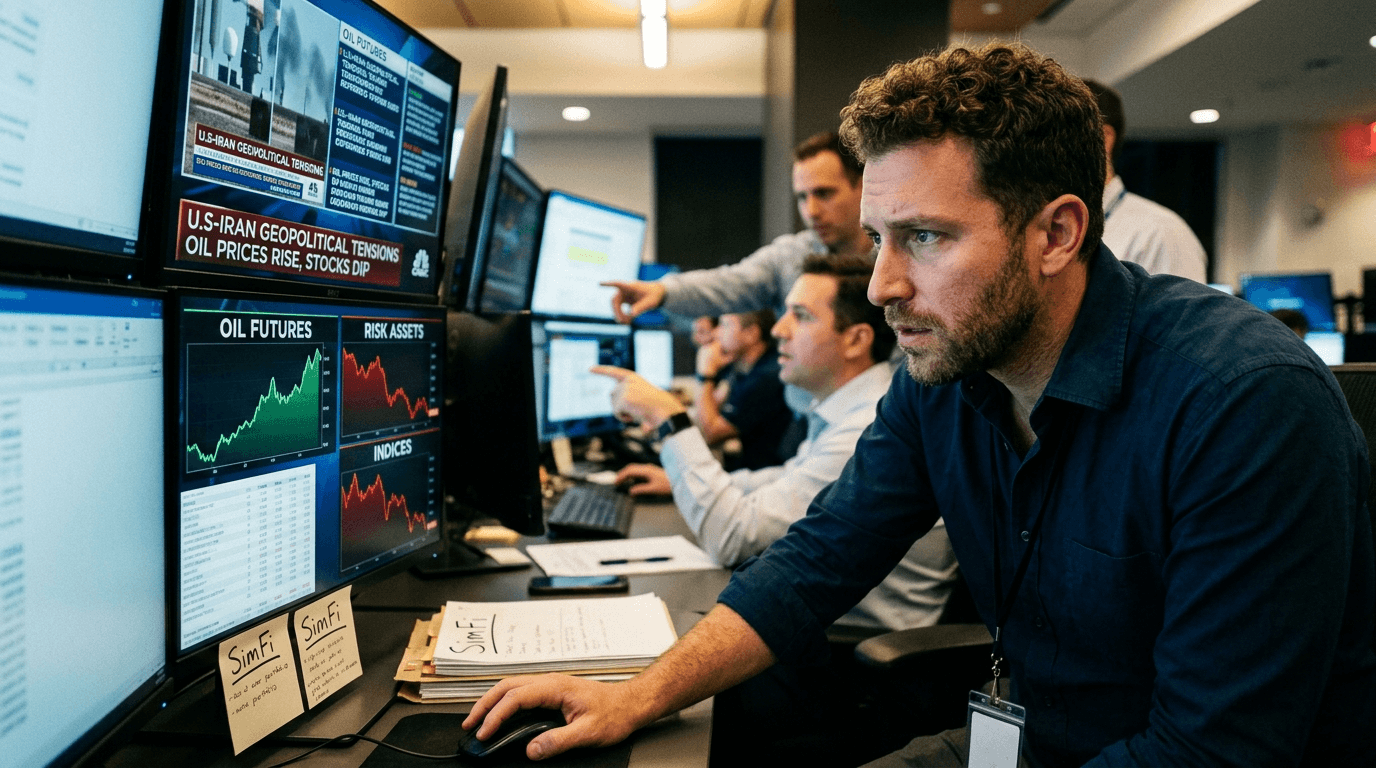
Renewed clashes between the United States and Iran have quickly reminded markets how fragile the current risk environment is, with oil prices ticking higher, risk assets wobbling, and safe‑haven demand returning to the fore.[4][10][15] For traders, this is a textbook moment where geopolitics, inflation expectations, and cross‑asset positioning collide in real time.[4][10][15]
Geopolitical Flashpoint Back In Focus
Over the past several hours, U.S. forces have reportedly struck Iranian launchers and related targets in the Persian Gulf, in response to earlier Iranian missile attacks on U.S. bases in Jordan and at sea.[8][11][13] These operations, targeting command centers and missile and drone facilities, raise the perceived risk to both U.S. assets and commercial shipping through the Strait of Hormuz, one of the world’s key energy choke points.[8][13][15]
Markets have reacted in line with the familiar “geopolitical shock” playbook. Benchmark crude futures are up roughly 1% as traders price in a higher risk premium for Middle Eastern supply and transit routes.[4][10][15] Asian equities have opened under pressure, reflecting both the direct impact of higher energy costs on regional corporates and a general shift toward risk‑off positioning.[4][5][7] At the same time, traditional safe‑haven assets such as the yen and gold are catching demand, underscoring the defensive tone across global portfolios.[4][5][7]
For traders on SimFi platforms, this geopolitical backdrop is not just a headline risk; it is a live macro driver that can reshape intraday volatility, correlation structures, and liquidity conditions across asset classes.
OIL’S RISK PREMIUM AND INFLATION EXPECTATIONS
The move in oil may look modest at around 1%, but its significance lies in what the market is repricing: the probability of supply disruption and sustained tension in a region that anchors global energy flows.[4][10][15] Each incremental flare‑up in the Gulf tends to add a layer of risk premium, with traders reassessing the odds of shipping bottlenecks, sanctions, or damage to production capacity.[10][13][15]
Higher crude prices feed directly into inflation expectations, particularly in economies heavily reliant on imported energy. In previous episodes of heightened U.S.–Iran tension, oil rallies have contributed to speculation that central banks might need to stay hawkish for longer, or at least delay rate cuts, to avoid an inflation resurgence.[5][6][15] That macro narrative can be just as important as the price move itself, because it influences bond yields, equity valuations, and currency dynamics.
For simulated traders, this is a prime opportunity to model different paths for oil: a short‑lived spike that fades as diplomacy resumes, or a more sustained climb if clashes persist. Each scenario has distinct implications for equity sectors (energy, airlines, industrials), inflation‑linked bonds, and commodity‑sensitive currencies.
Pressure On Risk Assets
Risk assets, particularly equities, tend to struggle when markets suddenly need to reprice geopolitical risk and inflation simultaneously. Asian stock indices are already tracking lower as investors rotate out of cyclicals and higher‑beta names into more defensive exposures.[4][5][7] Elevated energy costs squeeze margins for transportation, manufacturing, and consumer sectors, while higher volatility raises the cost of leverage and reduces appetite for carry trades.[5][6][15]
Credit markets can also feel the strain as risk premiums widen, especially for issuers exposed to energy prices or dependent on global trade routes that run through the Middle East.[5][6][15] Emerging‑market currencies often face two‑sided pressure: on one side from higher oil import bills, on the other from potential capital outflows as global investors seek safety.
In a SimFi environment, this risk‑off tilt can be translated into multi‑asset scenarios where equity indices sell off, credit spreads widen, and volatility indices such as VIX‑style gauges spike. Practicing how portfolios respond to such shocks—across equities, FX, and commodities—helps traders refine position sizing, hedging strategies, and drawdown management.
SAFE‑HAVEN FLOWS: YEN, GOLD AND BEYOND
The renewed U.S.–Iran clashes are again highlighting the market’s reflex to seek shelter in safe‑haven assets during periods of heightened uncertainty.[4][5][7] The Japanese yen, long regarded as a defensive currency, has firmed toward key intervention watch levels as investors pare back carry trades and unwind leveraged positions funded in yen.[5][7][10] Gold, meanwhile, is seeing renewed buying as a hedge against both geopolitical risk and the possibility of renewed inflation pressure if oil remains elevated.[4][5][7]
Government bonds in major economies can also benefit from flight‑to‑quality flows, although the inflation angle complicates the picture: if oil‑driven inflation risks rise, yields may not fall as sharply as in a pure growth scare.[6][10][15] This creates a nuanced environment where safe‑haven assets do well in relative terms, but the exact mix of FX, precious metals, and rates performance depends on how the inflation narrative evolves.
For simulated traders, these dynamics are ideal for exploring cross‑asset hedging. For example, scenarios where long gold and long yen positions partially offset drawdowns in global equities, or where duration exposure in bonds cushions portfolio volatility even if yields do not plunge.
What Simulated Traders Should Focus On Now
For E8 Markets participants and other SimFi traders, the current episode provides several actionable lessons.
First, link headlines to tradeable risk factors. Renewed U.S.–Iran clashes are not just a political development; they directly feed into oil risk premiums, inflation expectations, and safe‑haven flows.[4][10][15] Building scenarios that connect these dots is crucial.
Second, practice cross‑asset thinking. A 1% move in oil is meaningful when it shifts expectations for central bank policy, impacts equity sector performance, and reshapes FX flows into the yen and commodity currencies.[4][5][7] Simulated portfolios should test how positions in energy, equities, FX, and gold interact under different paths for the conflict.
Third, stress‑test for persistence versus quick resolution. One scenario assumes that tensions ease, leading to a retracement in oil and a recovery in risk assets.[12][14] Another assumes repeated tit‑for‑tat strikes that keep volatility and energy prices elevated, weighing on equities and supporting safe‑havens.[10][13][15] Comparing portfolio outcomes under both can help traders design more robust strategies.
Finally, treat this as a live training ground in risk management. Adjusting position sizes, setting dynamic stop‑loss levels, and using simulated hedges in gold, yen, or volatility instruments can sharpen discipline without real‑world capital at stake.
Conclusion
Renewed U.S–Iran clashes have once again underscored how quickly geopolitics can ripple through oil, equities, currencies, and safe‑haven assets.[4][10][15] While the immediate moves in crude and risk assets may appear moderate, the underlying repricing of energy risk and inflation expectations can have outsized effects on portfolio performance over time.[5][6][15] For traders in the SimFi space, this environment offers a valuable opportunity to connect macro headlines to market behavior, test cross‑asset strategies, and refine risk management—so that when the next real‑world shock arrives, their playbook is ready.