
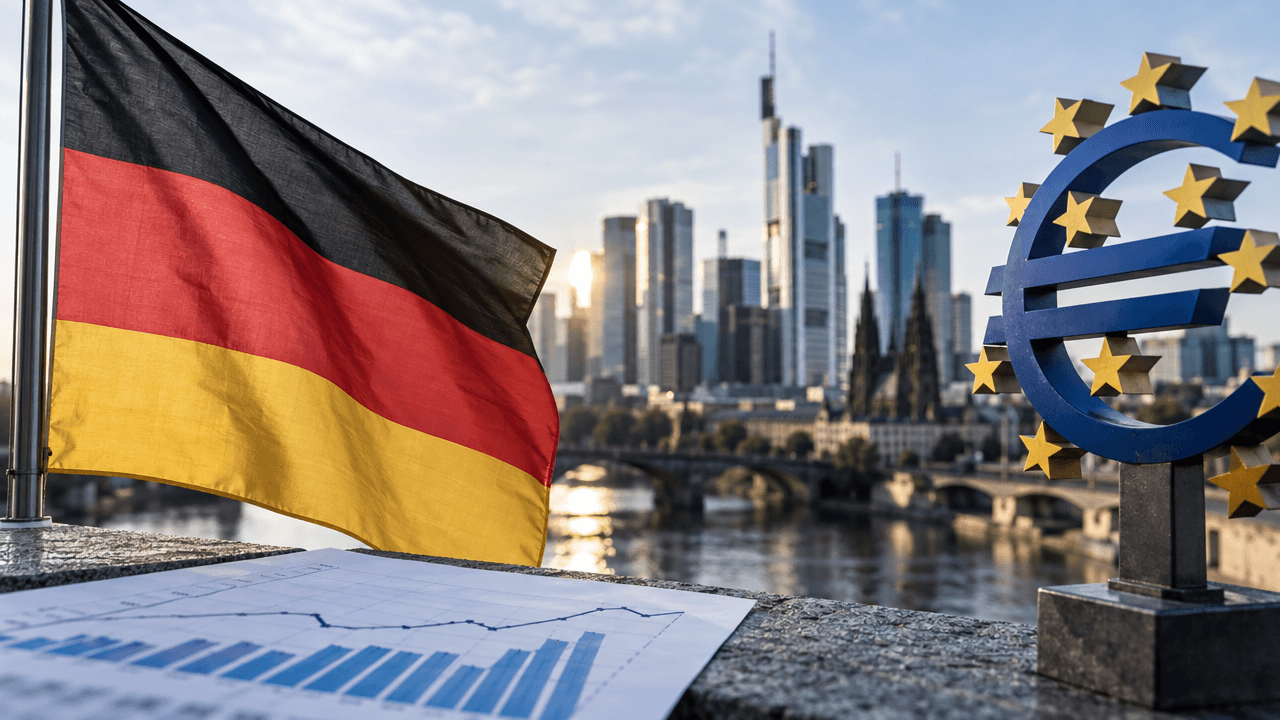
Germany’s business mood is once again at the center of the euro-area growth story, and the Ifo survey has moved from a local indicator to a regional market signal. As Europe’s largest economy emerges from a period of weak activity and energy shocks, traders increasingly treat each Ifo release as a live read on whether the euro-area recovery is gaining traction or stalling.[3][6][7][8]
GERMANY’S IFO SURVEY: WHY IT MATTERS
The Ifo Business Climate Index aggregates how thousands of German firms assess their current situation and their expectations for the next six months.[1][5] Because these companies span manufacturing, services, trade, and construction, the survey captures real-time sentiment across the core of Europe’s industrial and consumer economy.[1][5]
Germany accounts for a substantial share of euro-area output, so shifts in German business confidence often precede turns in broader regional growth data.[7][8] When the Ifo survey improves, it usually signals stronger order books, investment plans, and hiring intentions that can ripple through supply chains into neighboring economies.[1][7][8] For this reason, currency, rates, and equity traders monitor the Ifo release as closely as official GDP and PMI reports.
Reading The Latest Numbers
The most recent data show a clear improvement in sentiment. In September 2026, the Ifo Business Climate Index rose to 89.9, up from 88.8 in August and beating market expectations of 89.0.[3][4][6][9][10] This was the highest reading since May 2023, marking a notable step away from the low-80s range seen during the worst of Germany’s slowdown.[3][4][6]
The forward-looking component is particularly important. Ifo’s expectations index climbed to 90.4 in September, from around 89 in August, again surpassing consensus forecasts.[4][6][10][11] That rise signals that German companies not only feel better about current conditions, but also anticipate stronger activity ahead, despite elevated energy prices and geopolitical uncertainty.[3][4][6][11]
Current conditions also improved, with the Ifo current situation index rising to about 89.5 from 88.5, indicating that firms are already experiencing a modest pickup in demand rather than merely hoping for one.[4][6][10][13] These moves continue an upward trend that began in mid-2026, when the index started posting consecutive monthly gains and business morale reached levels not seen in over a year.[7][12][14]
From Berlin To The Euro Area
This upswing in German sentiment dovetails with a broader narrative of gradual recovery in the euro area. Germany’s economy recently grew by around 0.3% quarter-on-quarter, slightly above earlier estimates, suggesting that the worst phase of stagnation may be behind it.[7][12] Meanwhile, the Ifo Institute’s autumn forecast projects German real GDP growth of roughly 1.4% in 2026 and 1.2% in 2027, supported by improving sentiment and a normalization in supply-side pressures.[8]
When a leading survey and hard GDP data both surprise to the upside, markets interpret this as confirmation that domestic demand and investment are stabilizing.[7][8][12] Because Germany is so integrated into euro-area production networks, stronger German orders can translate into higher factory utilization and export volumes in countries such as the Netherlands, Austria, and parts of Central and Eastern Europe.[7][8]
As a result, the Ifo release now acts as a high-frequency barometer for euro-area growth expectations. A stronger print tends to lift forecasts for the bloc’s output and inflation, while a weaker reading can trigger downgrades and raise concerns about renewed stagnation.[7][8][10] Traders incorporate these shifts directly into pricing for euro-area assets.
Implications For Ecb Policy, Euro Fx, And Equities
For the European Central Bank, the combination of better activity data and firmer sentiment complicates the policy outlook. A sustained Ifo rebound supports the case that underlying growth is resilient enough to withstand tighter financial conditions, which could reduce the urgency of additional monetary easing.[7][8][10] At the same time, if improved sentiment feeds through to stronger wages and domestic inflation, the ECB may lean more cautiously on rate cuts than markets previously anticipated.[7][8]
In foreign exchange markets, upside surprises in the Ifo survey often translate into a stronger euro, as investors price in higher growth and a less dovish ECB path.[10][11] When expectations and current conditions both beat consensus, the move can be immediate: algorithmic strategies keyed to economic releases will buy euros against the dollar and other majors within seconds of the data hitting the tape.[10]
European equity futures also react quickly. Better business climate readings support cyclical sectors such as industrials, autos, and capital goods, which are sensitive to investment and export demand.[6][9][10] At the same time, Germany-focused indices benefit from the perception that earnings forecasts may be too conservative if the recovery continues to broaden.[7][9] For equity traders, the Ifo survey is therefore both a sentiment gauge and a potential catalyst for repositioning.
Practical Takeaways For Simulated And Live Traders
For E8 Markets participants operating in a simulated finance environment, the Ifo survey offers an excellent case study in how a single data point can influence multiple asset classes. The release includes three key components—business climate, current conditions, and expectations—that each carry different information about the cycle.[1][10] Learning to interpret their interplay helps traders build more nuanced macro scenarios.
Ahead of the release, simulated traders can practice forming expectations based on prior months’ trends, energy prices, and broader euro-area indicators. After the data print, they can observe how euro crosses, Bund yields, and European equity futures react relative to consensus forecasts.[6][9][10] This provides a structured way to develop skills in event-driven trading without capital at risk.
Another practical application is scenario-building. For example, a strong upside surprise in the expectations index combined with a modest rise in current conditions might justify a bullish tilt on European cyclicals, while still leaving room for volatility if hard data fail to confirm the survey.[4][6][10][11] Conversely, a disappointment in the Ifo survey could be used to test defensive strategies focused on high-quality, less cyclical names and a weaker euro profile.
Key Takeaways For Your Trading Playbook
First, treat the German Ifo survey as a leading indicator for euro-area growth, not just a local sentiment measure. Its breadth across sectors and its strong historical correlation with GDP make it a meaningful input into macro views.[1][7][8]
Second, focus on surprises relative to consensus—not just the direction of the index. Markets move most when reality diverges from expectations, and recent Ifo releases have shown that even modest positive surprises can trigger notable reactions in FX and equity futures.[6][9][10][11]
Third, integrate the three components of the survey. A synchronized rise in business climate, current conditions, and expectations, as seen in recent months, sends a stronger signal of a broadening recovery than a move in any single index alone.[4][6][10][13]
Finally, use simulated environments to rehearse your response playbook around economic releases. Whether you trade for real or in SimFi, the discipline of preparing scenarios, tracking outcomes, and refining strategies is the same—and the Ifo survey is a timely, high-impact event around which to practice.