
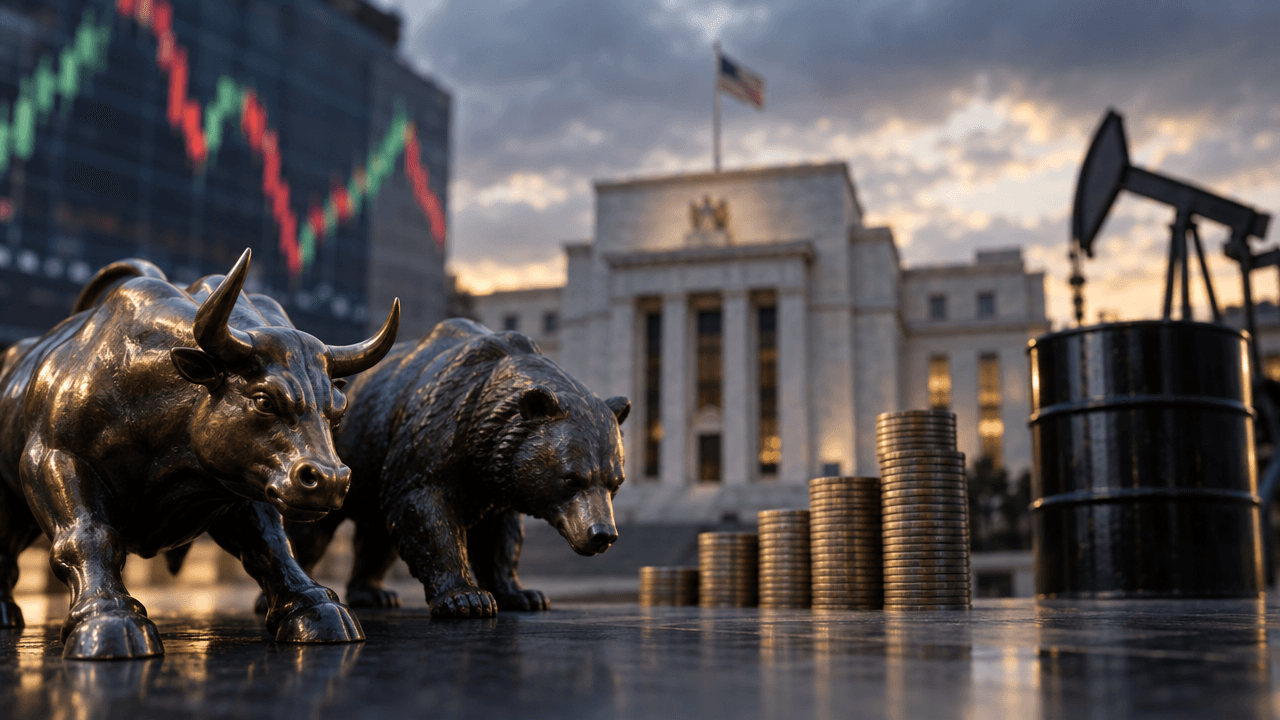
Global equity markets are treading water, with major indices mixed to slightly higher as investors weigh surging bond yields and a sharp rebound in oil prices against a pivotal U.S. Federal Reserve decision later today.[10][13][14] This combination of higher discount rates and rising input costs is challenging risk appetite, leaving equities sensitive to any shift in the Fed’s tone on inflation and future rate moves.[9][11][12]
Markets At A Crossroads
Recent months have already seen a pattern of “mixed” equity performance, with modest gains in broad global benchmarks masking wide dispersion beneath the surface.[13][14] European and some Asia‑Pacific markets have at times outperformed, while U.S. indices have experienced more volatility, especially in technology and growth names that are most exposed to changes in interest rates.[4][13][14] That backdrop helps explain why today’s price action feels hesitant: investors have enjoyed strong returns in parts of the market but remain wary of how far higher yields and commodity prices can stretch valuations.
For traders, a mixed equity tape ahead of a major central bank event usually signals one thing: positioning is cautious, not panicked. Futures stabilizing while cash indices diverge slightly often reflect hedging activity, sector rotation and short‑term profit‑taking rather than a wholesale rush to the exits.[1][4] In simulated environments, this is a useful scenario to study because it highlights how markets behave when the narrative is uncertain but not yet stressed.
Why Bond Yields Matter For Equities
Government bond yields across the U.S., Europe, Japan and the U.K. have climbed to multi‑year or even multi‑decade highs, reshaping the investment landscape.[3][5][7] In the U.S., the 10‑year Treasury yield recently approached the 5% level, a threshold last seen consistently before the global financial crisis, raising the “risk‑free” rate that underpins equity valuation models.[11] Longer‑dated yields, including 30‑year bonds, have also reached levels not seen for roughly two decades, intensifying pressure on borrowers and on richly valued assets.[9][15]
Higher yields matter for stocks because they work through several channels at once. First, they raise the discount rate applied to future cash flows, particularly hurting long‑duration assets like high‑growth technology names.[7][9][11] Second, they tighten financial conditions by lifting borrowing costs for companies and households, which can weigh on earnings expectations and consumer spending.[5][7] Third, they provide a more attractive alternative to equities for conservative investors, especially when real (inflation‑adjusted) yields move higher.[3][11]
From a trading and SimFi perspective, the current environment is ideal for testing interest‑rate sensitivity across sectors. Scenarios with 10‑year yields oscillating around 4.5–5% and 30‑year yields near cycle highs allow traders to explore how valuation multiples compress, how dividend‑oriented sectors compete with bonds, and how leverage affects equity risk.[3][9][11] Simulating such yield curves helps build intuition for how quickly sentiment can swing when the bond market reprices the path of policy.
OIL’S RALLY AND THE INFLATION NARRATIVE
Oil prices have staged a strong recovery, with benchmark Brent and WTI crude contracts posting single‑session gains of roughly 2–3% and trading in the low‑to‑mid‑$80s per barrel.[6][8] Geopolitical tensions, particularly conflict involving Iran and wider Middle East risks, have reignited concerns about supply disruptions and a renewed inflation shock.[3][5][8] As a result, energy markets are reinforcing the message from bonds: inflation may prove more persistent than previously hoped, keeping central banks on alert.[5][12]
For equities, higher oil prices have a double‑edged effect. Energy producers and related service firms tend to benefit, with margins and cash flows improving when prices stay elevated.[8] On the other hand, sectors exposed to fuel and transportation costs—such as airlines, logistics and certain manufacturers—face margin pressure, especially if demand softens.[5][8] Higher energy costs also filter into headline inflation, which can delay or dilute any future easing by the Fed and other central banks.[5][12]
Simulated trading allows market participants to explore cross‑asset dynamics when oil and yields rise together. By modeling scenarios where Brent moves toward the high‑80s while 10‑year Treasury yields push higher, traders can observe how equity correlations shift, which sectors emerge as relative winners, and how volatility behaves in these regime changes.[3][6][8] These exercises are particularly relevant for risk management and portfolio construction.
What To Watch From The Fed
The immediate catalyst for today’s cautious tone is the upcoming Federal Reserve decision, with markets laser‑focused on the policy statement and forward guidance rather than just the rate move itself.[9][11][12] After a long tightening cycle and recent episodes of bond‑market volatility, investors are looking for clarity on whether the Fed still sees inflation risks skewed to the upside or is preparing for a more balanced stance.[2][9][11] Any adjustment in the Fed’s projections for growth, inflation or the “dot plot” of future rates could have outsized impact on both yields and equity risk appetite.[11][12]
A key question is whether the Fed acknowledges the recent surge in long‑term yields as doing some of its tightening work. If policymakers signal that higher market rates reduce the need for aggressive future hikes, bond yields could stabilize or even retreat, potentially supporting equity valuations.[9][11] Conversely, if the Fed maintains a hawkish tone and hints at more tightening despite elevated yields and higher oil, markets may interpret that as a signal that inflation risks are still not fully contained.[5][12]
For traders on simulated platforms, this is an opportunity to rehearse reaction functions. Building playbooks for different Fed outcomes—dovish hold, hawkish hold, or surprise guidance—helps prepare for real‑world volatility around central bank events.[9][11][12] Watching how futures and options markets price these scenarios offers clues on where positioning is stretched and where moves could be most dramatic.
Practical Takeaways For Simulated Traders
First, treat the combination of mixed equities, rising yields and higher oil as a stress‑test for valuation discipline. Running scenarios in which discount rates rise by 50–100 basis points across the curve can reveal which holdings rely most heavily on multiple expansion rather than fundamental growth.[3][9][11]
Second, use sector rotation frameworks. Simulate portfolios that tilt toward energy, financials and value‑oriented names in higher‑rate environments, while trimming exposure to long‑duration growth stocks that are more vulnerable to yield spikes.[7][9][13] Observe how portfolio volatility and drawdown profiles change when the narrative shifts from “lower for longer” to “higher for longer.”
Third, integrate macro triggers into your trading rules. Events like Fed decisions, major inflation releases, or geopolitical shocks to oil supply can be encoded as catalysts that alter position size, hedge ratios or stop‑loss levels.[3][5][8] Testing these rules in a simulated environment helps refine discipline before applying them to live risk.
Finally, pay close attention to correlations. Periods when both yields and oil are rising often coincide with changing relationships between equities, bonds and commodities.[3][6][12] SimFi tools can help map these shifts, enabling traders to identify when diversification benefits shrink and when concentrated bets become more dangerous.
Conclusion
Global equities sitting in a mixed, cautious posture while bond yields and oil rally is a textbook “inflection point” setup: markets are balanced between optimism about growth and concern about inflation and policy tightening.[3][5][11] The Fed’s next move, and more importantly its guidance, will help decide whether higher yields and energy prices are a temporary headwind or the start of a more persistent regime. For traders using simulated finance, this is a valuable moment to deepen understanding of cross‑asset dynamics, stress‑test strategies and prepare for the kind of volatility that often follows major central bank decisions.[3][9][12]