
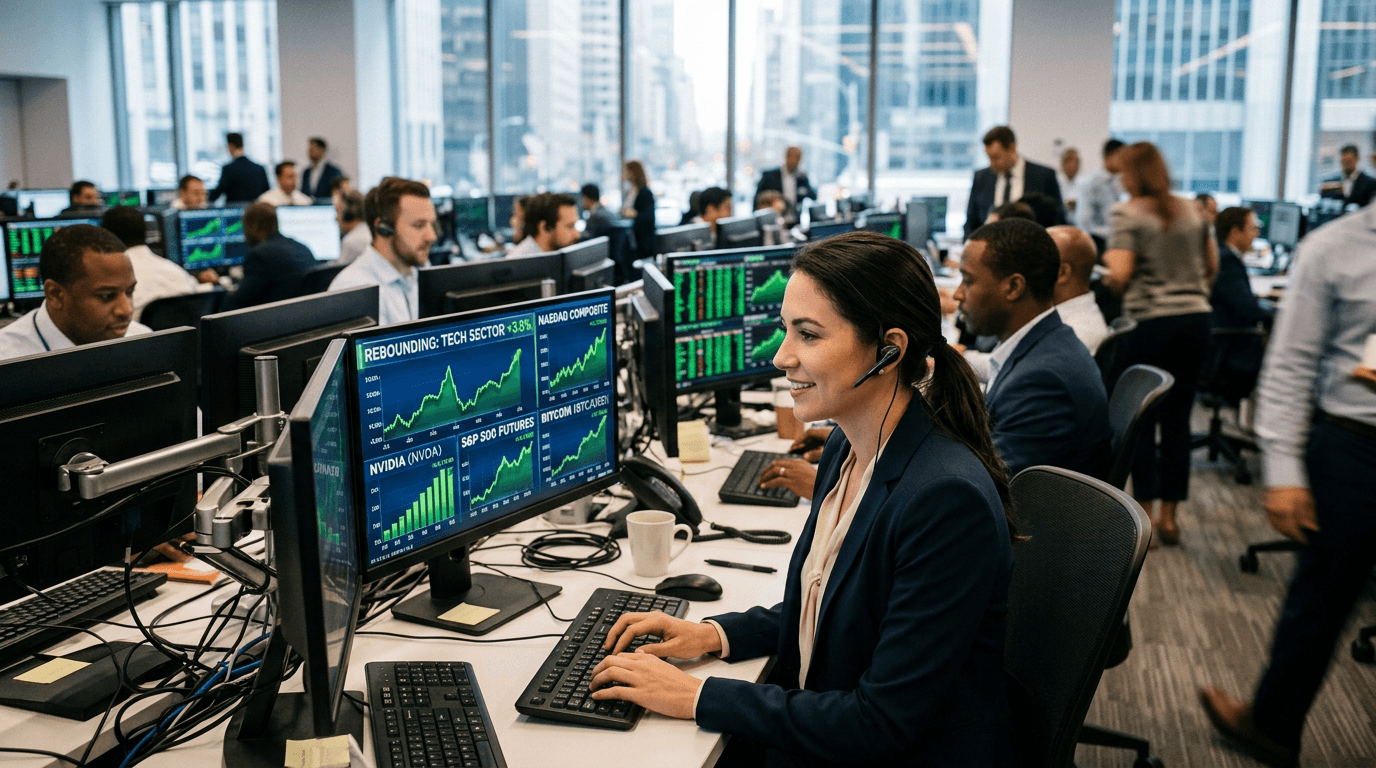
Global equities and index futures are pushing higher as AI-linked and broader technology stocks rebound, lifting major benchmarks and rekindling risk appetite after a volatile stretch. The move is most visible in US and European markets, where growth and semiconductor names are once again leading, helping indices mark fresh 52‑week highs and encouraging traders to reassess both earnings strength and the path of interest rates.[1][3] This is not just a story about one sector; it is a reminder of how central AI and digital infrastructure have become to the global risk cycle.
Global Equities Catch A Bid
Recent sessions have seen a broad-based recovery across major equity markets, with US indices supported by gains in technology and semiconductor stocks and European benchmarks pushing to new one‑year highs.[1][3] In earlier episodes, similar AI-driven surges helped the S&P 500 notch strong multi‑month gains, underlining how concentrated leadership can still translate into broad index performance.[4]
European indices such as the Euro Stoxx 50 and FTSE 100 have previously responded positively to tech optimism, closing higher even when rate‑hike risks from the European Central Bank were on the radar.[1] This pattern shows that when investors believe earnings can grow faster than borrowing costs, equity markets often choose to focus on growth prospects rather than monetary policy headwinds. For traders, that context is critical: index futures can rally even in the face of hawkish messaging if the market narrative shifts back to profits and productivity.
Ai And Tech As The New Market Engine
The current rebound is part of a wider, multi‑year AI theme in which chipmakers, cloud platforms, and data‑center infrastructure providers have become the core “engine room” of global equity performance.[3][4] AI bellwethers like Nvidia have delivered extraordinary revenue growth and share‑price returns—its revenue jumped more than 60% year‑on‑year in one recent quarter, and the stock has surged over 1,300% since late 2022—helping justify renewed appetite for the sector after periodic shakeouts.[2][3]
Semiconductor stocks, in particular, have played an outsized role in driving index gains. At one point, the sector contributed to a roughly 16% rise in the S&P 500 over just two months, a move so strong it has only occurred a handful of times since 1950.[4] When that kind of leadership re‑emerges after a pullback, as we are seeing, it tends to improve confidence that the AI investment cycle still has room to run. For traders, monitoring earnings from key AI names, capex plans from major cloud providers, and demand indicators for memory and networking chips is essential to understanding whether this rally is a short‑term bounce or the resumption of a longer trend.
Why Index Futures React So Quickly To Ai Sentiment
Equity index futures are often the fastest way for global investors to express a view on changing tech sentiment, which is why they tend to move sharply when AI narratives turn from fear to optimism. When recent volatility pressured AI and tech stocks, futures reflected that risk‑off tone; as those names rebound, futures have shifted higher, signaling renewed willingness to take risk exposure ahead of cash-session opens.[10]
From a trading perspective, that sensitivity is driven by the heavy index weightings of mega‑cap tech and semiconductor stocks. When these names gap higher on earnings beats or guidance upgrades, index futures must quickly price in the impact on overall market capitalization and sector earnings. For simulated traders on platforms like E8 Markets, this environment is ideal for practicing scenarios: for example, testing how the S&P 500, Nasdaq, or Euro Stoxx futures respond to surprise AI‑sector news, and refining entry and exit rules around major tech earnings days.
Cross-asset Ripple Effects: Fx And Crypto
The rally in AI and tech is not confined to equities. As risk sentiment improves, traders are rotating into higher‑beta assets and reducing demand for traditional havens, influencing currency pairs and digital assets. When equity markets set fresh highs on the back of AI optimism, past episodes have shown concurrent strength in cyclical currencies and speculative segments of crypto, as investors express a broader “risk‑on” stance.[3]
In FX, this can mean support for currencies tied to export‑driven tech economies—such as the Korean won or currencies of semiconductor hubs—whenever local equity markets advance on AI‑related optimism.[3] In crypto, renewed enthusiasm for technological innovation and digital infrastructure often spills over into renewed interest in tokens aligned with computing, data, or smart‑contract ecosystems. For traders, the key lesson is correlation: AI‑driven equity moves can shift volatility regimes across FX and crypto, offering both opportunities and risks when positioning across multiple asset classes.
Practical Takeaways For Simulated And Live Traders
For active traders—whether in live markets or a SimFi environment—the current AI‑led rebound offers several practical lessons. First, leadership matters: when a narrow group of stocks dominates index weights, their earnings and guidance can outweigh macro headlines in the short term. Tracking a focused dashboard of AI bellwethers, chipmakers, and hyperscale cloud firms can provide an early read on potential index futures moves.[2][3][4]
Second, volatility around AI narratives tends to be episodic. Periods of “bubble” concern and valuation anxiety can trigger sharp pullbacks, but strong fundamental data—such as revenue beats or long‑term capex commitments—often catalyze fast recoveries.[2][6] Simulated trading can be used to stress‑test strategies against these swings: for example, running playbooks for both upside breakouts after earnings and downside gaps when sentiment turns. Over time, this helps build discipline in sizing positions, using protective stops, and avoiding overreaction to short‑term headlines.
Finally, the cross‑asset nature of the current rally is a reminder that modern markets are deeply interconnected. A rebound in AI and tech equities can lift index futures, support cyclical FX, and add momentum to risk‑sensitive crypto segments—all while central bank expectations continue to evolve. Using simulated environments to model these linkages allows traders to experiment with multi‑asset strategies, such as pairing index futures positions with FX hedges or using crypto as a complementary risk expression, before committing capital in live markets.