
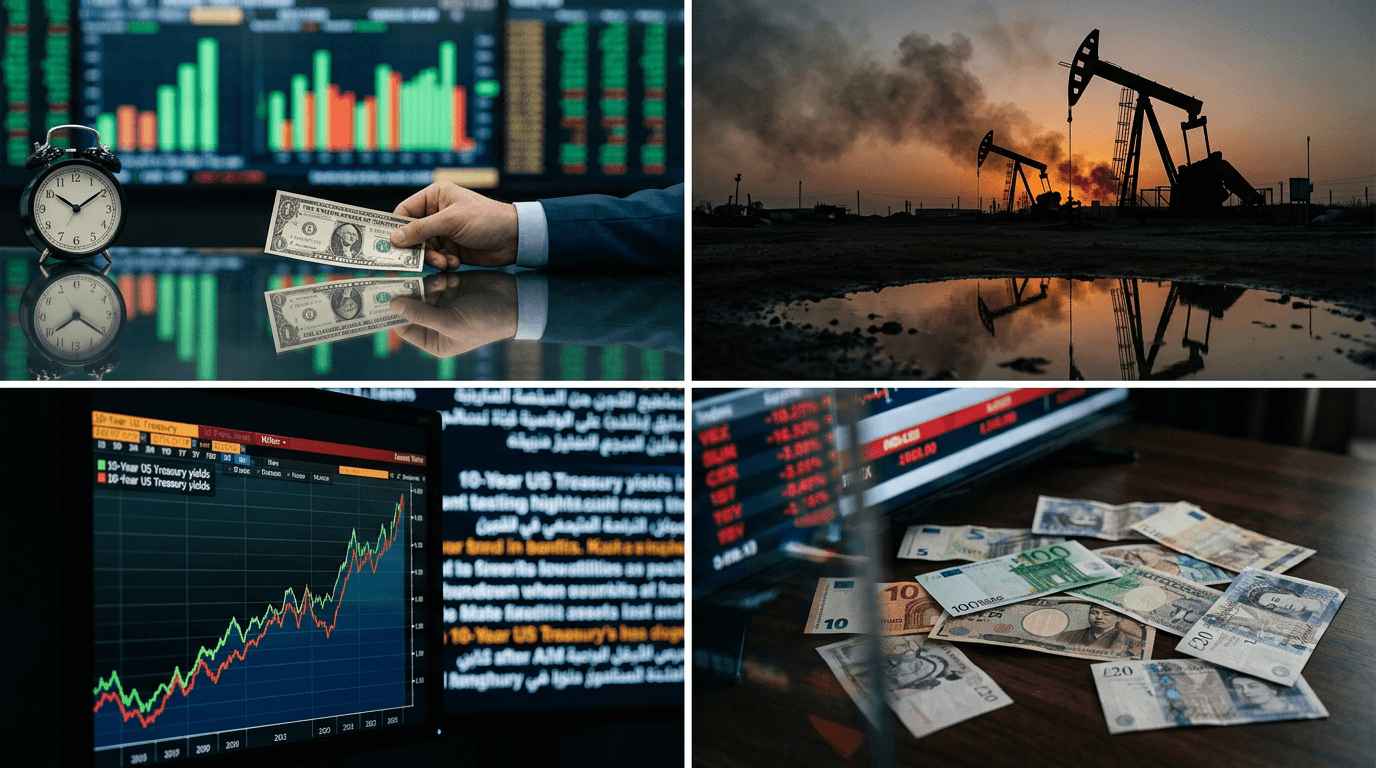
Global government bond markets are once again at the center of a geopolitical storm, with yields spiking as tensions between the U.S. and Iran escalate and investors rush toward the safety of the U.S. dollar.[1][2][17] The result is a complex risk-off backdrop in which bonds, currencies, crude oil and interest-rate futures are all repricing geopolitical risk premia in real time.[5][10][15][17]
Markets Reprice Geopolitical Risk
The latest flare-up in the Middle East has extended what was already a volatile period for global fixed income, pushing benchmark yields in the U.S., Europe and the U.K. back toward multi-week or even multi-month highs.[1][6][11][17] Ten-year U.S. Treasury yields have been trading in the mid‑4% area, near the upper end of their recent range, while German Bund and U.K. gilt yields have also climbed, reflecting a broad-based global repricing of risk.[4][6][9][13][17]
Energy markets are a key transmission channel for this shock. Renewed tensions around Iran and shipping risks in the Strait of Hormuz have driven oil prices sharply higher, with single‑day moves of more than 5% as traders factor in potential supply disruptions.[3][7][10][11][17] Higher crude prices feed directly into headline inflation and can spill over into core prices via transportation, manufacturing and food costs, complicating the path toward lower inflation and rate cuts that markets had been hoping for.[2][8][11][17]
As a result, traders are not just pricing geopolitical risk but also rethinking the outlook for central bank policy. Rate‑cut expectations across major economies have been scaled back, with futures markets now implying a slower and shallower easing cycle as policymakers confront a mix of war‑driven inflation risks and still‑uncertain growth prospects.[2][8][19][20][17] This shift in the policy narrative is a major driver behind the jump in yields, even as broader risk sentiment remains fragile.
Why Bond Yields Rise In A Crisis
For many newer traders, the instinctive assumption is that “risk‑off” means bond yields fall as investors seek safety. The current episode is a reminder that reality is more nuanced. In this case, rising inflation fears and reduced rate‑cut expectations are outweighing the traditional safe‑haven bid for government bonds, leading to a sell‑off in prices and an upswing in yields.[1][2][8][15][18][17]
Mechanically, bond prices and yields move in opposite directions: when investors sell bonds, prices drop and yields rise to attract new buyers.[8][15][18] During a war‑driven oil shock, investors worry that central banks will have to keep policy tighter for longer to prevent inflation from re‑accelerating, so they demand a higher yield to compensate for that risk.[2][8][18][20][17] This “inflation risk premium” is being priced across the curve, from short‑dated maturities linked closely to policy rates to long‑dated bonds that embed expectations about inflation, growth and fiscal sustainability.[1][4][11][18][17]
Another important dynamic is the reassessment of bonds’ role as a portfolio hedge. Historically, government bonds tended to rally when equities sold off, providing diversification. Recent episodes, including the current Middle East shock, show that when inflation risk is front and center, stocks and bonds can both weaken at the same time.[1][8][15][16][17] For traders, this means traditional risk‑parity and 60/40 assumptions need to be revisited, and correlation risk must be managed as actively as price risk.
Safe-haven Flows And Fx: Dollar In Demand
While some government bond markets are losing their traditional safe‑haven status, the U.S. dollar is firmly back in the spotlight as a defensive asset of choice.[11][17] Higher Treasury yields, deep liquidity and the U.S. economy’s relative resilience combine to support safe‑haven flows into dollar assets when geopolitical uncertainty rises.[4][6][11][17]
That combination has lifted the dollar against many emerging‑market and high‑beta currencies, including those closely tied to global growth and commodity cycles.[5][11][17] Risk‑sensitive currencies with external funding needs, such as the South African rand, often come under pressure as investors rotate out of carry trades and into perceived safety, compressing risk‑adjusted returns and widening funding spreads.[2][11][17] At the same time, traditional havens such as the Swiss franc and Japanese yen may see mixed performance, as higher U.S. yields reshape interest‑rate differentials and make dollar assets more attractive on a relative basis.[5][11][17]
FX markets are also being buffeted by swings in crude and interest‑rate futures. Oil exporters may see near‑term support from higher energy prices, while large importers face deteriorating terms of trade and potential pressure on their currencies.[2][3][10][11][17] Layered on top of this are shifts in expectations for Fed, ECB and BoE policy, which feed directly into rate‑differential trades and the pricing of forwards and options across the major currency pairs.[6][8][9][19][17]
Implications For Traders And Simulated Finance Participants
For traders operating in live markets or on Simulated Finance platforms, this environment is both challenging and full of learning opportunities. The key takeaway is that “risk‑off” is not a one‑dimensional concept: depending on the source of stress, safe‑haven flows can favor the dollar, gold or cash, while bonds may behave in non‑traditional ways if inflation risk dominates.[1][2][8][11][15][17]
Three practical guidelines stand out
First, monitor the interaction between yields, oil and FX rather than looking at any one market in isolation. When crude spikes and yields rise together, it is a signal that inflation risk and rate expectations are driving the narrative, which has implications for everything from equity valuations to carry trades.[2][3][8][10][11][17]
Second, pay close attention to the yield curve. Moves in 2‑year versus 10‑year yields can tell you whether markets are repricing near‑term policy rates, longer‑term inflation risk, or both.[4][6][18][19][17] Steepening and flattening episodes around geopolitical headlines often mark shifts in the dominant theme, which can help traders adjust positioning in rates, FX and equity sectors.
Third, stress‑test strategies against correlation shocks. If your framework assumes that bonds will reliably hedge equity risk, scenarios like the current one can break that assumption.[1][8][15][18][17] Using simulated environments to explore “stagflation” regimes—higher yields, weaker risk assets, strong dollar—can help refine position sizing, stop‑loss rules and diversification.
What To Watch Next
Looking ahead, markets will be highly sensitive to three main drivers: the trajectory of Middle East tensions, the path of oil prices, and central bank communication. Any signs of de‑escalation between the U.S., its allies and Iran could take some risk premium out of energy and bond markets, easing upward pressure on yields and potentially softening safe‑haven dollar demand.[1][3][14][17] Conversely, further disruptions to shipping routes or energy infrastructure would reinforce the current inflation‑risk narrative.
Oil price behavior will remain a crucial barometer. Sustained moves higher increase the odds that inflation data surprises to the upside, forcing central banks to re‑anchor expectations and possibly delay rate cuts.[2][8][10][11][18][17] At the same time, policymakers will be watching growth closely; if higher energy costs begin to weigh heavily on consumption and investment, the debate could shift from “how fast do we cut?” to “how do we navigate a stagflation‑like mix of weak growth and sticky prices?”[2][18][20][17]
For traders, the overarching message is clear: geopolitical risk can rapidly reshape the cross‑asset landscape, and traditional safe‑haven assumptions do not always hold. In this episode, global yields are spiking, the dollar is in demand, and risk assets are grappling with the dual challenge of war‑driven inflation and policy uncertainty.[1][2][8][11][15][17] Building robust playbooks for these regimes—whether in live markets or simulated environments—can turn volatility into a source of insight rather than just risk.