
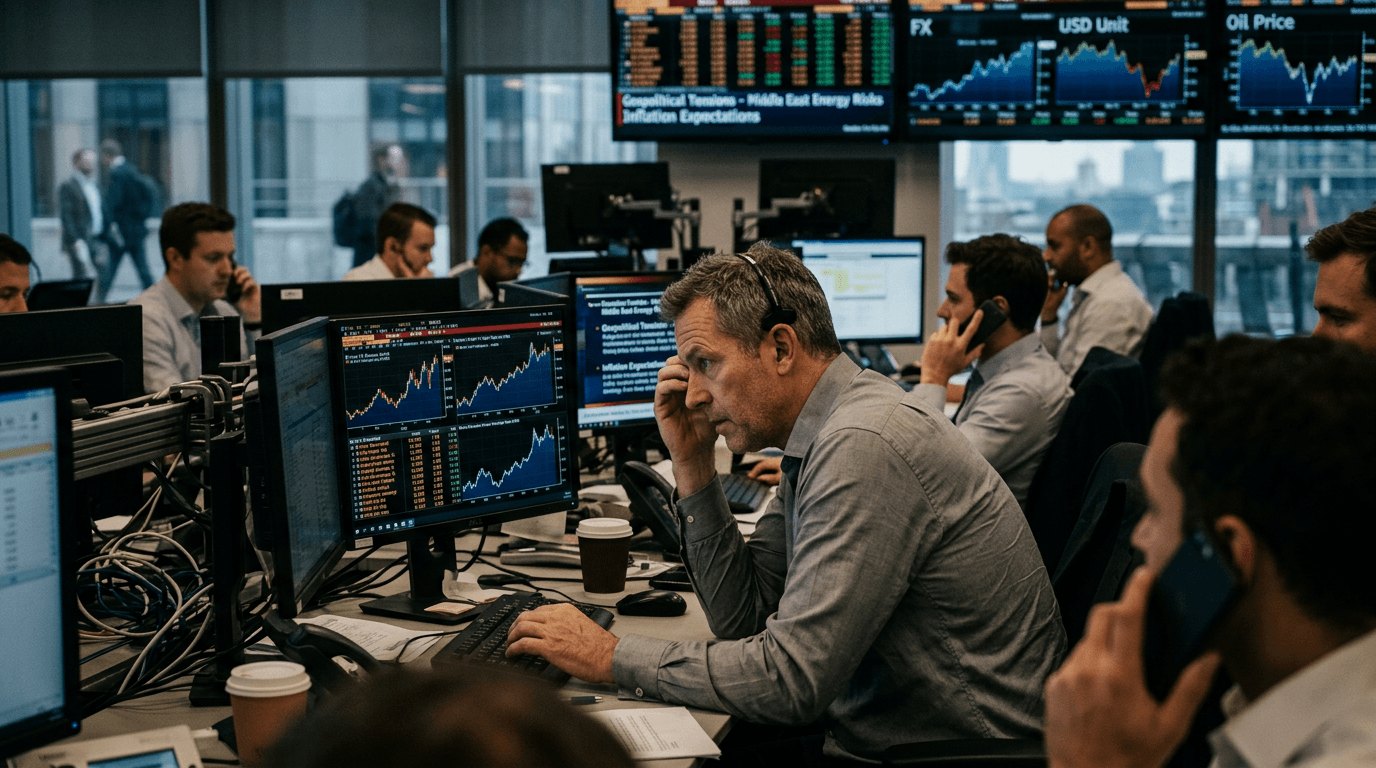
Global government bond markets are once again on edge, with yields clinging to multi‑week highs as traders weigh the risk of a serious U.S.–Iran confrontation and its knock‑on effects across asset classes.[2][10] Benchmark U.S. Treasury and eurozone yields have retraced to levels last seen earlier in the year, reversing weeks of steady fixed‑income gains and forcing investors to rethink how much geopolitical risk is already priced into markets.[2][11] For traders, the message is clear: the “risk‑free” rate is moving, and every asset that prices off it—currencies, rates futures, equities, and commodities—is being repriced in real time.[9][20]
WHY YIELDS ARE STUCK AT MULTI‑WEEK HIGHS
At the core of the story is a sharp repricing of both inflation risk and the path of global monetary policy.[7][10] In the United States, the 10‑year Treasury yield has been hovering around the 4.6% area, near its highest levels in roughly a month, while the two‑year note—most sensitive to Federal Reserve expectations—is holding around 4.23–4.28%, close to year‑to‑date peaks.[2] In Europe, the 10‑year German Bund yield has climbed to roughly 3.06–3.09%, with two‑year Bund yields pushing toward 2.8%, their highest since mid‑2024 as markets price a stickier inflation backdrop.[2][11] Similar moves are visible in UK gilts and longer‑dated Japanese government bonds, where yields have risen to multi‑year highs amid concerns about energy prices and domestic inflation.[10][12]
Mechanically, higher yields reflect lower bond prices—investors are demanding a bigger return to hold government debt in an environment of elevated uncertainty.[9] When markets suddenly reassess the balance of risks around inflation, fiscal policy, and geopolitics, they offload duration, pushing yields higher across the curve.[7][11] Takeaway: when benchmark 10‑year and 30‑year yields jump, traders should assume the discount rate used across valuations—from FX carry models to equity pricing—has just been reset higher.
How Geopolitics Translates Into Bond Pricing
The U.S.–Iran risk is not just a headline; it feeds directly into bond pricing through the energy and inflation channels.[10][15] Markets worry that any disruption to Middle Eastern oil supply could drive crude prices sharply higher, as seen in past episodes of regional conflict.[15][16] Higher oil and energy costs tend to pass through to headline inflation, forcing central banks to consider tighter policy or delaying expected rate cuts.[7][12] As investors scramble to incorporate these scenarios, they demand a higher term premium—the extra yield required to hold longer‑dated bonds in uncertain times—pushing long yields up.[3][11]
There is also a tug‑of‑war between safe‑haven flows and inflation fears.[9] In a typical flight‑to‑quality episode, investors pile into Treasuries and Bunds, driving yields down.[9] Today, the inflation and energy shock narrative is dominating, so the net effect remains higher yields despite geopolitical tension.[7][15] That is why major bond markets have been “battered and bruised” over recent sessions, with two‑year and ten‑year yields rising sharply in the U.S., UK, and eurozone.[5][11] Takeaway: geopolitics can push yields either way; the key is to identify whether the dominant channel is safe‑haven demand (lower yields) or inflation and term‑premium repricing (higher yields).
Impact On Fx Carry Trades And Risk Assets
Elevated yields are reshaping FX carry trades by altering interest‑rate differentials between funding and target currencies.[5][9] As U.S. and European yields push higher, the dollar and other high‑yielding currencies become more attractive as carry targets, especially versus lower‑yielders like the yen or Swiss franc.[6][10] That can support the dollar against risk‑sensitive currencies, particularly emerging‑market FX that is exposed to both higher global rates and potential energy‑price shocks.[7][15] Traders running carry strategies now face a double challenge: changing yield curves and rising volatility around geopolitical headlines.[5][9]
Rates futures are also adjusting, as markets curb expectations for rapid or aggressive rate‑cut cycles.[4][11] Higher front‑end yields signal that investors see policy staying restrictive for longer, which feeds directly into swap curves and futures pricing.[18][20] Equity markets feel this via the equity risk premium: when the “risk‑free” anchor rises, valuation models require a higher expected return to justify stock prices, often pressuring growth and long‑duration sectors first.[9][11] Takeaway: in a rising‑yield environment driven by geopolitical risk, traders should expect tighter financial conditions, more volatile carry returns, and increased sensitivity of equities to rate moves.
Practical Takeaways For Simulated Traders
For traders using a SimFi platform, this environment is a live stress test of macro‑aware strategy design.[2] First, make the global yield curve a core part of your pre‑trade checklist: know where the U.S. 2‑year and 10‑year, Bunds, gilts, and JGBs are trading before you take a position in FX, indices, or commodities.[6][10] Second, practice scenario analysis around U.S.–Iran headlines—build playbooks for escalation (higher oil, higher yields, stronger dollar, weaker risk assets) and de‑escalation (lower oil, stabilizing yields, relief rallies in EM and high‑beta equities).[15][16]
Risk management needs to adapt to higher‑yield, higher‑volatility regimes.[9][18] Carry trades that looked attractive in a stable environment can suffer when yield curves move abruptly, so tighten stop‑loss levels, reduce leverage, and monitor correlations between FX, bonds, and oil more closely.[5][7] In equity and index trading, pay attention to sectors most sensitive to discount‑rate changes—growth, tech, and highly indebted names—versus more defensive, cash‑flow‑rich companies.[9][11] Takeaway: use simulated trading to rehearse how your strategies behave when the risk‑free rate jumps; the goal is to build playbooks before you face these conditions in real markets.
What To Watch Next
Looking ahead, the key drivers of global yields will be the evolving U.S.–Iran narrative, energy prices, and central bank communication.[10][12] Any credible diplomatic progress could take some of the risk premium out of oil and bond markets, allowing yields to drift lower and easing pressure on carry trades and equities.[15][16] Conversely, signs of escalation—direct confrontation, supply disruptions, or sanctions impacting energy flow—would likely reinforce the current high‑yield regime and keep volatility elevated.[10][15]
Traders should also watch upcoming inflation prints and policy speeches for clues on whether central banks will lean against or tolerate the recent rise in yields.[7][11] If policymakers signal comfort with tighter financial conditions, markets may conclude that the higher‑for‑longer rate story has more room to run.[12][20] For SimFi participants, this is an ideal time to test macro strategies across multiple asset classes, refine risk controls, and build confidence in navigating complex geopolitical‑macro intersections.[2] Takeaway: stay focused on the intersection of geopolitics, energy, and central bank guidance—these are the levers that will decide whether today’s multi‑week yield peaks become a new normal or just another spike in a volatile cycle.