
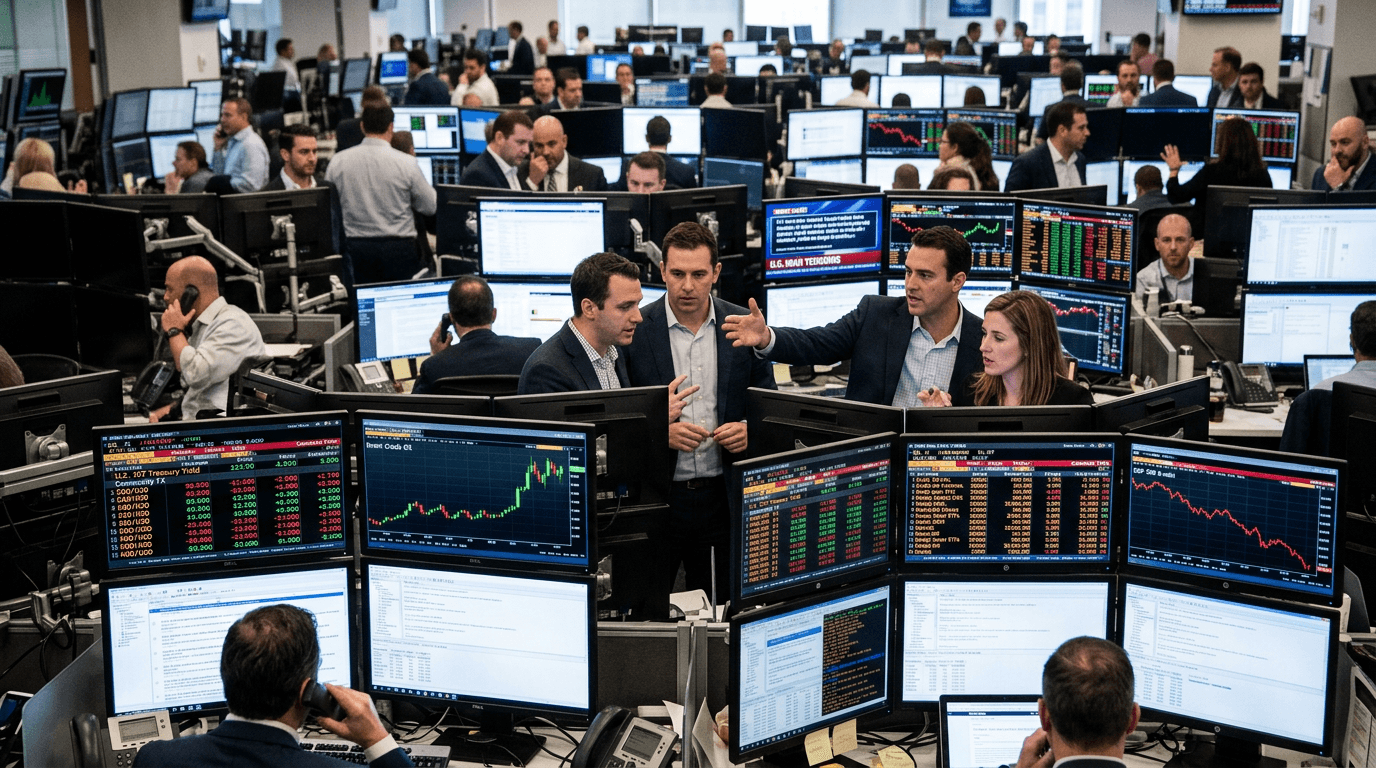
Reports of renewed pessimism from U.S. officials over a potential Iran deal have rippled quickly through global markets, driving a jump in sovereign bond yields, a rebound in crude oil from recent three‑month lows, and fresh strength in commodity‑linked currencies such as the Canadian dollar.[2][12] At the same time, risk assets—from broad equity indices to high‑beta FX—are coming under pressure as traders reassess geopolitical risk, inflation expectations, and energy supply dynamics.[2][12]
Global Market Reaction
When headlines signal deteriorating U.S.–Iran relations, markets instinctively price in a higher probability of disruption in the Middle East, particularly around key transit routes like the Strait of Hormuz, through which roughly a fifth of the world’s oil and liquefied natural gas once flowed prior to the war’s outbreak.[8][12] Recent strikes and naval blockades have already led some major oil companies and trading firms to halt shipments through the area, highlighting how quickly physical supply concerns can translate into price moves.[12]
In this environment, global bond yields have moved higher, reflecting a combination of rising inflation expectations and an increased term premium—the extra compensation investors demand to hold longer‑dated debt amid greater uncertainty.[2][12] Episodes of intensified U.S.–Iran conflict have previously seen oil prices jump sharply while equities retreated, as investors shifted out of risk assets and into instruments better suited to inflationary or geopolitical shocks.[2][7] The latest move fits that pattern: yields and oil higher, risk assets lower, and volatility picking up across macro markets.
For equity indices, the impact is uneven. Energy producers and oilfield services typically benefit from higher crude prices, while fuel‑intensive sectors such as airlines, shipping, and select industrials face margin pressure.[7][20] Broader indices often trade lower as investors factor in the drag of higher energy costs on corporate earnings and consumer purchasing power, a dynamic already visible in previous Iran‑related price spikes.[20]
Why Geopolitical Tensions Move Bond Yields
There are three main channels through which U.S.–Iran tensions can push global yields higher:
First, oil and inflation expectations. Any conflict that hinders oil availability or transit routes tends to lift crude prices, restoring a “geopolitical risk premium” to energy markets.[10][12] Analysts note that even partial disruptions or delays in Gulf exports can produce short‑term spikes pushing prices into the $80–$100 range as both production and transit risks compound.[19] Higher expected energy costs feed directly into inflation forecasts, which are critical inputs in bond pricing; as inflation expectations rise, nominal yields must increase to preserve investors’ real returns.
Second, term premium and uncertainty. When geopolitical risks rise, markets often demand extra compensation to hold longer‑maturity bonds because future policy, growth, and inflation outcomes become harder to predict.[12][19] Even if central banks are not changing policy immediately, the distribution of potential future scenarios widens—from contained skirmishes to broader regional conflict—and that uncertainty is reflected in higher yields, particularly at the long end of the curve.
Third, fiscal and growth considerations. A prolonged conflict that lifts oil prices can weigh on global growth, but it can also pressure government budgets via higher defense spending and softer tax revenues if activity slows.[15][20] Some investors may price in greater future issuance, which can contribute to higher yields as the expected supply of bonds increases. At the same time, the traditional “risk‑off” rally in government bonds can be muted or even reversed if inflation fears dominate the flight‑to‑safety impulse.
The net result is what we are currently seeing: a bear move in bonds—prices down, yields up—coexisting with weaker equities and elevated volatility, a reminder that not all shocks produce the classic low‑yield, risk‑off template.
Impact On Oil And Commodity Currencies
Oil is the most obvious transmission channel from U.S.–Iran tensions to global markets. Crude prices have shown a pattern of surging on renewed hostilities, including recent episodes where U.S. strikes and Iranian retaliation pushed Brent and WTI sharply higher across several sessions.[7][8][10] In one flare‑up, Brent crude climbed above $78 after gaining more than 5% the prior week, as markets re‑priced the risk of a wider Middle East conflict and potential constraints on Gulf supply.[10] In another, Brent exceeded $90, marking its highest level in weeks as both sides expanded attacks that curtailed shipments through the Strait of Hormuz.[9]
The current rebound in crude from three‑month lows reflects similar concerns: if diplomatic pessimism persists and the conflict escalates, the odds of sustained supply disruptions rise, supporting prices despite otherwise abundant global inventories.[5][12] For commodity‑linked FX such as the Canadian dollar, Norwegian krone, and, more broadly, currencies of resource‑exporting economies, this matters directly. Higher oil prices improve terms of trade for these countries, bolster energy sector revenues, and can attract capital flows into their asset markets, providing support to their currencies even as broader risk sentiment deteriorates.
This divergence—commodity FX holding up while high‑beta or emerging‑market currencies weaken—is a hallmark of geopolitically driven oil shocks. Traders who understand these relationships can seek relative value, for example by contrasting oil‑linked currencies with those more exposed to energy import costs.
Positioning In Energy Futures And Equity Indices
Energy futures markets tend to react swiftly to Iran‑related headlines, not only in outright prices but also in the shape of the forward curve. During volatile weeks marked by shifting expectations about U.S.–Iran negotiations and military actions, crude has experienced sharp swings as traders recalibrate scenarios around transit risks, spare capacity, and potential demand destruction.[12][14] In more extreme conflict simulations, analysts warn that simultaneous disruptions to production and transit could drive short‑term price spikes into the upper double‑digit range, with futures curves reflecting tight near‑term supply and elevated volatility.[19]
This backdrop affects positioning in both futures and options. Hedgers—such as airlines and refiners—may increase long hedges or buy upside call protection, while speculative accounts trade around momentum, mean reversion, and event risk. Equity index traders, meanwhile, must consider cross‑sector dispersion: energy and defense names can outperform, while consumer discretionary, transportation, and select industrials lag.[7][20] Index‑level exposure becomes a balance between these sector dynamics and the global macro picture of higher yields, potentially slower growth, and elevated geopolitical risk.
For SimFi participants, this is an ideal environment to explore multi‑asset interactions: how a shock in one market (crude futures) cascades into FX, rates, and equities, and how relative trades—such as long energy, short cyclicals—might behave during such episodes.
How Traders Can Navigate This Environment
For traders and investors, especially those using simulated finance platforms, several practical takeaways stand out:
Monitor correlations, not just headlines. U.S.–Iran news moves more than oil alone; it affects yield curves, commodity FX, equity sectors, and inflation expectations. Watching how these relationships evolve in real time can sharpen your macro intuition.
Separate short‑term volatility from structural trends. Many Iran‑related price spikes have been sharp but not always persistent, fading as markets reassess the durability of supply disruptions or as diplomatic channels reopen.[11][16][18] Scenario analysis—asking what happens if tensions escalate, stabilize, or reverse—helps avoid over‑reacting to single headlines.
Use risk‑appropriate structures. In a live market, traders might favor options to express views on tail risks or use spreads to limit capital at risk when trading high‑volatility instruments like crude. In a SimFi setting, you can experiment with these structures without financial consequences, building familiarity with how they respond to large macro shocks.
Focus on cross‑asset thinking. Geopolitical events like renewed U.S.–Iran tensions are inherently cross‑asset. Practicing how to link bond yields, oil prices, FX moves, and equity performance builds the kind of holistic perspective that professional macro traders rely on daily.
As global yields jump, oil rebounds, and commodity currencies find support, the latest U.S.–Iran headlines are offering a live case study in how geopolitics, energy markets, and financial assets intersect. For traders in both real and simulated environments, understanding these linkages is essential to navigating today’s complex market landscape.