
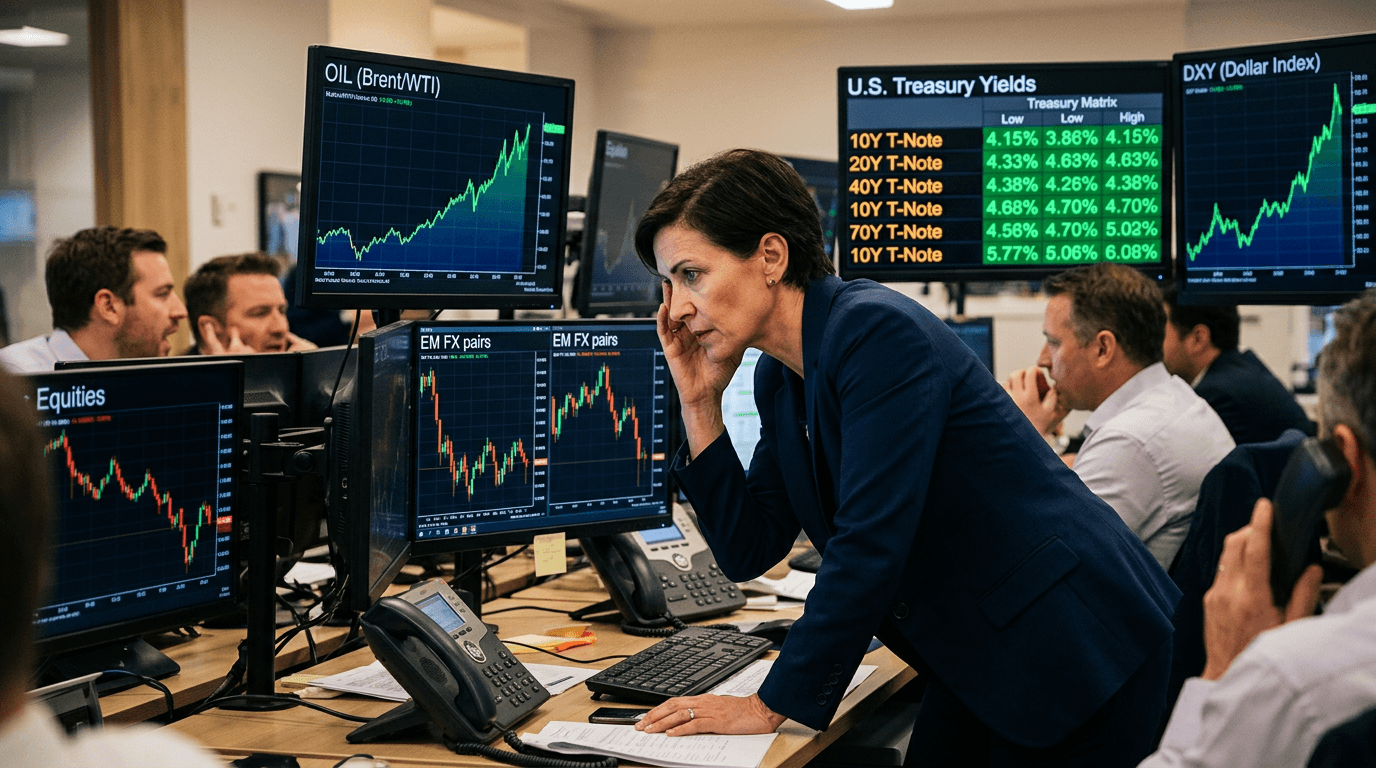
Global markets are once again trading on geopolitics, as renewed U.S.–Iran tensions drive a sharp spike in government bond yields, a bid for the safe‑haven dollar, and a fresh rally in oil futures.[19] For traders, this is not just another headline‑driven move; it is a live case study in how geopolitics, inflation expectations, and central bank policy converge to reshape the macro trading landscape.[11][19] The result is mounting pressure on risk‑sensitive assets, with emerging‑market FX and equity index futures feeling the strain.[19]
GLOBAL YIELDS BACK NEAR MULTI‑WEEK HIGHS
Global government bond yields were already elevated before the latest escalation, and the renewed U.S–Iran tensions have pushed them back toward multi‑week peaks.[9][19] In the U.S., the 10‑year Treasury has been trading in the mid‑4% range, hovering around levels seen over the past month and flirting with recent highs.[19] Long‑dated U.S. 30‑year yields are near their highest levels since 2007, underscoring how far the market has moved from the low‑rate era.[2][12][19]
This yield reset is not limited to the U.S. Across the G7, average 10‑year borrowing costs have climbed to roughly 4%, up from about 3.2% before Middle East tensions intensified.[4][19] Eurozone and UK government bonds have seen similar moves, with some ten‑year and longer‑dated yields at 15‑ to 20‑year highs.[11][19] Even traditionally low‑yield markets such as Japan, Australia, and New Zealand have experienced upward pressure on sovereign yields, reflecting a global repricing of interest‑rate and inflation risk.[13][19]
SAFE‑HAVEN FLOWS: DOLLAR UP, OIL HIGHER, RISK ASSETS UNDER PRESSURE
Geopolitical stress often triggers a flight to perceived safe assets, and this episode is no different: the dollar has benefited from classic safe‑haven demand as investors seek liquidity and security.[19] At the same time, risk‑sensitive currencies, particularly those in emerging markets, have come under pressure, with EM FX and equity index futures feeling the impact of both higher yields and higher volatility.[19]
Oil futures have moved higher as markets re‑price the risk of supply disruption and potential spillovers across the broader Gulf region.[18][19] Earlier Iran‑related headlines pushed Brent above the USD 70 per barrel mark, and fresh tensions have kept energy markets on edge.[16][18] Rising oil prices feed directly into inflation expectations, which then loop back into higher yields as investors demand more compensation for holding long‑term debt.[5][11][19] That feedback loop—geopolitics to oil, oil to inflation, inflation to yields—is exactly what is playing out in real time.
Risk assets are caught in the crossfire. Global equity indices have struggled as higher discount rates and higher uncertainty weigh on valuations.[11][12] For emerging‑market stocks and currencies, the combination of a stronger dollar, rising global yields, and geopolitical risk is particularly toxic, driving outflows and widening spreads.[11][19]
WHY THIS TIME LOOKS MORE LIKE A STAGFLATION SCARE THAN A CLASSIC “FLIGHT TO QUALITY”
In a textbook risk‑off episode, investors rush into government bonds, pushing prices up and yields down. Yet in recent Iran‑related episodes, yields have often risen instead, signaling a different narrative.[5][11] Analysts point to a “stagflationary oil dilemma”: markets are less worried about immediate recession and more concerned about persistent inflation and the possibility that central banks will have to stay restrictive for longer.[5][16][17]
Higher oil prices act like a tax on consumers and businesses, but they also raise headline inflation and can keep core inflation sticky.[16][18] When traders believe central banks will respond not with cuts but with prolonged higher policy rates—or even renewed hikes—long‑term yields can rise despite the increase in risk.[11][17][19] Recent price action in U.S. Treasuries and European bonds reflects exactly that dynamic, with short‑dated yields particularly sensitive to evolving rate expectations.[8][11][17]
From a macro‑trading perspective, that distinction matters. A pure flight‑to‑quality phase tends to favor long‑duration government bonds and weigh heavily on cyclicals. A stagflation scare, by contrast, can punish both bonds and equities while boosting the dollar and commodities like oil.[5][11][16] Understanding which regime the market is trading in is critical for positioning across rates, FX, and equity index futures.
Key Implications For Traders And Portfolio Construction
For rates traders, elevated and volatile yields mean the term premium—the extra compensation for holding longer‑dated bonds—is back in focus.[19] Curve trades (such as steepeners and flatteners) become more attractive tools for expressing views on how central banks will balance inflation risk against growth concerns.[5][8][11] Episodes like the current U.S.–Iran flare‑up can produce sharp intraday swings in different parts of the curve, rewarding traders who are disciplined about scenario analysis and risk management.
FX traders need to watch how the dollar trades not only against traditional safe‑haven peers but also against high‑beta and EM currencies.[11][19] Safe‑haven demand can coexist with changing interest‑rate differentials; when both favor the dollar, the move can be powerful and extended. At the same time, cross‑asset volatility tends to rise, affecting carry trades and strategies that rely on stable correlations across FX, rates, and equities.[11][19]
Equity and index‑futures traders face a more complex backdrop. Higher discount rates weigh on growth and long‑duration sectors, while energy, defense, and certain value segments may benefit from higher oil prices and shifting fiscal priorities.[11][18] Index futures become a flexible tool for hedging broad market exposure when single‑name risk is elevated but the main driver is macro in nature.
Using Simulated Finance To Train For Geopolitical Shocks
For traders developing or refining strategies, simulated finance environments offer a way to practice navigating complex, cross‑asset shocks without capital at risk. Multi‑asset SimFi platforms can replicate conditions where yields are near multi‑week highs, oil is elevated, and FX volatility is rising, letting traders test how their systems perform under stress.[19]
This is particularly valuable in regimes where historical data may be limited—such as the current mix of high yields, lingering inflation risks, and frequent geopolitical headlines.[2][11][19] By replaying scenarios of past U.S.–Iran flare‑ups and adjusting parameters around oil, rates, and FX correlations, traders can build playbooks for future events, from hedging rules and stop‑loss logic to macro filters that respond to changes in policy expectations.
Conclusion And Practical Takeaways
Renewed U.S–Iran tensions are not happening in a vacuum; they are hitting markets at a time when global yields are already elevated, central banks are reluctant to ease, and inflation risks remain front and center.[11][19] The result is a powerful combination: higher government bond yields, a stronger safe‑haven dollar, firmer oil futures, and more pressure on risk‑sensitive assets, especially in emerging markets.[11][18][19]
For traders, three practical lessons stand out. First, always connect geopolitics to the inflation and policy narrative—oil shocks can change rate expectations as quickly as data prints.[5][11][16] Second, monitor cross‑asset signals: yields, FX, commodities, and equity index futures are telling different facets of the same story.[11][18][19] Third, use both live markets and simulated environments to stress‑test strategies against these complex shocks, building a robust framework for the new, higher‑yield macro landscape.