
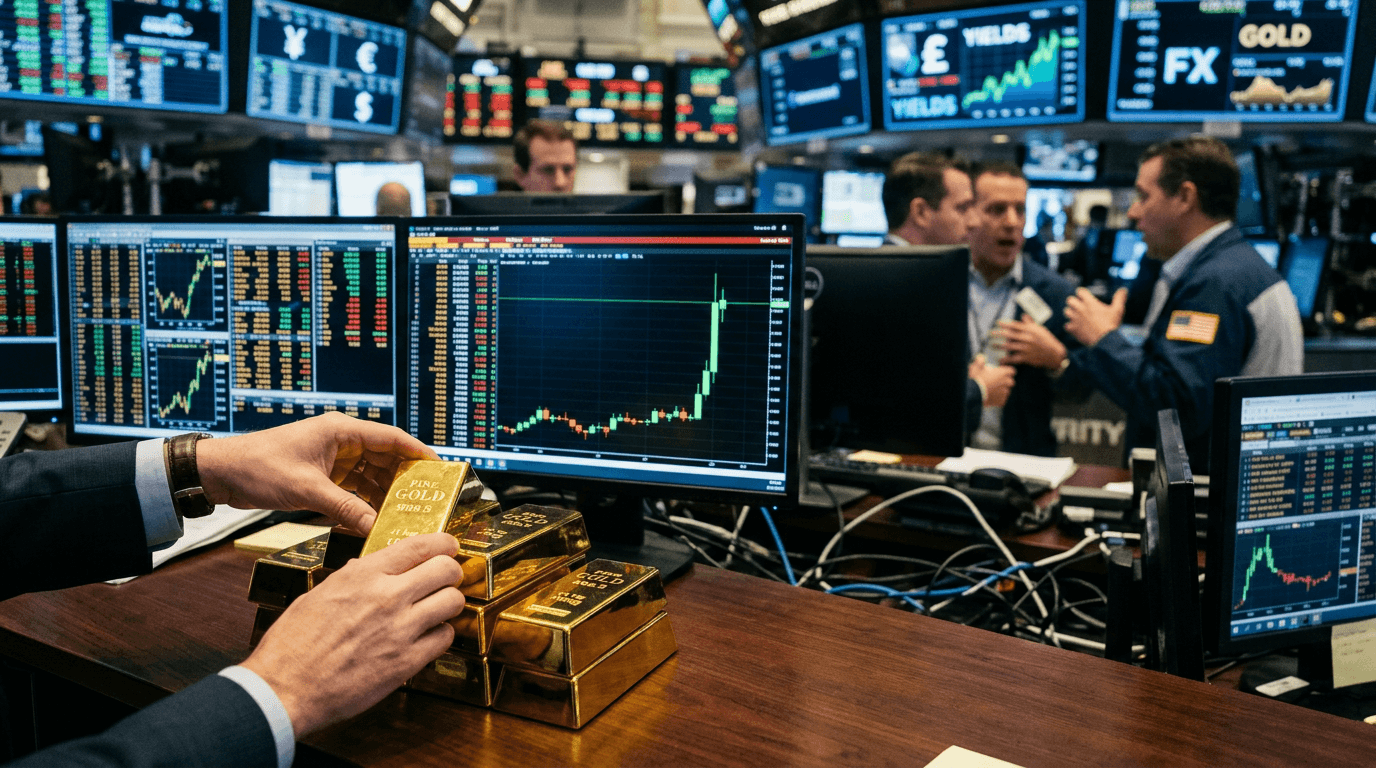
Gold’s decisive push back above the $4,000 mark has reminded markets that when fear returns, traditional safe havens can move very quickly. A more than 2% daily jump, powered by a weaker U.S. dollar and renewed demand for defensive assets, has turned gold from a slow-moving store of value into a central character in the macro narrative once again, with implications for FX, rates, and broader risk sentiment.[1][3][4]
WHAT’S DRIVING GOLD ABOVE 4,000?
Breaking $4,000 an ounce is not just another price move – it is a new all‑time milestone for gold and a powerful psychological level for investors and traders.[1][3] Major outlets report futures closing just above $4,000 after touching intraday highs slightly higher, cementing this move as a historic breakout rather than a brief spike.[1]
Several macro drivers are converging at once. First, gold has rallied nearly 50% year‑to‑date, a performance last seen in the late 1970s when inflation, a weak dollar, and geopolitical tension dominated the landscape.[1][3][6] Second, the U.S. dollar index has fallen roughly 10% this year, making dollar‑denominated gold cheaper for foreign buyers and boosting demand.[1][3] Third, expectations of further Federal Reserve rate cuts have lowered real yields, improving the relative appeal of an asset that does not pay interest but benefits when borrowing costs fall.[1][3][4][5]
Central banks and institutional investors are also part of this story. Persistent official‑sector buying has been shifting reserves away from U.S. Treasuries toward gold, reinforcing the narrative that gold is a strategic hedge against currency and policy risk.[2][3][6] At the same time, physically backed gold ETFs have added hundreds of tonnes this year, with inflows driven by both professional asset allocators and retail investors worried about missing the rally.[3][4][5]
Safe-haven Flows And The Weaker Dollar
Safe-haven demand is the glue holding these drivers together. Gold is traditionally sought when uncertainty rises – whether that is linked to geopolitical tension, trade disruption, government shutdowns, or doubts about fiscal sustainability.[2][5][6][9] Recent headlines describe investors “seeking secure investments amidst rising concerns regarding global economic and political instability,” pushing spot prices above $4,000 and igniting the strongest rally since the 1970s.[2][6]
The weaker dollar is a critical part of this safe‑haven rotation. When investors worry about “debasement” – essentially the erosion of purchasing power or confidence in the currency – they often buy gold as an alternative store of value.[5] Analysts have described the current move as a “debasement trade,” with investors hedging against rising government debt, questions around central bank autonomy, and the relative decline of traditional safe havens like U.S. bonds.[5][6]
For traders, the key takeaway is that safe‑haven flows rarely move in isolation. As capital exits risk assets and seeks protection, gold tends to rally alongside other defensive plays such as the Japanese yen or high‑quality government bonds. But when the dollar itself is under pressure, gold can decouple and become the primary destination for nervous capital, amplifying its moves and its importance in macro positioning.[2][3][5]
Impact On Fx, Rates, And Risk Assets
A sharp move in gold above $4,000 is more than a commodity headline; it is a macro signal. In FX markets, a falling dollar and rising gold often go hand in hand, particularly against currencies where local demand for gold is strong. Gold’s outperformance versus major currencies like the euro, yen, and pound this year underscores its role as a global store of value rather than a purely dollar‑centric asset.[2][6]
In rates markets, expectations of further Fed cuts and lower real yields have been central to gold’s surge.[1][3][4][5] When markets price in easier policy, yields on safe government bonds fall, and the opportunity cost of holding gold decreases. At the same time, heightened concerns about fiscal deficits and long‑term debt sustainability can make investors less comfortable owning long‑dated Treasuries, pushing them toward gold and reinforcing the move.[5][6]
On the risk asset side, the signal is more nuanced. Equities can still trade at or near highs while gold is rallying, especially if investors are hedging tail risks rather than fleeing risk entirely.[6] But when gold breaks to new records on safe‑haven demand, it often coincides with rising volatility, sector rotation away from cyclical names, and a more defensive bias in portfolios. For traders, that means watching correlations: are stocks and gold rallying together, or is gold rising while equities struggle? The answer shapes both tactical trades and risk management.
HOW TRADERS CAN NAVIGATE A 4,000+ GOLD MARKET
For active traders – including those using simulated finance platforms to refine their strategies – the current environment offers both opportunity and risk. Gold’s rally has compressed the usual time it takes to move between major price milestones: it climbed from $3,500 to $4,000 in just over a month, versus an average of nearly three years between earlier $500 increments.[3] That acceleration implies elevated volatility and the risk of abrupt reversals.
One practical approach is to treat $4,000 as a key psychological pivot. Technical strategists are already highlighting nearby support and resistance levels around this zone and cautioning that a failure to hold above $4,000 could trigger a deeper correction.[5][7] For directional traders, that means clearly defining scenarios:
- How do you position if gold consolidates above $4,000 and grinds higher?
- What is your plan if price rejects the level and falls back toward prior moving averages and support zones?
Risk management is critical. Wider intraday ranges and gap moves around macro news can quickly punish over‑leveraged positions. Simulated environments are particularly useful here: traders can stress‑test gold strategies under different assumptions for the dollar, yields, and risk sentiment, learning how their P&L reacts before committing real capital.
What To Watch Next
Gold’s sharp recovery above $4,000 raises an important question: is this the early stage of an extended trend or a late‑cycle blow‑off move? Analysts are divided, but several factors will likely decide the answer.[3][5][6]
First, the path of monetary policy. If the Fed continues to cut rates or signals tolerance for higher inflation, the fundamental case for gold as a non‑yielding store of value remains strong.[1][3][4][5] Second, the durability of the weaker dollar. A sustained downtrend would keep the wind at gold’s back; a sharp dollar rebound could cap the rally. Third, the evolution of geopolitical and policy risks – from trade frictions to fiscal debates – will shape safe‑haven demand over time.[2][5][6]
For traders and investors, the practical takeaway is that gold above $4,000 is both a warning light and a roadmap. It signals elevated uncertainty in the macro backdrop, but also offers a clear asset through which to express views on currencies, rates, and risk appetite. Whether you are trading live markets or building playbooks in a simulated environment, understanding why gold has recovered so sharply – and how it interacts with the rest of the macro complex – is essential to navigating the next phase of this cycle.