
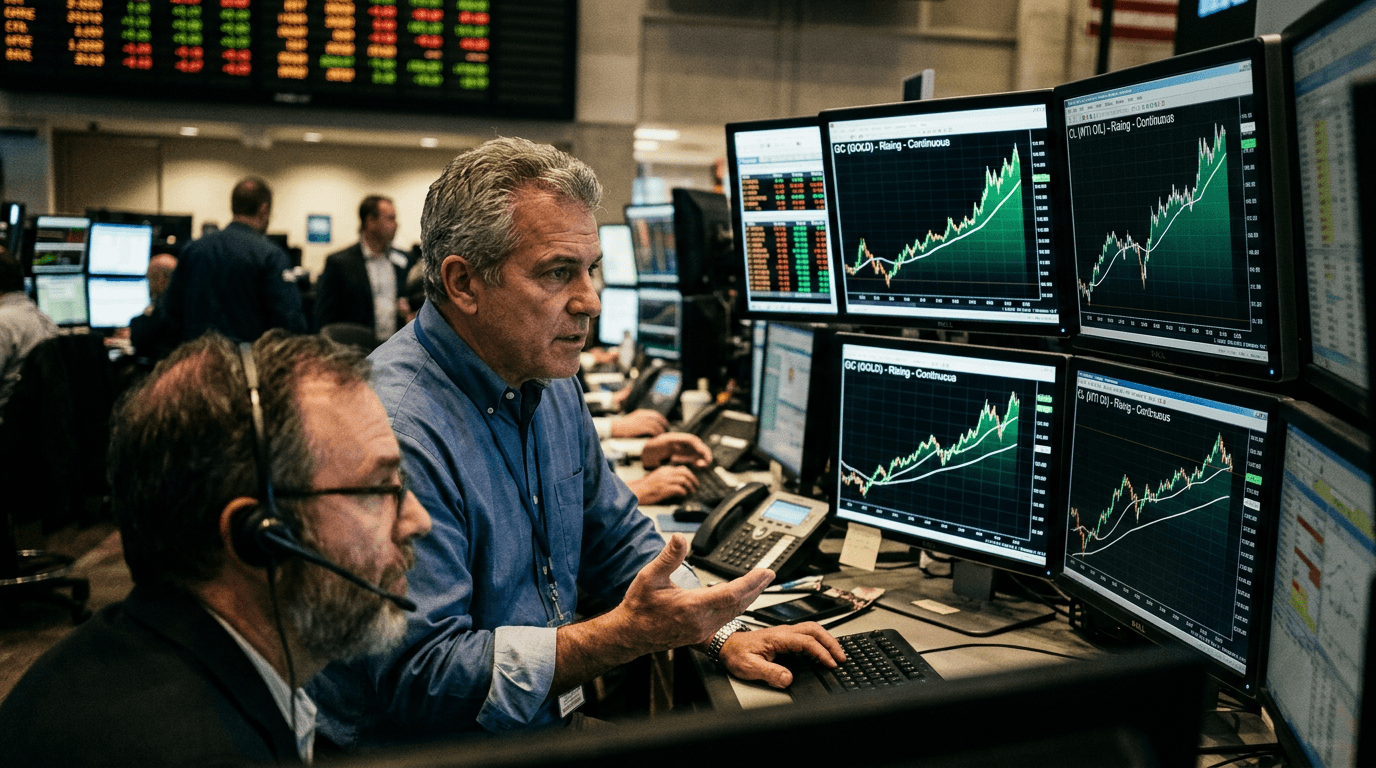
Commodities are back in the spotlight as gold and oil-linked futures push higher together, rekindling inflation narratives and drawing renewed interest from macro and cross-asset traders.[3][4][12] At the same time, the dollar has logged its strongest daily gain in about two weeks, underscoring a complex backdrop in which traditional safe havens, inflation hedges, and growth-sensitive assets are all moving at once.[12] For traders in both live and simulated markets, this alignment of gold, oil, and the dollar is a timely case study in how global themes translate into futures pricing and portfolio positioning.[3][4][12]
Macro Backdrop: Commodities, Currencies, And Inflation Expectations
Recent data show Brent crude futures trading in the high-$80s per barrel, with active volumes reflecting persistent interest in energy exposure.[2][11][13] Gold futures, meanwhile, have been holding above $4,400 per ounce, with continuous contracts and front-month maturities both recording meaningful daily moves.[2][5][12] This tandem strength in energy and metals has emerged even as the dollar firmed, challenging the typical assumption that a stronger dollar automatically suppresses commodity prices.[7][12]
Historically, rising oil prices tend to feed into higher inflation expectations because energy is a key input across transportation, manufacturing, and consumer goods.[3][4] Gold, in turn, is often treated as an inflation hedge and a store of value when investors worry that real purchasing power in fiat currencies may erode.[3][4][10] When both commodities rise together—especially against a firm dollar—it suggests that markets are simultaneously pricing in higher nominal growth, renewed inflation concerns, and a demand for portfolio insurance.[3][4][12]
Some analysts have described the recent pattern of rising gold and oil as a potential stagflationary signal: higher input costs and inflation expectations paired with concerns about growth momentum.[3] Whether that narrative fully materializes or not, futures markets are clearly being used to express macro views, with traders scaling into and out of energy and metals positions as new data arrive on labor markets, central bank policy, and geopolitical risk.[4][10][14]
Gold Futures: Inflation Hedge And Policy Signal
Gold futures have stayed active, with December contracts trading around the mid-$4,400s per ounce and posting daily gains of around 0.5% to 1% during recent sessions.[2][5][12] Spot gold and near-dated futures have also responded quickly to shifts in expectations for central bank rate paths, often firming when softer economic data or geopolitical tensions raise the odds of more accommodative policy.[4][14][15]
In recent trading, gold has advanced alongside a rebound in Treasury yields and renewed speculation about future rate hikes, highlighting its dual role as both a hedge and a macro sentiment barometer.[4] When labor data come in weaker or economic uncertainty rises, gold tends to catch a bid as investors seek defensive exposure.[4][14] Conversely, pullbacks in oil or easing inflation fears can temporarily cap its upside, as seen when crude corrections helped ease near-term inflation pressures and tempered gold’s rally.[10]
For traders, gold futures offer several practical angles:
1. As an inflation hedge: Positioning in longer-dated gold futures can be used to protect portfolios from upside surprises in inflation prints or unexpected shifts in central bank rhetoric.[3][4] 2. As a policy signal: Shorter-dated contracts and intraday moves around economic releases—jobs data, inflation reports, policy meetings—provide clues about how the market is repricing rate expectations.[4][10][14] 3. As a cross-asset diversifier: Gold often exhibits low correlation to equities and some credit assets over longer horizons, making it a valuable tool for risk management.[3][4]
Oil-linked Futures: Energy Rally And Market Ripple Effects
On the energy side, Brent and WTI crude futures have traded in the low-to-high $80s per barrel, with active liquidity across front-month and continuous contracts.[2][5][11][13] Recent rebounds in oil prices have revived discussions about renewed inflation risk, particularly as supply dynamics, geopolitical considerations, and OPEC-plus decisions intersect with demand concerns.[4][9][12]
Kitco notes that a jump in oil helped revive the “inflation-risk trade,” with higher energy prices feeding expectations that headline inflation could re-accelerate, even as some economic data point to cooling growth.[4] As Brent and other crude benchmarks move higher, equity markets in commodity-heavy regions, such as Canada, often respond, with futures linked to those indices tracking the interplay between rising gold and shifting oil prices.[15]
For traders focused on oil-linked futures, several themes stand out:
1. Term structure and carry: Contango or backwardation in the oil curve can signal market views on near-term supply-demand balances and influence roll yield strategies.[5][11] 2. Geopolitical risk: Headlines around Middle East tensions, production cuts, and sanctions frequently drive intraday volatility in crude futures.[9][14][15] 3. Inflation pass-through: Higher energy costs can eventually feed into consumer prices, making oil futures a direct proxy for inflation-sensitive trades.[3][4]
Cross-asset Positioning In Simulated Markets
The simultaneous move higher in gold and oil offers an ideal environment for simulated trading on platforms like E8 Markets, where participants can test macro theses without capital at risk. When gold and oil rally together, traders can explore stagflation scenarios, inflation hedges, and relative value trades in a controlled, data-rich environment.[3][4][12]
For example, a simulated trader might construct:
1. A long gold/long oil macro-inflation basket to express a view that inflation risks are underpriced.[3][4] 2. A long gold/short cyclical equity pair trade, assuming higher input costs and policy uncertainty will weigh on growth-sensitive stocks.[3][15] 3. A volatility strategy in commodity futures, using options or dynamic position sizing to capture larger intraday swings as inflation and policy narratives evolve.[4][10][12]
Because simulated environments mirror live futures data—from contracts like GC (gold), CL (crude oil), and BZ (Brent)—without real-money consequences, traders can stress-test their ideas, refine timing, and learn how cross-asset relationships behave across different regimes.[2][13] This is particularly valuable when markets send mixed signals, such as a strong dollar coexisting with strong commodities, forcing traders to think beyond simple one-factor models.[7][12]
Practical Takeaways For Simfi Traders
For traders engaging with gold and oil-linked futures in a simulated finance setting, several actionable lessons emerge from the current environment:
1. Watch the trio: Track gold, oil, and the dollar together rather than in isolation. When all three move strongly, it often reflects deeper macro shifts in inflation expectations, growth concerns, or geopolitical risk.[3][4][12] 2. Use futures volume and open interest as confirmation. Active trading in Brent and gold contracts signals that institutional participants are repositioning, which can validate or challenge your macro thesis.[2][5][11][13] 3. Incorporate economic calendars. Align simulated trades with upcoming events—jobs reports, inflation data, central bank meetings—to understand how real markets price risk around catalysts.[4][10][14] 4. Practice risk management. Use stop-loss levels, position sizing rules, and scenario analysis in your SimFi strategies to build habits that translate into live trading discipline. 5. Think in portfolios, not single trades. Combine gold, oil, equities, and FX exposures in your simulations to see how cross-asset diversification and correlations evolve during periods of commodity-driven volatility.[3][4][15]
Conclusion
Gold and oil-linked futures moving higher together, against the backdrop of a strong dollar, reflect a complex macro landscape where inflation expectations, growth worries, and demand for hedges all intersect.[3][4][12] For traders, this is more than a headline; it is an opportunity to study how energy and metals prices transmit into cross-asset positioning, risk sentiment, and portfolio construction.[3][4][10] In a simulated finance environment, the current commodity backdrop becomes a live classroom—allowing traders to develop, test, and refine strategies that can stand up to the real-world dynamics driving gold and oil today.[2][5][12]