
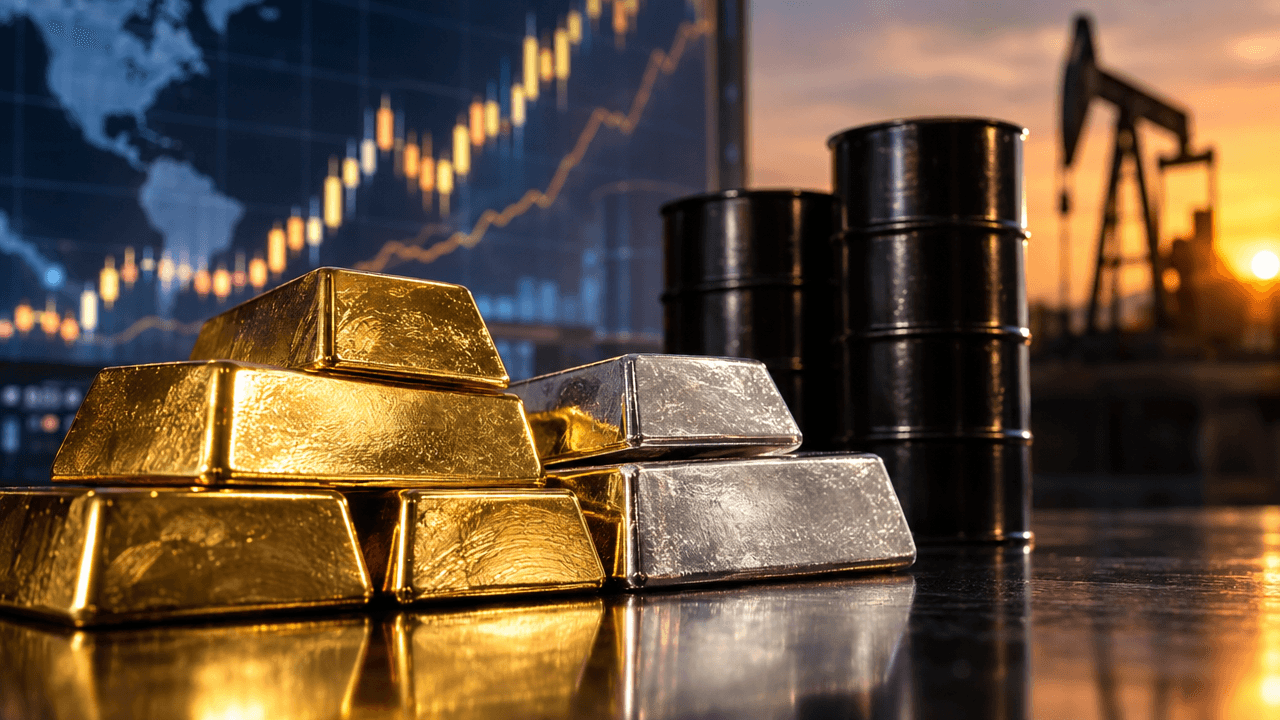
Gold and silver futures are pushing higher as traders rush to rebuild inflation and policy hedges in the wake of a sharp surge in crude oil prices[2][15]. The move in precious metals is unfolding alongside elevated U.S. Treasury yields, signaling a broader repricing of both inflation risk and the odds of a more hawkish Federal Reserve stance across macro markets[11][13]. For traders, this is a classic moment where seemingly separate markets—energy, rates, and metals—are suddenly moving in the same narrative.
Market Backdrop: Oil Surge, Inflation Fears, And The Fed
Rising oil prices act as a tax on the global economy, pushing up production and transportation costs and feeding directly into headline inflation[4][7]. Recent research shows that every 10% increase in global oil inflation can raise domestic inflation by roughly 0.4 percentage points in the near term, underlining why central banks watch crude prices so closely[4]. When oil spikes, markets quickly reassess how long policy rates may need to stay restrictive, and whether additional tightening is on the table[4][13].
The latest oil rally has done exactly that: it has revived expectations that the Federal Reserve may have to keep rates higher for longer, or even consider another hike if inflation data re-accelerates[13][14]. Higher energy costs are limiting the Fed’s room to pivot toward cuts, since doing so too soon risks unanchoring inflation expectations[13]. U.S. Treasury yields, particularly on the 10- and 30-year maturities, have pushed toward multi-year highs as investors demand greater compensation for holding nominal bonds in an environment of renewed inflation and policy uncertainty[11][13]. This combination—oil up, yields up, inflation risk up—is what is driving demand for hedges in metals futures.
Why Gold And Silver Respond To Oil And Policy Risk
Gold’s reputation as an inflation hedge is more nuanced than many assume. Historically, gold has been less about hedging inflation mechanically and more about hedging the risk that the institutions meant to control inflation—central banks—fail in that mission[3]. When traders believe the Fed could fall behind the curve, or that inflation might prove stickier than policymakers expect, gold tends to attract capital as a store of value and as a hedge against policy credibility risk[3][12].
In the current environment, the oil surge raises the probability of exactly that kind of policy challenge, even as higher yields increase the opportunity cost of holding non-yielding assets like gold and silver[11][13]. Normally, rising real yields pressure precious metals lower because investors can earn more on safe, interest-bearing instruments[11]. Yet metals can still rally if defensive and inflation-hedging demand outweighs that yield headwind, particularly when geopolitical risks around energy supply—such as tensions in the Strait of Hormuz—drive crude above psychologically important levels like $100 per barrel[14][15]. This is why recent sessions have seen gold and silver futures bounce despite firm yields and lingering expectations of Fed hawkishness[2][15].
Silver adds another dimension. It is both a monetary metal and an industrial commodity, with demand tied to manufacturing, solar, and electronics. In periods of energy-driven inflation, silver can respond not only as a hedge but also to expectations of higher input costs and potential disruptions in industrial supply chains[2][4]. That dual character often makes silver more volatile than gold, amplifying its response to macro shocks.
How Futures Markets Express These Hedges
For professional and active traders, gold and silver futures are among the most efficient vehicles for expressing views on inflation, policy, and risk sentiment. Futures on major exchanges offer deep liquidity, tight spreads, and standardized contract sizes, making them suitable for both directional trades and portfolio hedges. In episodes like the current oil surge, traders may buy gold futures to hedge equity or bond portfolios they expect to suffer if inflation stays higher and the Fed remains restrictive.
One common macro expression is a long-gold position paired against risk assets that are sensitive to higher real yields and tighter policy, such as growth equities or high-yield credit. If inflation and policy risk materialize, the pain in those risk assets can be offset by gains in the gold hedge. Silver futures can be used similarly, though traders must account for its higher volatility and industrial linkages. Another approach involves relative-value trades: for example, going long gold futures while shorting oil futures if a trader believes that the inflation shock is already priced into energy but not yet fully into metals.
Futures also allow for nuanced term-structure views. Traders can choose between near-dated contracts to capture short-term risk events—such as upcoming inflation prints or Fed meetings—and longer-dated contracts to position for structural shifts in inflation and policy. Margining and leverage make risk management critical in this context, which is why simulated finance environments are valuable for testing these strategies before committing real capital.
Using Simulated Finance To Navigate Fed And Inflation Risk
For traders learning to navigate these cross-asset dynamics, a simulated finance (SimFi) platform can serve as a risk-free laboratory. In a simulation, traders can build hypothetical portfolios that combine gold and silver futures with oil and rates exposures to see how different scenarios—such as a sustained oil shock or a surprise dovish turn by the Fed—affect performance.
One scenario could involve modeling a sustained Brent crude price above $100, alongside rising Treasury yields and a delayed peak in inflation. Traders can observe how a long gold futures position cushions the portfolio relative to a pure equity or bond allocation. Another scenario might test the opposite: oil rolling over, inflation easing, and the Fed signaling eventual cuts. In that environment, gold’s defensive premium may fade, and simulated trades can reveal how quickly metals can give back gains when real yields move higher or policy risk recedes[11][12].
By experimenting in a simulated setting, traders can learn where gold and silver hedges genuinely add value and where they simply add volatility. They can also stress-test position sizing, margin calls, and drawdown limits, building rules that are robust to the kinds of macro shocks that oil and inflation often produce.
Practical Takeaways For Traders
First, treat gold and silver as hedges against policy and credibility risk as much as against inflation itself. When oil-driven inflation raises questions about the Fed’s ability to keep prices stable without damaging growth, metals tend to respond[3][4][12].
Second, remember that higher real yields are a structural headwind for precious metals. A rally in gold or silver during periods of rising yields usually reflects strong defensive or geopolitical demand; such moves can reverse quickly if risk sentiment stabilizes or the policy outlook becomes clearer[11][13][15].
Third, watch the triangle of crude, yields, and central bank expectations. Oil spikes that push inflation higher, yields up, and Fed hike odds stronger are precisely the conditions where metals hedging becomes relevant[4][7][13]. When any one of those legs weakens—oil falls, yields stabilize, or the Fed’s stance looks more predictable—the case for aggressive metals hedging becomes less compelling.
Fourth, use futures for targeted, time-bound hedges rather than permanent allocations. Align contract expiries with the risk windows you care about, such as key data releases or policy meetings, and size positions conservatively to manage leverage.
Conclusion: Navigating An Oil-shocked Macro Landscape
The current rise in gold and silver futures reflects a market wrestling with dual shocks: an energy-driven inflation impulse and the prospect of a Fed that may need to stay hawkish longer than previously thought[2][4][13][15]. Elevated yields, repriced rate expectations, and surging crude prices have created a backdrop where traders are willing to pay for protection against both inflation and institutional missteps.
For traders and investors, the key is to understand what metals are actually hedging at any given moment and to integrate that understanding into a disciplined, scenario-driven approach. Using futures—ideally tested first in a simulated environment—offers a flexible way to navigate this oil-shocked landscape without overexposing portfolios to any single macro narrative. As long as energy prices and policy uncertainty remain elevated, gold and silver will likely stay central to the conversation about how to hedge Fed risk and inflation in modern markets.