
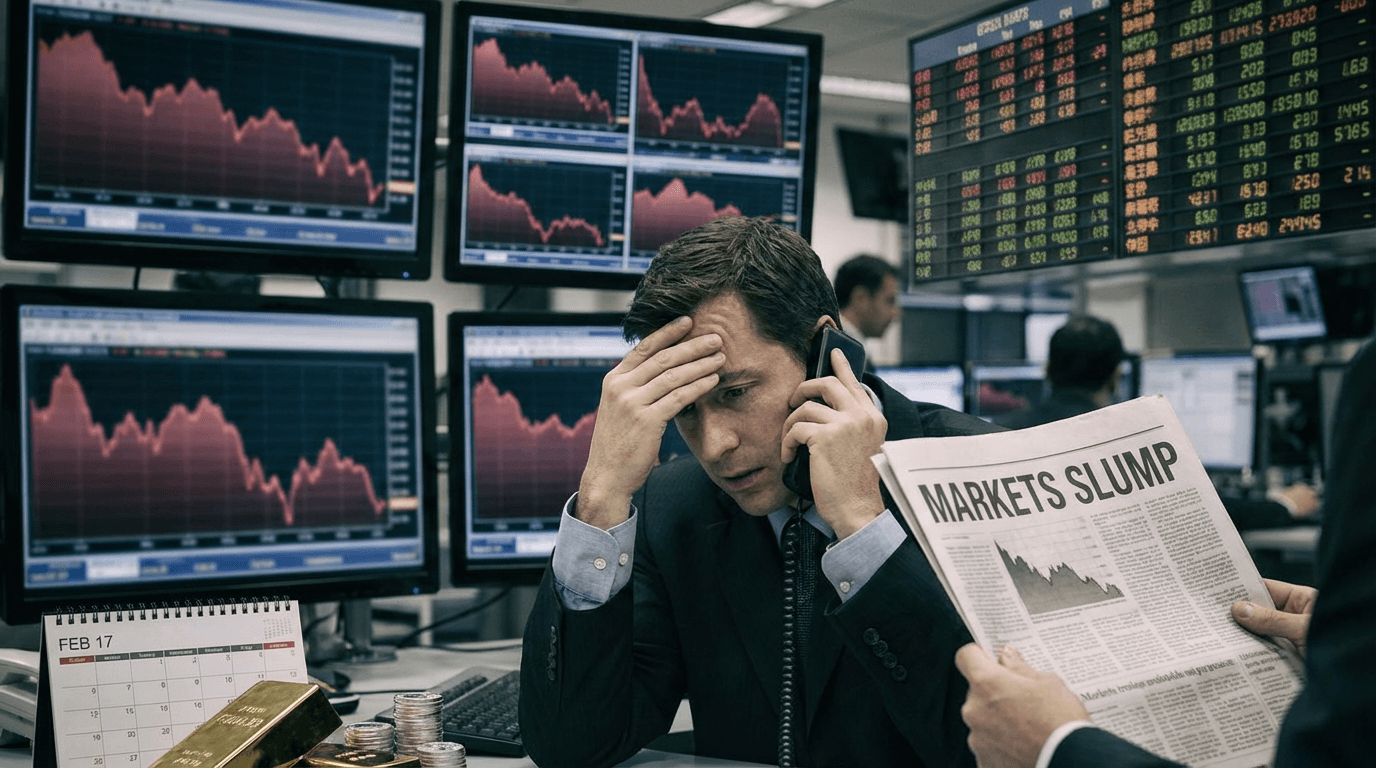
On Tuesday, February 17, 2026, the precious metals market experienced a significant downturn, with both gold and silver registering notable losses. Investor sentiment shifted, and broader market forces applied downward pressure on commodity prices. Silver led the downturn with a sharper decline, while gold also retreated from its recent highs, hinting at a potential turning point in the precious metals rally that has defined much of early 2026.
### THE MAGNITUDE OF TODAY'S DECLINE
Today's selloff was significant enough to catch the eye of market observers closely monitoring precious metals. Silver's price plummeted approximately 4 to 6%, varying based on the time of day and data sources, with spot prices dipping to $72.44 per ounce, testing critical support levels. Gold's decline was slightly more moderate but still substantial, with prices dropping 2.5 to 3.35% and reaching intraday lows around $4,858 before recovering slightly as the trading session progressed. These losses mark the weakest levels seen in roughly 11 days, as both commodities revisited key technical support zones after a brief recovery from a severe selloff on January 31.
The timing of this decline is particularly noteworthy given the strong year-to-date performance of both metals. Despite today’s weakness, gold remains about 66% higher than it was a year ago, while silver has surged nearly 130% over the same period. This context is crucial for investors assessing whether today’s decline is a temporary pullback or signals a more significant shift in market direction.
### WHY ARE PRECIOUS METALS FALLING?
Several factors contributed to today’s sharp decline across the precious metals complex. A significant driver appears to be a rebound in the U.S. dollar, which generally moves inversely to precious metals prices. As the dollar strengthens, commodities priced in dollars become more expensive for international buyers, potentially reducing demand and exerting downward pressure on prices.
Beyond currency dynamics, broader market forces are also at play. The selloff reflects ongoing sector rotations and market declines occurring across various asset classes, not just precious metals. This suggests a shift in investor risk appetite, possibly towards different areas or into cash positions as market participants reassess their portfolios.
Supply and demand dynamics also warrant attention. While industrial demand and constrained supply have supported prices for much of 2026, today’s decline indicates these supportive factors may be temporarily overshadowed by other market considerations. Silver, in particular, is more responsive to economic trends due to its industrial applications, which may explain why silver experienced a steeper fall than gold today.
### UNDERSTANDING THE DIFFERENCE: GOLD VS. SILVER VOLATILITY
Understanding the different volatility profiles of precious metals is crucial. Gold is typically the least volatile among major precious metals, serving as a more stable store of value and portfolio hedge. In contrast, silver can undergo significant price swings within a single trading day, making it more sensitive to changing market conditions and economic sentiment.
Today’s price action highlighted this difference. While gold retreated about 2.5 to 3%, silver’s steeper 4 to 6% decline underscores its characteristic tendency towards more dramatic moves. This volatility profile has important implications for how investors should approach allocating between these two metals, aligning with their risk tolerance and investment objectives.
### WHAT THIS MEANS FOR INVESTORS
For investors holding positions in precious metals, today’s decline underscores several key considerations. First, despite their reputation as safe-haven assets, precious metals are not immune to market volatility. Price pullbacks are a normal aspect of participating in these markets, even when longer-term trends remain positive.
Second, the substantial year-over-year gains in both metals—66% for gold and 130% for silver—suggest today’s pullback might represent profit-taking or a healthy consolidation rather than a reversal of the fundamental factors supporting higher prices. Investors who believe in the longer-term case for precious metals might view dips as opportunities rather than warnings.
Third, the stark difference in volatility between gold and silver highlights the importance of aligning your precious metals allocation with your investment profile. Conservative investors seeking portfolio stability might prefer gold’s relative steadiness, while those with a higher risk tolerance might accept silver’s volatility in exchange for potentially greater upside during rallies.
### KEY TAKEAWAYS FOR TRADERS AND INVESTORS
Today’s sharp decline in precious metals prices serves as a reminder that all assets experience periods of weakness, regardless of their fundamental appeal. The 2.5% to 3% decline in gold and the steeper 4% to 6% drop in silver reflect normal market dynamics as different sectors and assets compete for investor capital.
For those considering precious metals investments, today’s price action should prompt careful evaluation of your time horizon, risk tolerance, and portfolio objectives. Whether you’re considering a gold IRA, physical metals, or commodity ETFs, understanding how these assets behave during volatile periods is essential for long-term success. The broader context—with gold up 66% and silver up 130% year-over-year—suggests that despite today’s weakness, the fundamental case for precious metals exposure remains compelling for many investors.