
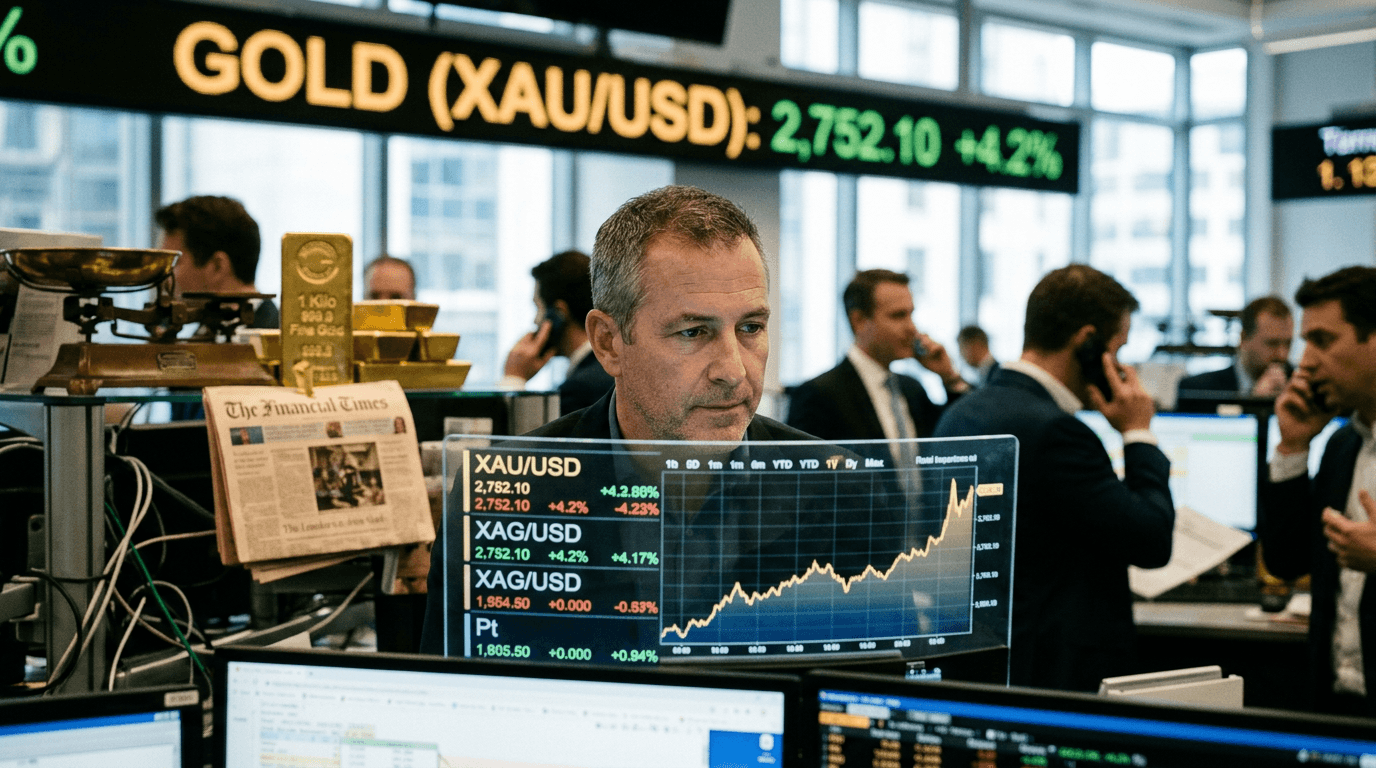
Gold remains firmly entrenched above the $4,700 per ounce milestone, marking a significant psychological and technical level that underscores the precious metal's powerful bullish momentum in 2026. With spot gold having already reached record highs above $4,749 and analysts projecting further upside to $4,800-$5,000 by mid-year, the drivers behind this sustained strength deserve careful examination. The interplay between safe-haven flows, currency dynamics, and central bank activity creates a compelling backdrop for understanding gold's current trajectory and what it means for market participants seeking inflation hedges and portfolio diversification.
Safe-haven Demand Fuels Record Prices
The rally in precious metals reflects a fundamental shift in investor sentiment driven by escalating geopolitical tensions. When uncertainty grips global markets, capital flows into assets perceived as safe stores of value. Gold, with its historical role as a non-correlated hedge and its immunity to counterparty risk, naturally benefits from this flight to safety. Recent tensions between the United States and Europe over Greenland control, combined with evolving Middle East dynamics, have consistently reignited demand for bullion among institutional and retail investors alike.
This safe-haven premium is not merely speculative. Market participants are genuinely concerned about headline risks and their potential to disrupt financial stability. Unlike equities or bonds that depend on issuer solvency or economic stability, gold offers a tangible alternative that has preserved purchasing power through countless crises. As geopolitical uncertainty persists without clear resolution, expect continued capital allocation toward precious metals as insurance against tail risks.
The Dollar Weakness Advantage
A weaker US dollar represents another critical pillar supporting gold's ascent above $4,700. As the dollar index approached 98 on recent trading, down meaningfully from stronger levels earlier in the cycle, commodities priced in dollars became more attractive to international buyers. When the greenback weakens, foreign investors effectively receive a price discount on gold and other dollar-denominated commodities, spurring demand from Asia, Europe, and emerging markets.
This relationship works both ways. Sustained dollar weakness typically occurs during periods of economic uncertainty or when capital flees lower-yielding assets. Since gold yields nothing but offers optionality during crises, it becomes the preferred alternative when real yields compress. Current market expectations for lower US interest rates have further pressured the dollar while making gold's zero-yield characteristic less of a drawback compared to falling-yield bonds.
Central Bank Buying Provides Structural Support
Behind the headline price moves sits a powerful structural force often overlooked by retail traders: central bank accumulation. The People's Bank of China and other monetary authorities worldwide have maintained substantial gold-buying programs, providing a persistent bid under the market. This central bank demand is distinct from speculative flows and tends to be less volatile, creating a floor beneath price movements.
When central banks buy gold, they do so for long-term strategic reasons, not for trading profits. They seek to diversify reserves away from dollar exposure, hedge against inflation, and strengthen balance sheets. This institutional-grade demand provides confidence to private investors that the precious metal maintains intrinsic value beyond fleeting sentiment swings. The combination of Chinese retail investment appetite, ETF inflows from Western markets, and official central bank accumulation creates a three-part demand engine that has proven remarkably resilient.
Crowded Trade Concerns And Risk Management
Despite the bullish fundamentals, some market observers have raised caution flags. A Bank of America survey showed that many fund managers consider gold the "most crowded trade," meaning significant capital is already positioned for continued strength. When positions become this concentrated, the risk of sudden reversals increases. Any de-escalation of geopolitical tensions, a strengthening dollar, or higher-than-expected interest rates could trigger profit-taking and quick drawdowns.
Successful traders and investors should maintain perspective on these extremes. While the uptrend remains intact and fundamentals support higher prices, entering positions late in crowded moves carries elevated risk. Position sizing, trailing stops, and clear risk management protocols become essential when assets reach historic price levels with concentrated bullish positioning.
Key Considerations For Market Participants
Those seeking to engage with gold at current levels should consider multiple timeframes and entry strategies. Longer-term investors focused on portfolio protection and inflation hedging may find current prices justified despite near-term volatility risks. Traders hunting for short-term gains should wait for pullbacks or technical confirmation before initiating new longs. Both approaches have merit depending on individual risk tolerance and investment objectives.
Monitor three critical variables going forward: geopolitical headline developments, dollar strength indicators via the DXY, and central bank commentary regarding interest rates. These factors will likely determine whether gold consolidates around current levels or advances toward $5,000 as some projections suggest.
Conclusion
Gold's sustained position above $4,700 reflects genuine macroeconomic and geopolitical concerns rather than speculative excess alone. Safe-haven flows, dollar weakness, and central bank support form a credible foundation for the rally. However, the acknowledgment of crowded positioning and stretched valuations argues for selective entry strategies rather than indiscriminate accumulation. For investors and traders, the golden rule remains unchanged: understand your time horizon, manage risk ruthlessly, and maintain flexibility as circumstances evolve.