
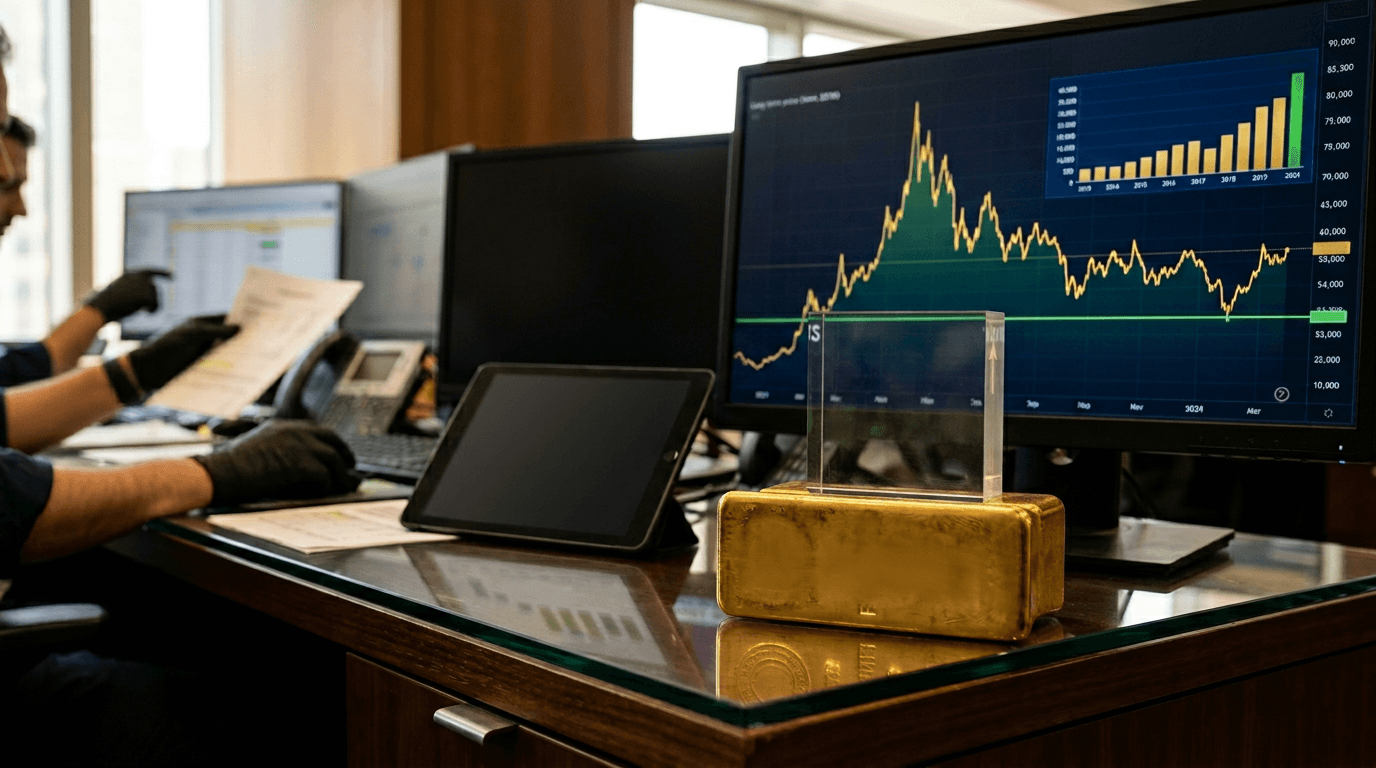
Gold has reached a pivotal moment in 2026, finding robust support at the psychologically significant $5,000 per ounce level. This milestone represents far more than just a round number—it marks a convergence of technical confluence, fundamental structural demand, and safe-haven flows tied to escalating geopolitical tensions in the Middle East. As traders and investors navigate an increasingly uncertain global landscape, gold's ability to hold this level while advancing toward new record highs demonstrates its enduring value as both a strategic portfolio hedge and a barometer of systemic risk.
THE SIGNIFICANCE OF $5,000 AND TECHNICAL CONFLUENCE
The $5,000 level carries substantial weight in the current gold cycle. According to recent market analysis, this price point aligns with critical Fibonacci retracement levels that technical traders use to identify support and resistance zones. The fact that gold has repeatedly found buying interest near this level—despite periodic pullbacks—signals that institutional players view it as a genuine floor for further upside exploration. Goldman Sachs raised its 2026 gold forecast by $500 to reach $5,400 per ounce, reflecting conviction that current price levels represent the early-to-middle stages of an extended bull market rather than a local top.
Technical analysis shows that support layers below $5,000 remain well-defined, with key levels identified at $4,650-$4,360 range serving as secondary support before the historical floor near $3,450. This layered support structure provides traders with identifiable risk-management points while signaling that pullbacks may represent buying opportunities rather than trend reversals. The trend remains decisively higher, supported by both technical indicators and fundamental drivers that show no signs of abating.
Safe-haven Flows And Geopolitical Risk Premium
The Middle East safe-haven demand represents a critical component of gold's current strength. Disruptions in the Hormuz region and broader regional tensions have elevated the risk premium investors demand to hold traditional assets like equities and bonds. Gold, by contrast, benefits from these geopolitical flashpoints because it carries no counterparty risk, requires no credit assessment, and maintains purchasing power across borders and political regimes. When investors fear military escalation or economic sanctions, they turn to gold as a currency-neutral store of value that operates outside conventional financial systems.
This safe-haven bid is distinct from other bull market drivers and tends to persist as long as uncertainty remains unresolved. Unlike rate-sensitive flows or trend-following momentum, safe-haven demand reflects a genuine shift in portfolio positioning toward assets that retain value during crisis scenarios. The current environment—characterized by multiple overlapping risk factors including policy uncertainty, fiscal strain, and regional conflicts—provides precisely the conditions that historically create sustained safe-haven demand.
Structural Demand From Central Banks And Institutions
Beyond safe-haven flows, gold continues to benefit from unprecedented structural demand from multiple sources. Emerging-market central banks maintain a relentless buying pace of approximately 60 tonnes per month, viewing gold as a strategic reserve asset that reduces dependence on U.S. dollar holdings. Simultaneously, Western gold ETFs have restarted accumulation after several years of net outflows, capitalizing on reduced carry costs as the Federal Reserve pursues rate cuts. Morgan Stanley analysts noted that strong ETF demand is absorbing limited inventories after years of supply deficits, creating a structural supply-demand imbalance that supports higher prices.
This institutional repositioning reflects a fundamental reassessment of gold's role in global finance. Rather than viewing gold as merely a speculative commodity, major financial institutions and central banks now treat it as a strategic macro hedge in an uncertain world. Gold has become central to diversification strategies for entities managing systemic risk, making the current cycle distinct from previous bull markets driven primarily by inflation concerns or currency devaluation.
The Dollar Dynamic And Rate Cut Expectations
The weakening U.S. dollar provides additional tailwind for gold prices, as dollar-denominated assets become more expensive for holders of other currencies. Historical data demonstrates that currency dynamics rank among gold's most reliable price drivers, and the current environment shows no exception. Anticipation of Federal Reserve rate cuts further reduces the opportunity cost of holding non-yielding assets like bullion, making gold more attractive relative to fixed-income alternatives.
Forward Outlook And Analyst Expectations
The consensus among major Wall Street forecasters points toward continued strength for gold through 2026. JPMorgan targets $5,055 in the final quarter, Goldman Sachs forecasts $5,400, and Societe Generale projects gold could reach $6,000 by year-end. These targets, while ambitious, reflect recognition that current conditions—macroeconomic instability, record central bank buying, currency uncertainty, and geopolitical risk—provide structural support for prices well above historical averages.
Analysts emphasize that while consolidation or modest pullbacks may occur, a sustained downturn appears unlikely given the fundamental drivers in place. Gold remains in the early innings of a longer structural cycle, with the debasement trade still in its initial phases. For investors, this suggests maintaining exposure to precious metals as portfolio diversifiers while using any pullbacks toward support levels as accumulation opportunities rather than exit signals.
Gold's holding pattern at $5,000 reflects the complex interplay between technical support, safe-haven demand, and structural institutional buying. The convergence of these factors creates a compelling foundation for continued strength as the year progresses.