
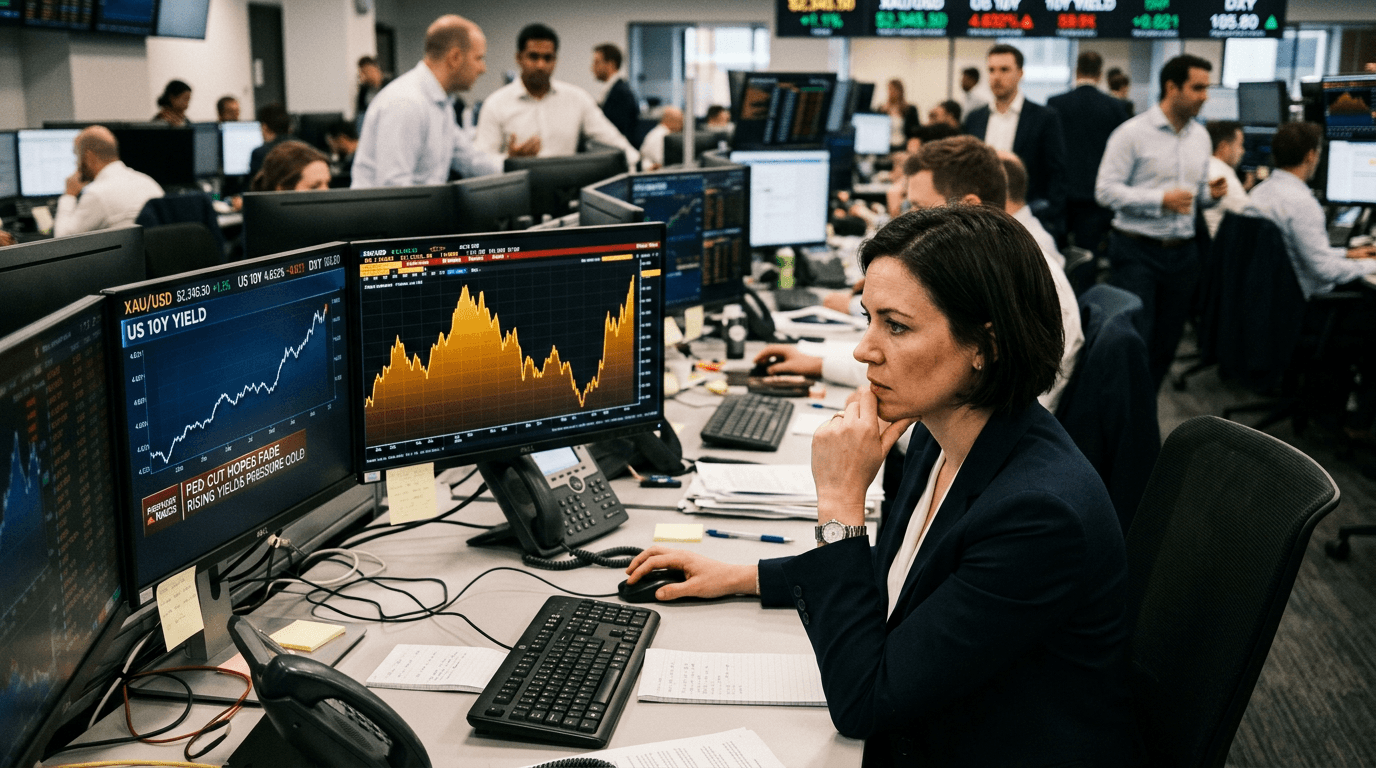
Gold is catching a bid again as investors rotate into defensive assets, but the metal is still poised to break its four-week winning streak. Rising geopolitical tension in the Middle East and a sharp rally in oil have revived safe-haven demand, helping gold futures recover from the previous session’s slide. Yet mounting inflation worries, higher bond yields, and fading expectations for aggressive Federal Reserve rate cuts are capping the upside and introducing genuine two-way risk for bullion traders.
WHAT’S DRIVING THE LATEST GOLD REVERSAL?
This week’s gold price action is a study in competing forces.
On one side, traditional safe-haven drivers are firmly in play. Headlines out of the Middle East have pushed traders to pare back risk in equities and credit, while the spike in crude oil prices has reinforced fears of broader economic and geopolitical instability. In this environment, capital often moves toward assets perceived as stores of value or portfolio insurance, and gold is typically near the top of that list.
On the other side, the macro backdrop is far from supportive. The recent surge in oil is stoking concerns that inflation may re-accelerate or at least prove stickier than previously assumed. That’s nudging Treasury yields higher as markets reprice the path of future interest rates. When yields rise, especially real (inflation-adjusted) yields, the opportunity cost of holding a non-yielding asset like gold increases. That tends to weigh on prices or at least blunt safe-haven rallies.
The result is a recovery in gold from short-term oversold levels, but not enough strength to avoid the first weekly decline in five weeks. For traders, the signal is clear: gold is no longer trading on a single dominant narrative.
SAFE-HAVEN FLOWS VS. YIELD AND DOLLAR HEADWINDS
Understanding the push-and-pull between safe-haven flows and yield dynamics is critical for anyone trading or allocating to gold.
When geopolitical risk spikes or financial markets wobble, institutional and retail investors often increase exposure to gold as a hedge against tail events. This can take the form of futures, ETFs, or even physical purchases by central banks and long-term allocators. These flows typically show up as sharp intraday or multi-session rallies, particularly when equity indices are under pressure.
However, this safe-haven support is now running into strong resistance from higher yields and a firm US dollar. As inflation concerns build, traders are scaling back expectations for aggressive or rapid Fed easing. Fed funds futures are shifting toward a “higher for longer” stance, or at minimum, a slower pace of cuts than markets were pricing earlier in the year. That repricing pushes nominal yields up and often lifts the dollar as well.
A stronger dollar makes gold more expensive for non-US buyers and tends to suppress demand at the margin. Combined with elevated real yields, it creates a powerful counterweight to safe-haven buying. That’s why we’re seeing days where gold pops on headlines, only to fade as the rates and FX markets reassert themselves.
Key takeaway: in the current regime, geopolitical headlines may drive the intraday direction, but yields and the dollar are anchoring the broader trend.
HOW RATE EXPECTATIONS ARE SHAPING GOLD’S PATH
Gold’s medium-term trajectory is increasingly tied to how the market interprets the Fed’s reaction function in a world of conflicting signals: slower growth risks on one side and renewed inflation pressures on the other.
If oil-driven inflation fears persist, bond markets are likely to keep pricing out aggressive rate cuts. That supports higher yields and a stronger dollar, both of which are traditionally negative for gold. In this scenario, rallies driven by risk aversion could struggle above recent highs, and the market may gravitate toward range-bound trading with a modest downside bias.
Conversely, if economic data begin to soften materially—particularly labor market or consumer data—markets may swing back toward expecting more decisive easing. Real yields could roll over, and the dollar could lose some altitude. Under that backdrop, today’s safe-haven flows would have far more room to express themselves, potentially reigniting a sustained uptrend in gold.
For active traders, watching the following indicators can be more useful than the headline price alone:
- Real yield benchmarks: Track key inflation-protected securities for direction in real rates.
- Fed funds futures: Monitor how many basis points of cuts are priced in over the next 6–12 months.
- Dollar index (DXY) or major FX pairs: A weakening dollar often unlocks upside in gold.
The interaction of these variables will likely determine whether this week’s softness is a brief pause in a broader bull trend or the start of a more extended consolidation.
Trading Implications: Volatility, Levels, And Risk Management
The clash between safe-haven demand and yield headwinds tends to produce an environment of elevated but choppy volatility. For traders, that has several practical implications.
First, intraday swings are becoming more sensitive to data releases and geopolitical headlines. Events that move rate expectations—even slightly—can flip sentiment quickly. That makes position sizing and leverage decisions critical. Overexposure into binary catalysts (Fed speeches, inflation prints, unexpected geopolitical developments) can be costly in this kind of two-way market.
Second, technical levels take on added importance as reference points amid shifting narratives. Recent swing lows and highs, major moving averages, and psychologically significant price zones act as magnets for flows and as areas where liquidity tends to concentrate. Breaks, holds, or false moves around these levels often signal whether safe-haven buyers or macro sellers are in control at any given moment.
Third, strategy selection matters. Trend-following approaches that worked when gold was grinding higher week after week may now generate more whipsaws. Many traders are pivoting toward:
- Tactical mean-reversion trades around clearly defined ranges.
- Event-driven setups aligned with upcoming macro releases.
- Options structures to express directional views while capping downside.
Risk management should reflect the reality that both sharp rallies and equally sharp reversals are plausible in the same week—or even the same session.
What To Watch Next
Gold’s rebound despite heading for a weekly loss underscores a broader shift in market behavior: the metal is being pulled simultaneously by near-term fear and longer-term macro repricing.
Going forward, traders and investors should focus on three core drivers:
1) Geopolitics and oil: Further escalation in the Middle East, particularly if it threatens energy supply lines, is likely to support both inflation expectations and safe-haven demand—a complex mix for gold.
2) Inflation and growth data: Surprises in either direction will feed directly into rate expectations. Hotter inflation keeps yields elevated; weaker growth revives the case for cuts.
3) Central bank and official sector behavior: Continued gold accumulation by central banks can cushion downside and reinforce the structural bid under the market, even when speculative flows turn cautious.
Gold’s first weekly decline in five weeks is not, by itself, a trend reversal signal. Instead, it’s a reminder that the easy part of the rally—where safe-haven flows faced little macro opposition—may be behind us for now. For disciplined traders, this more balanced, two-way environment can be an opportunity, provided they respect volatility, watch the rates and dollar backdrop closely, and remain flexible in their positioning.