
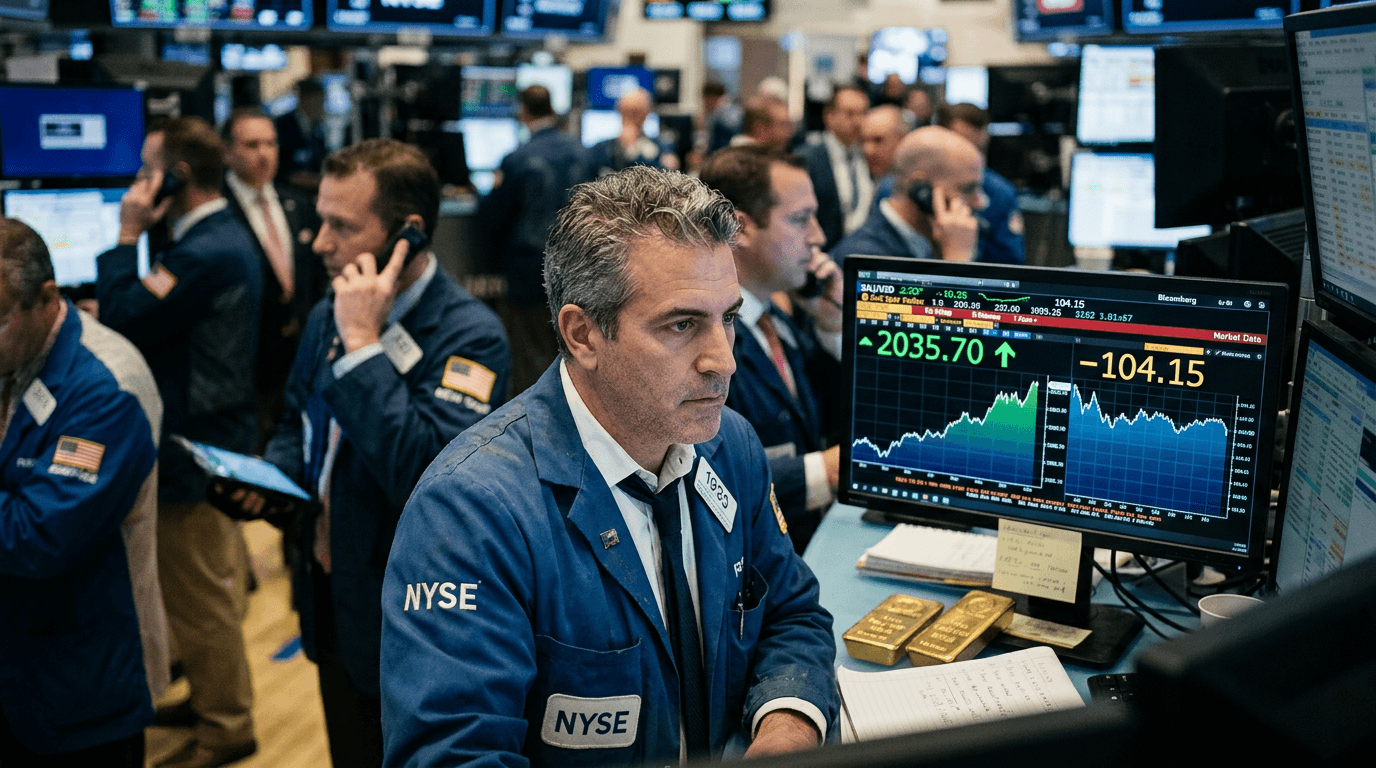
Gold is holding its ground as safe-haven demand stays elevated, even while the US dollar consolidates recent gains after a sharp rally.[6][5][8] This dynamic is reinforcing gold’s status as a core hedge in multi‑asset portfolios and is shaping how traders position across FX and rates markets.[6][13][14]
Market Backdrop: Geopolitics, Risk Sentiment And Gold
Tensions in the Middle East, particularly the US‑Israel–Iran axis, have kept geopolitical risk at the forefront of market pricing and driven a persistent bid for traditional safe havens.[2][4][6][7][10][13] Gold has been one of the main beneficiaries, with spot prices holding above the psychologically important $5,000 level, a zone that has acted as both technical and psychological support in 2026.[8][14]
News of military strikes and intensifying conflict has repeatedly sparked inflows into gold, sending prices toward and even above the $5,400 area as investors sought protection from tail‑risk scenarios.[6][9][10] At the same time, investors have rotated out of more volatile assets such as equities and crypto into gold, reinforcing its role as a portfolio stabilizer during episodes of heightened uncertainty.[13][14]
Importantly, this safe‑haven behavior is not a one‑off reaction; gold has been trending higher for more than a year, supported by central bank buying, ETF inflows, and expectations of a more accommodative US monetary stance.[6][10][14] The current geopolitical shock is therefore amplifying an existing bullish structure rather than creating it from scratch, which helps explain why gold has remained firm even as other macro drivers fluctuate.[8][14]
GOLD’S SAFE-HAVEN ROLE VS THE DOLLAR’S CONSOLIDATION
Typically, gold and the US dollar move inversely: a stronger dollar makes dollar‑denominated gold more expensive for non‑US buyers and often weighs on prices.[1][3][5] Recent trading has followed that pattern at times, with rising Treasury yields and a firmer dollar capping upside and triggering intraday pullbacks in gold.[2][3][5][11]
However, the more notable development is that gold has not significantly broken down despite the dollar consolidating its recent gains.[5][8] Safe‑haven buying has offset much of the dollar headwind, allowing gold to hold firm rather than retrace sharply.[6][8][13] In other words, risk hedging demand is strong enough that investors are willing to own gold even at elevated price levels and despite less favorable FX translation.
Structural flows are part of the story. Analysts note that BRIC and other emerging‑market central banks have been reducing exposure to dollar‑based assets in favor of gold reserves, a trend that has underpinned the metal’s longer‑term rally.[6] These official‑sector purchases, added to speculative and hedging flows from funds, help maintain a solid bid for gold even when short‑term macro factors—such as a stronger dollar or higher real yields—turn temporarily less supportive.[6][10][14]
For traders, this environment highlights a key nuance: gold is responding more to geo‑risk and structural demand than to the traditional dollar‑gold seesaw alone.[6][8][13][14] Strategies that assume a simple inverse correlation between the dollar index and XAU/USD may therefore underperform if they ignore the safe‑haven and central‑bank components of the current move.
Fx, Rates And Cross-asset Positioning
The dollar’s recent rally has been driven by rising US yields, resilient economic data and bursts of risk aversion, followed by a period of consolidation as traders reassess the path of Federal Reserve policy.[3][5][10][11][14] Higher yields and lingering rate‑hike or “higher‑for‑longer” expectations typically weigh on gold by increasing the opportunity cost of holding a non‑yielding asset.[5][10][11]
Yet the Middle East conflict has introduced inflation and growth uncertainty, complicating the outlook for rates and FX.[2][5][10][12] On the one hand, potential energy shocks could lift inflation and keep nominal yields supported.[5][12] On the other, downside risks to global growth and risk sentiment can pull investors into both the dollar and gold as parallel safe havens.[3][6][10][13]
This two‑pronged risk hedge is visible in elevated demand for both assets, even as the dollar’s upward momentum has paused.[4][5][8] In FX, that translates into pressure on risk‑sensitive currencies and EM FX, while core rates markets are seeing positioning that balances inflation concerns against the possibility of future Fed easing.[10][11][14]
For macro and multi‑asset traders, the key implication is that gold is now part of a broader defensive toolkit that includes the dollar, long‑duration government bonds, and volatility hedges.[6][10][13][14] Correlation structures can shift quickly in such regimes, so monitoring cross‑asset relationships—gold vs real yields, gold vs oil, gold vs high‑beta FX—becomes essential for both directional and relative‑value strategies.
Trading Implications: Levels, Technicals And Risk Management
From a technical perspective, gold’s price action still reflects a constructive bias.[8][14] XAU/USD is trading within an ascending channel, holding above its rising 50‑day exponential moving average and consolidating after reclaiming shorter‑term moving averages.[8] Momentum indicators such as the 14‑day RSI sit in mid‑range territory, signaling steady buying pressure without extreme overbought conditions.[8]
Upside, the market may test the upper boundary of the channel around the $5,470 area, with the prior all‑time highs near $5,598 acting as a longer‑term reference point.[6][8] On the downside, immediate support sits around the short‑term EMA zone near $5,160, followed by the lower channel boundary around $5,070 and the major psychological level at $5,000.[8][14] These levels provide clear landmarks for traders planning entries, stop‑loss placements and profit‑taking.
Given the headline‑driven nature of current moves, risk management is critical. Intraday volatility can spike on geopolitical news, economic data or Fed commentary, making position sizing and disciplined use of protective stops essential.[2][3][5][10][14] Traders should also remain aware of the potential for “whipsaw” action when safe‑haven flows, dollar strength and yield shifts collide in short timeframes.
For FX traders, gold’s resilience offers opportunities in relative‑value trades—such as pairing long gold exposure with short positions in high‑beta or commodity‑linked currencies that are more vulnerable to geopolitical shocks.[10][13][14] Rates traders, meanwhile, can use gold as a complementary hedge against scenarios where inflation risk resurfaces even as growth uncertainty limits the scope for aggressive tightening.
Applying These Insights In A Simulated Trading Environment
For traders using simulated finance platforms, the current backdrop is an ideal setting to practice multi‑asset risk management without real capital at stake.[14] Scenario‑based strategies—testing how portfolios behave under further Middle East escalation, a sharp dollar resurgence, or a surprise shift in Fed guidance—can deepen understanding of how gold interacts with FX and rates in stress environments.[10][13][14]
By building and back‑testing strategies that incorporate gold as a core hedge alongside dollar exposure and duration positions, traders can learn to design more resilient portfolios that respond to both cyclical and structural drivers.[6][10][14] This includes experimenting with position sizing around key technical levels, adjusting exposure as volatility regimes change, and evaluating how safe‑haven flows alter correlations within their simulated portfolios.
Ultimately, gold’s ability to remain firm even as the dollar consolidates underlines its enduring role in modern risk management.[6][8][13][14] For active traders, the challenge—and the opportunity—is to translate that macro narrative into disciplined, well‑tested strategies that can navigate the complex interplay of geopolitics, policy expectations and cross‑asset flows.