
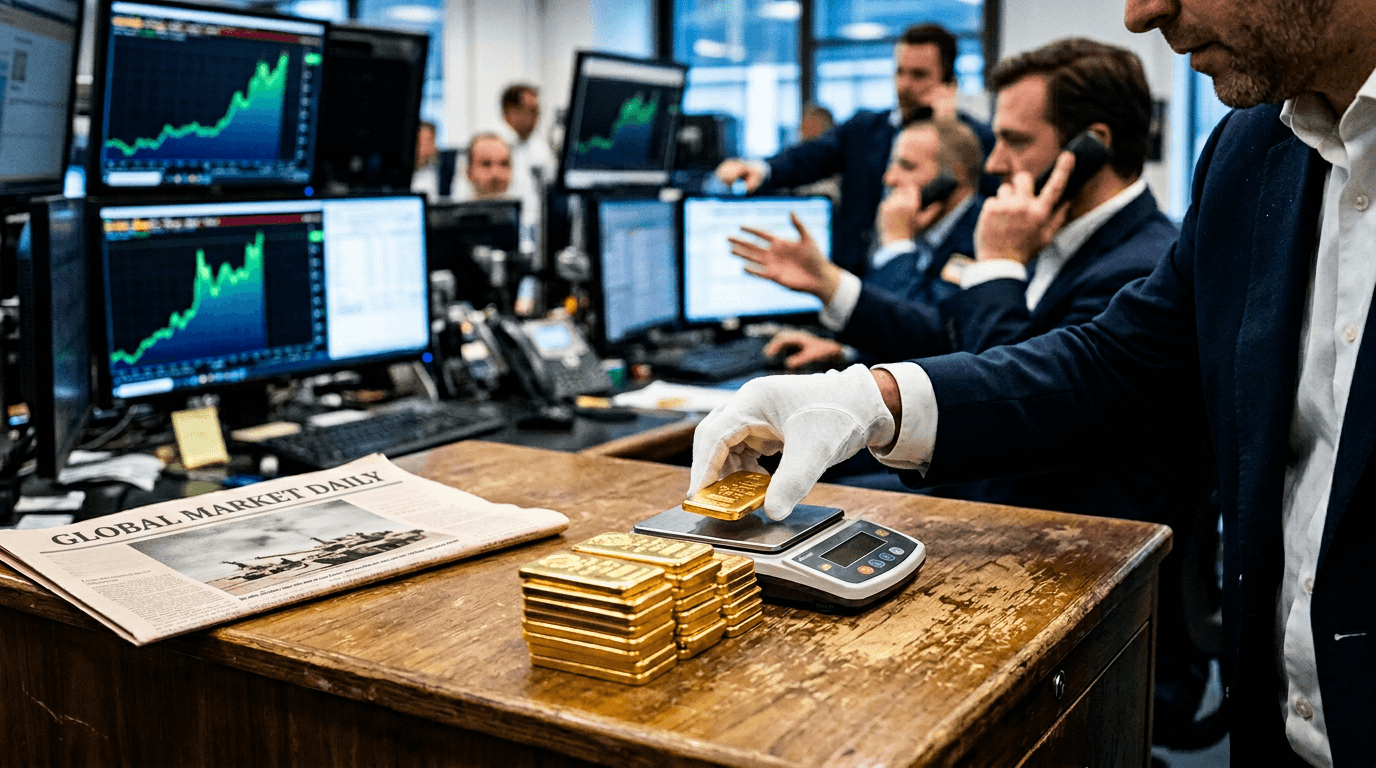
Gold prices surged dramatically on Monday as investors rushed into safe-haven assets following escalating geopolitical tensions in the Middle East. Spot gold jumped 2.2% to $5,394.26 per ounce, approaching the $5,419.32 level—a high not seen since late January—while U.S. Gold Futures climbed an impressive 3.1% to $5,410.34 per ounce. This explosive price action exemplifies precisely why gold remains the ultimate portfolio insurance during periods of uncertainty and conflict. For traders and investors monitoring precious metals markets, understanding the drivers behind this rally and the levels ahead is crucial for making informed decisions in an increasingly volatile environment.
The Geopolitical Catalyst Behind The Rally
The catalyst for gold's historic surge came over the weekend when coordinated military strikes by the United States and Israel targeted Iranian positions. This direct military engagement between world powers and a major oil-producing nation triggered immediate panic across global markets, with investors abandoning risk assets and pivoting toward tangible stores of value. The geopolitical shock was profound enough to override technical resistance levels and fundamental valuations, demonstrating that during true crisis moments, fear supersedes traditional market mechanics.
The immediate aftermath saw a classic risk-off market move across global financial systems. Equities declined sharply while crude oil surged on supply disruption concerns, creating a dual tailwind for precious metals. This combination of falling stocks and rising oil prices reinforced gold's appeal as an inflation hedge and a store of value during tumultuous periods. The shock was truly global—Indian gold markets alone saw domestic prices jump over 3,100 rupees per 10 grams in a single day, pushing rates to 1.64 lakh per 10 grams, demonstrating that this wasn't merely a Western phenomenon but a worldwide flight to safety.
Understanding Safe-haven Demand Dynamics
Safe-haven demand represents one of the most powerful and predictable forces in precious metals markets. When geopolitical or economic uncertainty spikes, investors systematically rotate from risk assets into instruments perceived as secure stores of value. Gold benefits from this dynamic on multiple levels. First, investors directly purchase physical gold, ETFs, and futures contracts seeking portfolio protection. Second, military conflicts involving major economies typically weaken risk currencies while strengthening the U.S. dollar initially, though this dynamic can reverse if the conflict intensifies.
The currency-hedge characteristic becomes particularly valuable during conflicts involving the United States. When American military actions create uncertainty about future monetary policy or deficit spending, investors seek alternatives to dollar-denominated assets. This weakness in the dollar paradoxically makes gold cheaper for international buyers, creating additional demand pressure from overseas. History demonstrates that gold averages 0.30% gains in the first week of conflicts and approximately 8.98% over a 12-month period, providing empirical evidence that geopolitical crises are persistently bullish for precious metals.
The Broader Market Context
It's crucial to understand that this rally didn't emerge from a vacuum. Gold was already experiencing a powerful bull run before the military escalation, having gained approximately 22% year-to-date through 2026. Multiple favorable factors had already created a bullish setup including persistent inflation concerns, consistent central bank buying, currency debasement fears, and ongoing macroeconomic uncertainty. Exchange-traded funds backed by physical gold had seen consistent inflows as investors sought inflation protection and portfolio diversification.
Silver participation in the rally—jumping nearly 8% alongside gold's breakout—confirmed that this was a broad-based safe-haven movement rather than isolated gold strength. When precious metals as a complex rise together on geopolitical news, it signals authentic flight-to-safety behavior rather than technical trading patterns. The combination of strong physical demand, limited new supply, and persistent macroeconomic concerns had already created a supply-demand imbalance pushing prices higher even before the latest crisis emerged.
Key Resistance Levels And Price Targets
The $5,400 per ounce level has emerged as the immediate resistance to watch for further upside moves. If buyers maintain momentum, the late-January record high of $5,595 per ounce becomes the next critical target. Market analysts are increasingly confident in targets of $5,500 to $6,000 per ounce by year-end if geopolitical tensions intensify further, with J.P. Morgan Global Research forecasting prices averaging $5,055 per ounce by Q4 2026. The technical picture remains strongly bullish with price action demonstrating virtually no retracement during the initial surge—a sign of conviction among institutional and retail buyers alike.
Trading Implications And Forward Outlook
For traders and portfolio managers, the path forward depends critically on conflict evolution. If military action remains limited and diplomatic solutions emerge quickly, gold may consolidate current gains but struggle to push substantially higher. However, if the conflict expands—drawing in additional nations, disrupting critical oil supply routes, or threatening broader regional stability—the safe-haven stampede could drive prices to historically unprecedented levels.
The asymmetry of potential outcomes currently favors gold bulls, as worst-case scenarios involving supply disruption or broader regional war would likely trigger unprecedented safe-haven demand. Meanwhile, the best-case scenario of rapid de-escalation would merely prevent further gains rather than trigger a collapse. For risk-aware investors, this favorable risk-reward dynamic reinforces gold's traditional role as essential portfolio insurance during uncertain times. As markets grapple with locked chokepoints and rising global instability, gold's extended winning streak since 1973 looks poised to continue.