
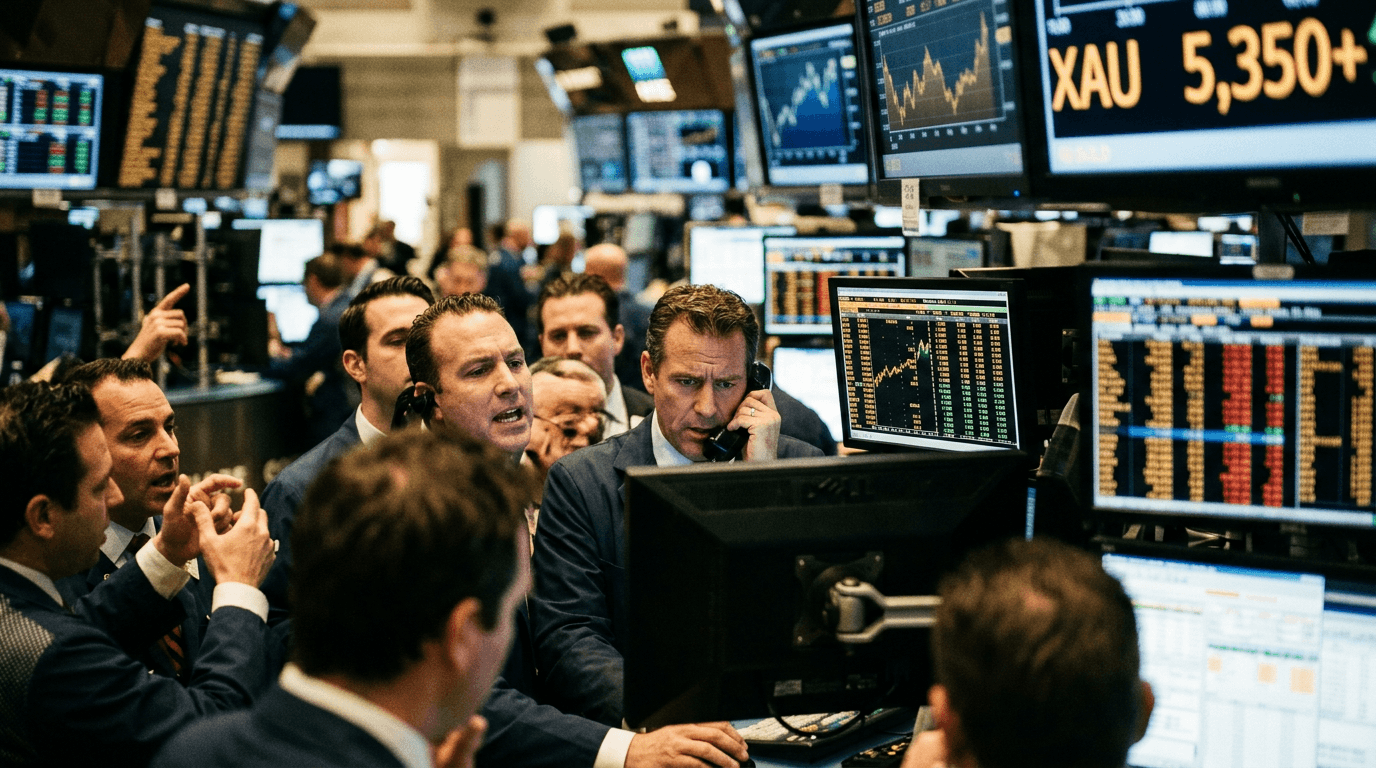
Gold prices have staged a remarkable recovery in recent trading sessions, surging past the $5,000 per ounce level as investors increasingly seek safe-haven protection amid escalating Middle East tensions. The precious metal's resilience reflects a fundamental market principle that has proven reliable across decades of trading history: when geopolitical uncertainty intensifies and traditional investment avenues appear risky, capital flows consistently redirect toward assets perceived as independent from sovereign risk and financial system stress.
This current rally carries particular significance for traders and investors navigating volatile markets in 2026. Gold has already advanced approximately 22 percent year to date, and the recent surge past $5,350 represents more than just a temporary price spike. It signals a structural shift in how institutional and retail investors view both immediate geopolitical risks and longer-term monetary dynamics.
Understanding Safe-haven Demand In Crisis Moments
Safe-haven demand emerges when investors prioritize capital preservation over yield generation. During periods of heightened uncertainty, assets that generate no cash flow—like gold—paradoxically become highly attractive. This counterintuitive dynamic reflects the reality that in severe crisis scenarios, investors will sacrifice returns to maintain portfolio stability.
The current Middle East situation exemplifies this principle perfectly. US and Israeli military strikes against Iranian targets, coupled with Iranian retaliation including missile and drone attacks across the region, have created genuine uncertainty about oil supply continuity, regional stability, and potential broader economic consequences. These fears manifest almost immediately in precious metals markets, where gold serves as the primary barometer of investor anxiety.
The speed of gold's reaction above $5,350 demonstrates how quickly capital reallocates during geopolitical shocks. When markets perceive tail risks as meaningful, defensive flows accelerate rapidly. For traders, this underscores an essential lesson: geopolitical crises rarely develop gradually. Market responses compress into compressed timeframes as information spreads and risk reassessment occurs.
The Geopolitical Premium And Escalation Scenarios
Market analysts have developed increasingly sophisticated frameworks for quantifying geopolitical risk premiums embedded in current gold prices. Based on the intensity of Middle East tensions, consensus forecasts suggest gold could trade within a range of $5,078 to $6,234 per ounce, depending on escalation scenarios and policy responses.
The base case assumes current tensions stabilize at elevated levels, allowing gold to consolidate near these higher price points after its sharp year-to-date advance. This scenario reflects market conditions where investors remain sensitive to headlines but exhibit some confidence that the situation remains contained.
However, more extreme escalation scenarios carry substantially different implications. In situations involving direct US-Iran military conflict, analysts project potential 15 percent rallies within two-week timeframes, potentially targeting $5,500 to $5,800 per ounce. Such rapid moves would reflect panic-driven capital flows into hard assets perceived as immune to geopolitical outcomes.
Understanding the distinction between these scenarios proves essential for timing trading decisions. A trader holding gold through a resolution of tensions without further escalation faces potential sharp mean-reversion moves lower. Conversely, traders positioned for further deterioration would benefit from additional rallies. The key lies in monitoring geopolitical developments and assessing which scenario markets are actually pricing.
Structural Support Beyond Headlines
While geopolitical headlines dominate short-term price action, underlying fundamentals establish support that limits downside risk and suggests gold prices may remain elevated even if immediate tensions ease.
Central banks have maintained near-record purchasing levels, with expectations for 900 to 950 metric tons of purchases in 2025. This official sector demand reflects strategic efforts to diversify reserves away from concentrated dollar holdings and hedge macroeconomic portfolio risks. Central banks recognize that gold provides valuable optionality during periods of monetary system stress or currency instability.
Dollar weakness has simultaneously supported gold prices. As markets process Middle East tensions and their implications for inflation and monetary policy, the dollar has weakened, making gold cheaper for international buyers and boosting demand from non-US investors.
The intersection of central bank accumulation, dollar weakness, and geopolitical risk premium creates a price floor for gold that extends beyond the immediate crisis. Physical demand in major trading hubs like Dubai has spiked amid supply constraints, further supporting prices.
Navigating Volatility And Inflation Concerns
A complicating factor emerges from rising oil prices stemming from Middle East tensions. These increases have disrupted traditional market relationships and prompted reassessment of inflation expectations. Markets have shifted Federal Reserve rate-cut expectations from earlier anticipated timelines to September, compressing the timeline for monetary accommodation.
This creates a complex environment where investors simultaneously anticipate higher inflation persistence and delayed rate relief—conditions historically favorable for gold accumulation. However, rising long-term Treasury yields on inflation concerns suggest some headwinds for non-yielding gold prices if geopolitical tensions unexpectedly ease.
Traders should monitor several key variables: escalation or de-escalation developments in the Middle East, incoming inflation data that might accelerate or delay Fed rate cuts, and the dollar's trajectory against other major currencies.
Actionable Takeaways For Traders
Gold's current strength reflects genuine structural support beyond headlines, but traders must recognize that geopolitical rallies can reverse sharply if tensions ease. Position sizing should reflect conviction about escalation scenarios rather than assuming current prices represent new permanent equilibriums. Watch central bank activity for signals about sustained demand, monitor crude oil prices as inflation indicators, and remain alert to unexpected de-escalation developments that could trigger mean-reversion moves.