
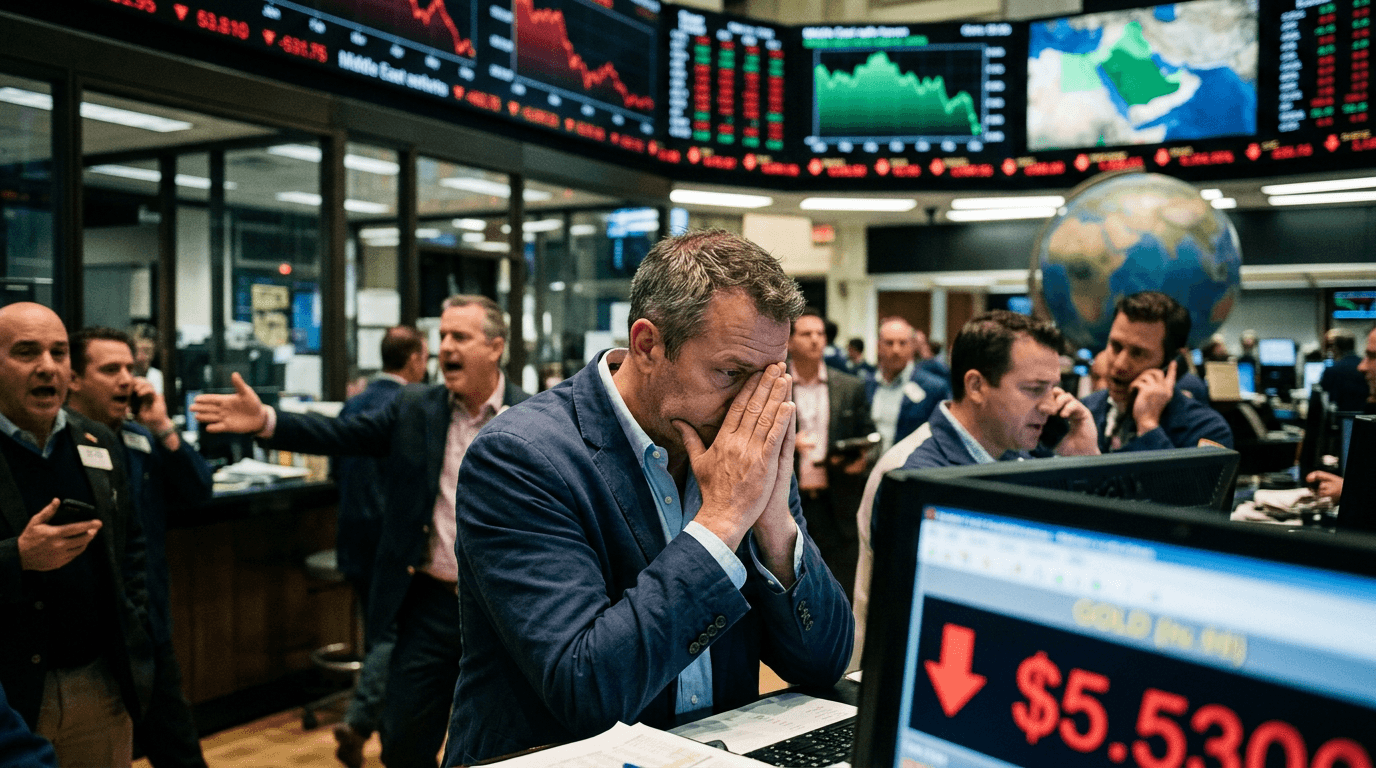
Gold’s latest pullback below the closely watched $5,300 level is a textbook example of how macro forces can collide: a surging U.S. dollar has overwhelmed the safe‑haven bid created by ongoing Middle East tensions, jolting traders who had grown accustomed to buying every dip in precious metals.[8] Instead of rushing into gold, many investors are now hedging risk through foreign exchange and cash, forcing a reassessment of what “safe haven” really means in today’s market.[5][7]
Dollar Strength Overtakes Safe-haven Demand
Gold is priced in U.S. dollars, so when the dollar rises sharply, the metal effectively becomes more expensive for buyers using other currencies, dampening demand and pressuring prices.[5][7] Recent sessions have illustrated this clearly: gold has fallen more than 1–2% on days when the dollar index and U.S. Treasury yields climb in tandem, pushing spot prices sharply lower despite geopolitical anxiety.[5][7]
The Middle East conflict has stoked fears about energy supply and inflation, traditionally supportive for gold.[5][7][13] Yet the same shock is driving investors into the dollar and short‑term cash instruments, as they seek immediate liquidity to navigate potential disruptions in growth and trade.[5] A stronger dollar becomes the “first responder” safe haven, leaving gold to play catch‑up or even trade in the opposite direction.
This dynamic is not new. Earlier in the year, gold surged past record levels above $5,300 when the dollar weakened and rate‑cut expectations were firm, reinforcing the narrative that dollar softness is one of the most powerful tailwinds for bullion.[4][6][10][15] The latest reversal below the $5,300 zone simply flips that macro backdrop: tighter financial conditions and a firmer dollar are now acting as headwinds, revealing how sensitive gold is to currency trends.
SAFE HAVENS IN COMPETITION: GOLD VS. FX
Safe‑haven flows are not monolithic; they rotate among assets like gold, the U.S. dollar, high‑quality sovereign bonds, and sometimes even defensive equities. The current environment highlights a critical nuance: in fast‑moving geopolitical episodes, investors often prioritize liquidity and flexibility over long‑duration hedges. The dollar, backed by deep FX markets and short‑term instruments, offers just that.
Recent moves show that Middle East tension has indeed generated risk‑off demand, but much of it has funneled into the dollar and cash rather than gold.[5][7] Rising oil prices and inflation worries might normally favor bullion, yet the fear that central banks could respond with tighter policy increases the appeal of interest‑bearing assets over non‑yielding gold.[5][7][13] In effect, gold and the dollar are competing safe havens, and the winner on any given day often depends on the balance between inflation anxiety and rate expectations.
For traders, this competition matters because it affects correlations. In calmer periods with dovish policy, gold and the dollar can move inversely, making gold a clean hedge against currency weakness.[4][6] In stressed, tightening environments, both can rise or fall together, or the dollar can rise at gold’s expense, undermining traditional hedging assumptions. Understanding which regime you are in is crucial for building effective defensive positions.
Implications For Gold Futures And Real-rate Expectations
Gold’s slide below key levels has immediate consequences in the futures market. As spot prices retreat, gold futures are repricing the path of interest rates and real yields, with traders reducing aggressive rate‑cut bets and acknowledging the possibility of more persistent tightness.[5][7] Rising nominal yields increase the opportunity cost of holding gold, which does not pay interest, and higher real yields (yields adjusted for inflation) historically correlate with weaker gold prices.
Recent sessions saw gold futures drop alongside a jump in benchmark 10‑year Treasury yields, as inflation worries from the Middle East met expectations that central banks would remain cautious rather than rush into easing.[7] This combination—geopolitical risk plus firm real rates—is particularly challenging for gold: the metal gains some support from fear, but loses ground to the appeal of interest‑bearing assets.
Futures traders are also navigating heightened volatility. Sharp intraday swings around levels like $5,300 have forced frequent adjustments to margin, position sizing, and stop‑loss placement.[1][12][13] The market has transitioned from a one‑way rally to a “dangerous phase” where crowded long positions are vulnerable to brutal flushes whenever the dollar spikes or yields lurch higher.[1][8][13] For systematic and discretionary traders alike, this argues for more conservative leverage and a keen eye on cross‑asset indicators, not just the gold chart.
Portfolio Positioning: Reassessing Risk-off Hedges
For investors and simulated traders building diversified portfolios, gold’s break below a psychological threshold is a reminder that no single asset is a perfect hedge. Allocations that leaned heavily on gold as the primary risk‑off tool are now being revisited in favor of a mix of cash, high‑grade bonds, and selectively managed precious‑metal exposure.[7][13][14]
One practical takeaway is the importance of scenario analysis. In a “geopolitical shock plus dovish central bank” scenario, gold tends to outperform as inflation and currency debasement fears dominate. In a “geopolitical shock plus hawkish or cautious central bank” scenario, the dollar and real yields can rise, offsetting gold’s safe‑haven appeal and favoring FX and short‑duration bonds.[5][7] The current backdrop appears closer to the latter, which helps explain gold’s struggle to hold above $5,300 despite elevated global risks.[8]
Another takeaway is to think in terms of complementary hedges rather than substitutes. Gold can still serve as a long‑term store of value and a hedge against extreme monetary outcomes, while the dollar and high‑quality bonds help manage shorter‑term liquidity and drawdown risk. The trick is calibrating weights according to the macro regime—something simulated finance platforms are well suited to help traders practice, without the pressure of real capital at stake.
Lessons For Simulated Traders In A Volatile Macro World
Participants in simulated markets can treat this episode as a live case study in cross‑asset macro trading. Gold’s drop below $5,300, driven by a stronger dollar and shifting rate expectations, offers several key lessons.
First, always connect commodity trades to the broader macro picture. Gold does not move in isolation; its performance is tightly linked to currencies, yields, and inflation expectations.[5][7] Before entering a position, simulated traders can map out how a surprise in any of these variables—such as a sudden dollar rally or a hawkish central bank statement—would affect their trade.
Second, respect technical and psychological levels, but do not treat them as guarantees. The $5,300 area has acted as both a breakout zone and a support line in recent months; once broken, it can trigger stop‑loss cascades and momentum shifts.[1][8][12] However, these levels are only meaningful in context: if the macro narrative flips, a “support” can quickly become resistance, and vice versa.
Third, embrace risk management as a core skill. The recent “brutal flush” in precious metals has punished crowded positioning and complacent leverage, providing a clear lesson in why dynamic sizing, diversification, and disciplined exits matter.[13][14] In a simulated environment, traders can test how different risk frameworks—fixed fractional, volatility‑based, or macro‑triggered—perform when gold and the dollar move sharply against expectations.
Ultimately, gold’s pullback below $5,300 is less a verdict on the metal itself than a snapshot of a market where liquidity, real rates, and currency strength are temporarily trumping traditional safe‑haven logic.[5][7][8] For active traders and portfolio builders, the message is clear: safe havens are not static, correlations evolve, and the edge goes to those who track the full macro mosaic rather than any single price.