
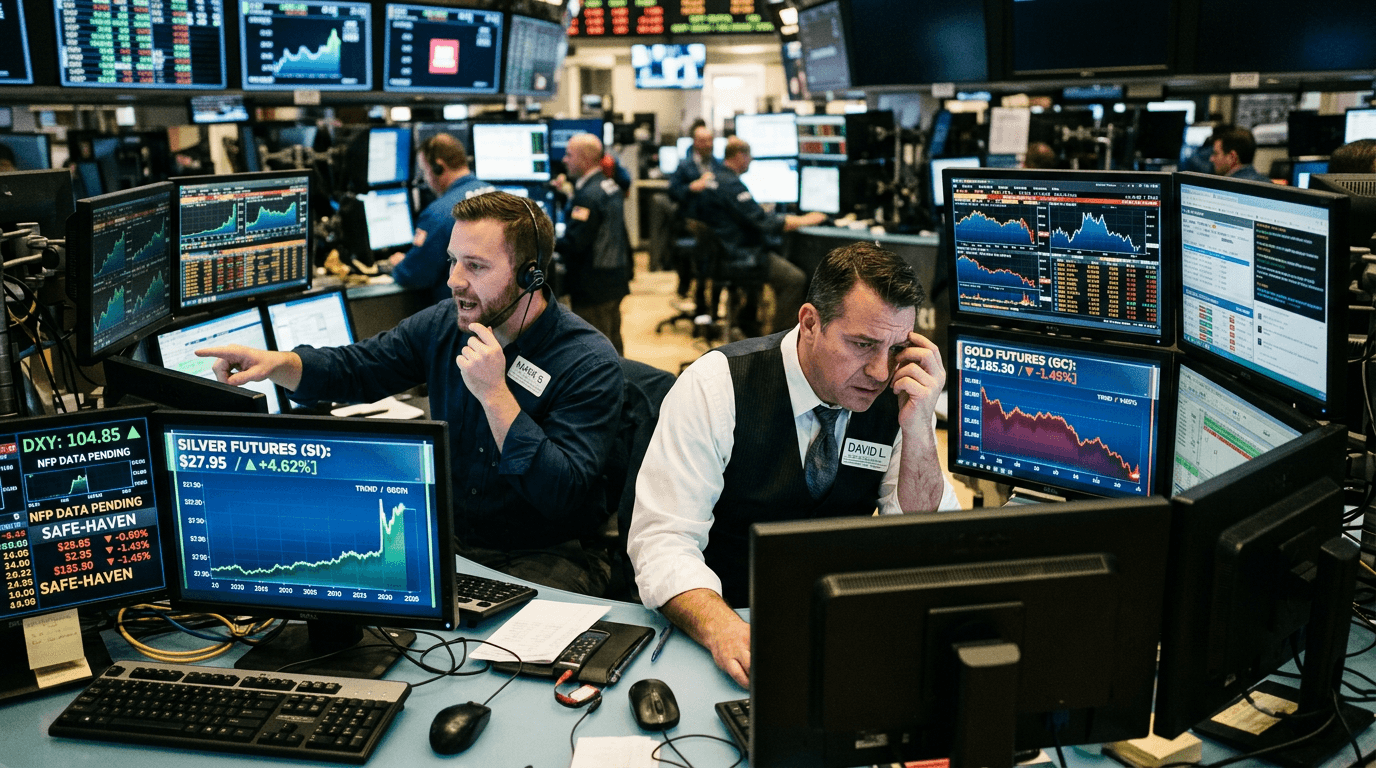
Gold and silver are sending mixed signals as traders brace for the next U.S. jobs report, highlighting how the same macro forces can pull different assets in opposite directions at the same time[12]. Gold has slipped back below the $5,300 mark intraday as a firmer dollar and shifting rate expectations weigh on prices, even as geopolitical tensions in the Middle East keep safe-haven demand in play[1][5]. Silver, by contrast, has surged above $84, drawing strong haven bids and speculative interest, with price action turning especially volatile in futures as markets position for upcoming Nonfarm Payrolls and bond yield moves[9][11][12].
WHAT’S PRESSURING GOLD DESPITE SAFE-HAVEN DEMAND
Gold’s latest dip is a classic case of safe-haven flows colliding with macro headwinds from the dollar and real yields[7][12]. A stronger U.S. currency makes dollar-priced bullion more expensive for non-dollar buyers, typically dampening physical and investment demand[1][5]. At the same time, resilient labor data in recent months has repeatedly pushed markets to scale back expectations for near-term Federal Reserve rate cuts, keeping real yields higher and increasing the opportunity cost of holding non-yielding assets like gold[1][5][6][9].
History shows this pattern clearly. After stronger-than-expected jobs reports, gold has often fallen 2–3% in a single session as traders reprice the Fed path and the dollar jumps[1][5][6][9]. When markets interpret robust payrolls as confirmation that the economy can withstand higher rates for longer, gold tends to struggle because it competes with safer, interest-bearing assets such as Treasuries[7][12].
Yet gold has not completely lost its appeal. Geopolitical tensions and war worries in the Middle East continue to underpin a base level of safe-haven demand, limiting downside and driving sharp intraday reversals when risk sentiment deteriorates[5][10][11]. In several recent episodes, gold has initially sold off on strong jobs data and rate repricing, only to recover as investors refocused on geopolitical risk and broader uncertainty[11]. This tug-of-war explains why gold can trade lower on the day even while underlying demand drivers remain supportive over the medium term.
Why Silver Is Bucking The Trend
Silver’s rally above $84 illustrates how the metal’s unique mix of safe-haven and industrial characteristics can produce very different price action from gold[9][10]. Like gold, silver benefits from risk-off sentiment and worries about geopolitical instability, which have recently driven the metal to multi-year highs[9][10][11]. But silver’s market is smaller, more speculative, and more sensitive to positioning, making it prone to outsized moves when investors crowd into futures and leveraged products[9][11].
Recent trading suggests a strong safe-haven bid in silver, amplified by momentum buying and short covering as prices break through key technical levels[9][11]. In prior episodes, silver has surged 4–6% on days when risk sentiment turned defensive, even if gold’s gains were more muted or temporarily constrained by dollar strength[9][11]. Silver also attracts investors who view it as “gold with beta”—a higher-volatility proxy for precious metal exposure that can outperform in risk-off phases but correct sharply when the macro narrative shifts[7][9][11].
At the same time, silver’s industrial demand links it to expectations for manufacturing, technology, and energy sectors. When markets look through near-term rate uncertainty and focus on longer-term demand for solar, electronics, and green infrastructure, silver can receive an additional fundamental tailwind that gold lacks[2][10]. The combination of haven flows, speculative interest, and industrial optimism helps explain why silver is rallying even as gold is struggling to hold its recent highs.
HOW THE U.S. JOBS REPORT MOVES GOLD AND SILVER
The Nonfarm Payrolls report is one of the most important recurring catalysts for precious metals, not because gold and silver “care” about jobs directly, but because the data reshapes expectations for Fed policy, real yields, and the dollar[7][12]. In practice, the relationship tends to follow a familiar playbook[7]:
When jobs data misses expectations, gold and silver usually rise. Softer payrolls hint at slower growth or recession risk, prompting traders to price in more cautious Fed behavior, lower future rates, and weaker real yields[7][8][10][12]. This combination reduces the opportunity cost of holding metals and often pushes the dollar lower, making gold and silver more attractive globally[7][8][10][12]. Risk-off behavior adds a safe-haven bid on top, as investors trim equity exposure and seek stability in reserve assets like gold[7][8][10].
Conversely, when jobs data beats expectations, gold and silver tend to fall. Strong payrolls support the narrative of a resilient economy, prompting markets to delay rate cuts or even consider further tightening[1][5][6][9][12]. That typically lifts yields and the dollar, pressuring precious metals as the relative appeal of income-generating assets improves[1][5][6][9][12]. In several notable cases this year, robust labor reports have driven gold and silver to their lowest levels in months as traders recalibrated expectations for the timing and magnitude of Fed easing[5][6][9].
It is crucial to remember one key principle that analysts often highlight: gold does not react to jobs data in isolation—it reacts to what the jobs data implies for the Fed, real yields, and the dollar[7]. Silver follows a similar macro logic but adds layers of volatility and speculative positioning that can produce divergent price moves around the same release[7][9][11].
Navigating Precious Metal Volatility In A Simulated Environment
For traders operating in a simulated finance (SimFi) environment, the current divergence between gold and silver is an ideal case study in multi-factor market behavior. It reinforces that price action is rarely driven by a single headline; instead, it reflects the interaction of monetary policy expectations, currency moves, yield dynamics, and risk sentiment.
In practice, there are several useful habits to develop:
- Build scenarios around the jobs report: “strong beat,” “in-line,” and “soft miss,” and map out likely paths for the dollar, yields, and metals under each[7][12].
- Track correlations: watch how gold and silver respond not just to payrolls, but also to real-time moves in bond yields and the dollar index[1][5][8][12].
- Respect positioning and technical levels: silver’s sharp moves often arise when speculative flows collide with crowded trades and key price thresholds[9][11].
Simulated trading allows participants to test how different strategies—such as hedging gold exposure with silver, or using options around data releases—would have performed under past jobs reports and geopolitical shocks. This kind of practice can improve decision-making before real capital is at risk, especially in markets where narratives can shift quickly from “Fed-driven” to “geopolitics-driven” within a single session[7][10][11].
Conclusion
Gold’s retreat below $5,300 and silver’s surge above $84 ahead the U.S. jobs report underline a central reality of modern markets: the same macro story can produce conflicting moves in closely related assets at the same time[9][11][12]. As safe-haven demand collides with a stronger dollar and evolving rate expectations, the precious metals complex is reminding traders that context matters as much as direction.
For both new and experienced market participants, the lesson is clear. Understanding how jobs data ripples through Fed policy, real yields, and currencies is essential to interpreting gold and silver moves—and to avoiding simplistic “one headline, one trade” thinking[7][12]. In a world where geopolitical risk remains elevated and monetary policy is data-dependent, practicing this analysis in a simulated environment can be a powerful way to stay prepared for the next bout of volatility.