
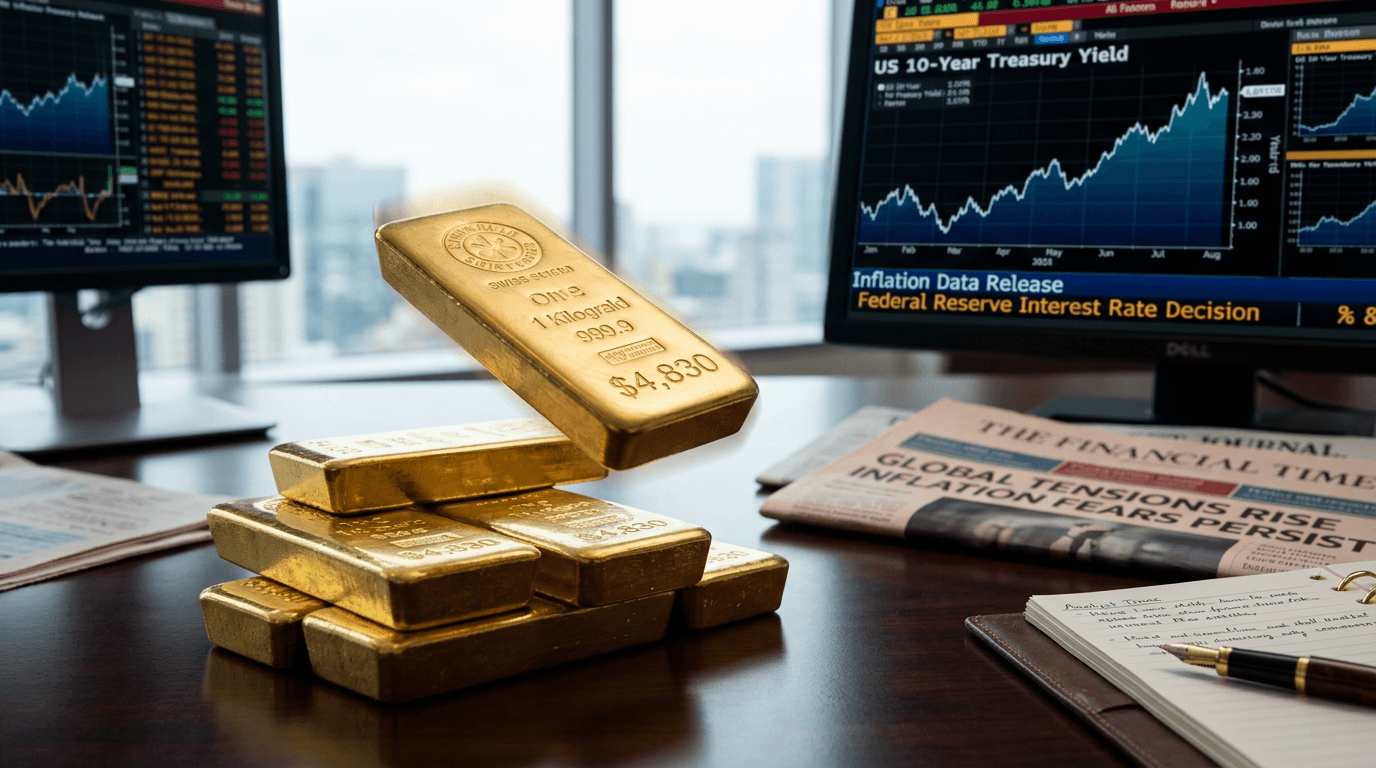
Gold prices have steadied around $4,830 by mid-April 2026, illustrating a complex interplay between traditional market dynamics and current economic realities. While geopolitical tensions typically drive gold prices higher, the present situation is more intricate, with inflation concerns and monetary policies exerting contrasting forces that confine the precious metal to a narrow trading band.[1][2]
The Paradox Of Geopolitical Risk In 2026
The escalation of the Iran conflict, which has pushed oil prices beyond $100 per barrel, would traditionally ignite a rush to gold as a safe haven.[1] For instance, the seizure of an Iranian cargo ship by the US Navy in the Gulf of Oman on April 19 would have historically led to increased investments in precious metals. Surprisingly, gold fell on that day, closing at $4,784.20, a 1.02% decline from the previous session.[2] This counterintuitive outcome highlights a fundamental shift in how geopolitical risks are currently priced in the markets.
The longstanding assumption that geopolitical tensions inherently boost gold prices has significantly weakened.[2] The issue isn't with gold's perceived value as a hedge; rather, the way geopolitical risks are transmitted has evolved. Now, the inflationary impacts of conflicts influence yields and the dollar, suppressing gold prices instead of supporting them, creating a scenario where macroeconomic headwinds may temporarily overshadow gold's role as a safe haven.[2]
Inflation: The Hidden Hand Suppressing Gold
The current consolidation in gold prices is primarily influenced by three factors: a strong US dollar, rising bond yields, and renewed inflation fears due to high oil prices.[1] Disruptions in commodity supply inherently drive inflation, and in this economic cycle, inflation has consistently led to tighter-than-anticipated monetary policy responses.[2]
The Federal Reserve has indicated that it is unlikely to adjust its policies in response to an oil shock that could embed inflation more deeply into the economy.[2] This stance, alongside the dollar's strength during energy crises, as capital shifts toward the US from commodity-reliant economies, presents significant obstacles for gold. As a non-yielding asset, gold struggles when real yields are high due to inflationary concerns and stringent monetary policy expectations.[3]
Persistent oil-driven inflation may limit the Fed's ability to ease monetary policy in the near future, maintaining elevated real yields and curbing potential gains for non-yielding assets like gold.[2] Iran's threats of retaliation and the breakdown of ceasefire conditions further intensify the inflation risk premium in oil prices, reinforcing the scenario where yields and the dollar continue to exert downward pressure on gold.[2]
Technical Consolidation And Key Support Levels
From a technical standpoint, gold is currently navigating a "level-to-level" market with clearly defined support and resistance zones.[1] The metal experienced a 15% drop from its January peak near $5,595 to a low of around $4,200 by mid-April, aligning with the 200-day simple moving average.[2] Its subsequent recovery to the $4,760 to $4,830 range now marks a crucial consolidation phase.
Key support is found at approximately $4,500 and then $4,000, while resistance levels are identified at $4,600, $4,700, and the critical $5,000 mark.[1] This structured market suggests that gold may remain in the $4,700 to $4,850 range, with future movements influenced by PMI data, inflation expectations, and Federal Reserve announcements.[2]
Long-term Support Remains Intact
Despite short-term pressures, gold's long-term trend remains intact, although momentum has slowed following a remarkable surge in 2025.[1] Central bank purchases continue to underpin gold demand, as global central banks diversify their reserves with precious metals.[1] Furthermore, ongoing geopolitical uncertainties sustain long-term demand for gold, even if immediate price movements are subdued.[1]
What This Means For Traders And Investors
The current gold market presents a dual outlook. In the near term, a de-escalation of tensions and a pullback in oil prices could lead to a recovery in gold prices toward the $5,000 to $5,200 range.[2] Conversely, if the conflict persists, higher inflation and tighter central bank policies may maintain pressure on gold within its current consolidation zone.[1]
The primary takeaway for gold investors is the need to closely monitor not just geopolitical developments, but also Federal Reserve communications, inflation data, and dollar strength. Although safe-haven demand is present, it is being overshadowed by mechanisms transmitting inflation risks. Recognizing this shift is crucial for navigating gold's current market dynamics and strategically adjusting positions for the coming weeks.