
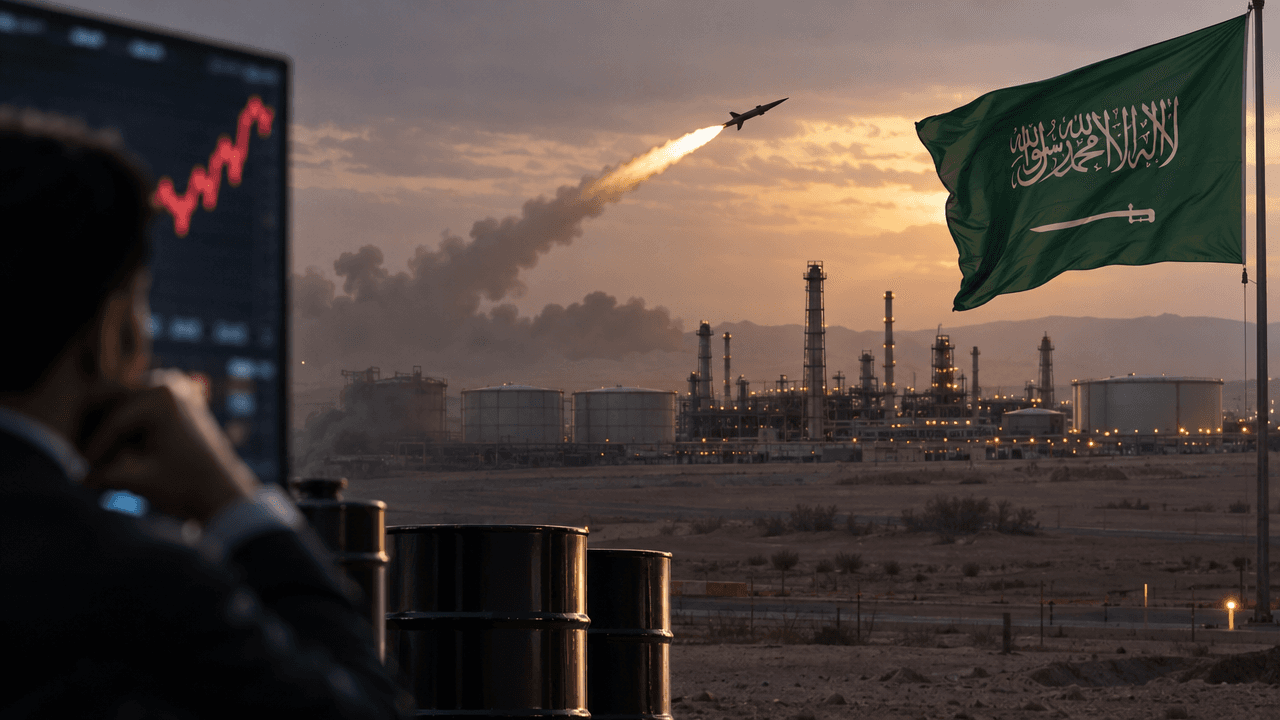
A new wave of attacks claimed by Yemen’s Houthi movement against Saudi Arabian targets has pushed geopolitical risk back to the center of financial markets. Reports involving Riyadh’s King Khalid International Airport, military sites, and Saudi energy infrastructure have raised fresh concerns that conflict could spread across the Gulf and threaten one of the world’s most important oil-producing regions. Saudi authorities have not independently confirmed every Houthi claim, making uncertainty itself a major market force. [2][3]
The initial market response was familiar: oil prices moved higher as traders priced in the possibility of supply disruption, while gold attracted safe-haven demand. The reaction reflects a basic principle of markets: when a geopolitical event threatens a critical commodity or transportation route, prices often respond before the physical impact is fully known.
Why The Gulf Matters To Global Markets
Saudi Arabia remains one of the central pillars of the global oil market. Its energy infrastructure includes major production, processing, storage, and export facilities. Even a temporary disruption can create concern about whether other producers, spare capacity, and strategic reserves could compensate quickly.
The latest Houthi claims reportedly included attacks on Aramco facilities in Riyadh and the Khurais area, as well as threats directed at airports and other infrastructure. The Houthis have also warned airlines and threatened energy facilities, increasing the risk that companies may alter operations even when damage is limited or unconfirmed. [1][5]
This is why oil can rise on headlines alone. Traders do not need to see a confirmed loss of millions of barrels before adjusting prices. They may instead anticipate higher insurance costs, delayed shipments, precautionary shutdowns, or a broader military response.
The location of the attacks also matters. Saudi Arabia is a major exporter, and facilities such as Yanbu connect domestic production with global markets. At the same time, wider regional tensions can affect shipping routes near the Red Sea, the Bab el-Mandeb Strait, and the Persian Gulf. A threat to several routes at once can create a larger risk premium than a single isolated incident.
OIL’S INFLATION CHANNEL
Higher oil prices can influence inflation through several channels. The most direct effect is at the pump, where increases in crude prices can eventually lift gasoline and diesel costs. Transportation companies may then face higher operating expenses, which can feed into freight rates and the prices of goods delivered by road, air, or sea.
Energy is also an important input for manufacturing, agriculture, chemicals, and utilities. Although the effect varies by country, sustained oil price increases can broaden from fuel markets into the wider economy.
The timing of the move is especially important. A brief oil spike caused by headline risk may have only a limited effect on consumer inflation if prices quickly retreat. A prolonged disruption, however, can become more significant. Businesses may pass higher costs to customers, households may reduce spending on discretionary items, and central banks may face renewed pressure to keep interest rates elevated.
The market is therefore watching not only the first reaction in crude futures but also the duration of the risk premium. Brent crude rose more than 3% during an earlier escalation involving claimed strikes on Saudi facilities, briefly moving above $108 a barrel. [10] Such moves become more consequential if they remain in place for several weeks.
The Safe-haven Response
Gold’s strength in periods of geopolitical stress reflects more than fear of war. Investors often use gold to diversify away from riskier assets, protect against currency uncertainty, and hedge against the possibility that inflation will remain higher for longer.
However, gold does not always rise in a straight line during a crisis. If traders expect higher interest rates in response to inflation, government bond yields and the U.S. dollar may strengthen, creating competition for gold. The result can be a market in which gold initially rises on safe-haven demand but later becomes sensitive to central-bank expectations and real interest rates.
Equity markets may also react unevenly. Energy producers can benefit from higher crude prices, while airlines, transport companies, manufacturers, and consumer businesses may face margin pressure. Import-dependent economies could experience a sharper inflation shock than countries that produce significant amounts of energy.
What Traders Should Watch Next
The next stage of the market reaction will depend on evidence rather than headlines alone. Traders should monitor four developments.
First, they should look for independent confirmation of damage to Saudi production, refining, storage, or export facilities. Claims that cannot be verified may produce sharp but temporary price swings.
Second, shipping activity and insurance costs will reveal whether the threat is affecting physical trade. A change in vessel traffic or route selection could signal that the risk is moving beyond financial markets.
Third, traders should watch the official response from Saudi Arabia, the United States, Iran, and other regional governments. Retaliation, a wider military operation, or diplomatic de-escalation could rapidly change the direction of oil and safe-haven assets.
Finally, central-bank communication will matter. If policymakers describe the shock as temporary, markets may look through the initial inflation increase. If they warn that energy prices could influence wages and expectations, interest-rate volatility may rise.
Practical Takeaways For Simfi Traders
The first lesson is to separate confirmed information from unverified claims. Headline-driven markets can move quickly, but entering after a sharp spike without a defined risk limit can be costly.
The second lesson is to monitor correlated markets. Oil, gold, the U.S. dollar, bond yields, equity indexes, and energy-sector shares can tell different parts of the same story.
The third is to consider time horizon. A short-term geopolitical premium may fade, while a sustained disruption can reshape inflation expectations and monetary policy.
For SimFi traders, this environment offers a useful exercise in scenario planning. Build a base case, a de-escalation case, and a supply-disruption case. Define what evidence would confirm each scenario before allowing a trade to become a reaction to emotion.
Conclusion
The attacks claimed against Saudi targets have reminded markets that geopolitical risk can become an inflation risk almost instantly. Oil and gold are responding not only to confirmed physical damage but also to uncertainty over escalation, shipping security, and future energy availability.
The most important question is whether the attacks remain isolated incidents or develop into a broader threat to Gulf production and transportation. Until that becomes clearer, volatility is likely to remain elevated, and disciplined analysis will matter more than reacting to every headline.