
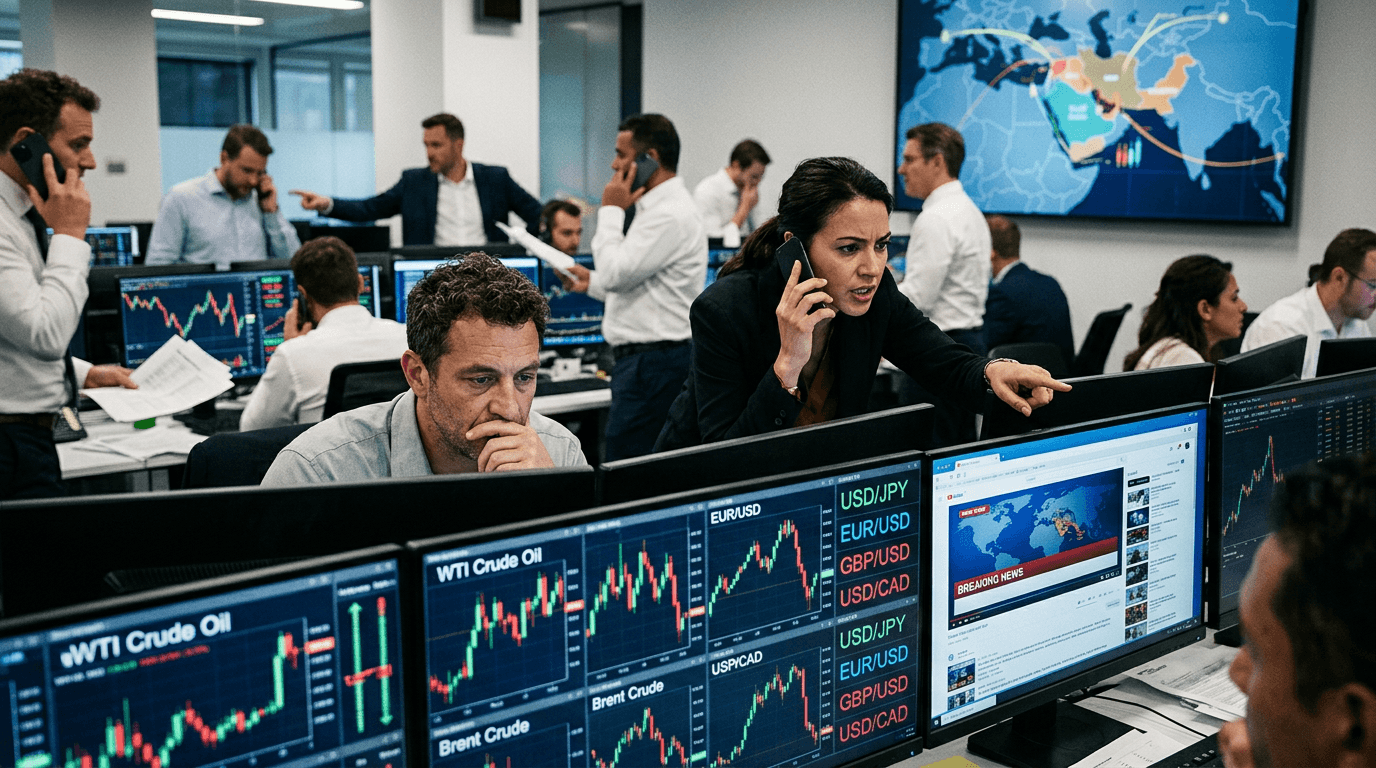
Screens across trading floors have been flashing red and green as fresh headlines from the Middle East and Gulf region drive sharp, fast moves in oil and foreign exchange markets. Renewed tensions around key shipping routes and energy infrastructure have lifted crude prices and safe-haven currencies, only for both to retrace as diplomatic signals briefly cool nerves, creating a challenging environment for intraday traders in oil futures and FX pairs linked to commodities and risk sentiment[2][6][12][19].
Why Gulf Tensions Matter For Markets
The Gulf is the beating heart of the global oil system. The Strait of Hormuz alone handles roughly a fifth of world oil flows and substantial liquefied natural gas shipments, making it one of the most critical chokepoints in global energy trade[9][17]. When conflict or threats disrupt traffic through this narrow waterway, the impact on physical supply is immediate and sizable.
Recent escalations have led to what the International Energy Agency describes as the largest supply disruption in the history of oil markets, driven by the effective closure of the Strait of Hormuz and damage to regional infrastructure[2][4][6]. Market participants are not just reacting to current barrels being blocked; they are repricing the risk of further disruptions, longer outages, and the knock-on effects on inflation and growth worldwide[5][17].
For traders, this means that geopolitical headlines from the region are no longer background noise—they are primary catalysts. A single report about attacks on tankers, stalled talks between major powers, or fresh sanctions can change the supply outlook and trigger repricing across commodities, rates, equities, and FX within minutes[8][12][16][18].
Key takeaway: Gulf geopolitics are now a core macro driver, not a niche regional risk, and should sit near the top of any trader’s daily watchlist.
Oil Prices: From Supply Shock To Headline Swings
Crude markets have already experienced powerful moves as tensions escalated. Brent futures have repeatedly pushed above key psychological levels, breaching $95 per barrel and holding over $100 during more intense phases of the conflict[1][4][9][13]. In one recent episode, Brent surged nearly 60% in a single month as the Strait of Hormuz was effectively closed and traders priced in sustained supply outages[9].
Yet the price action has not been a one-way street. After sharp spikes driven by news of infrastructure damage or renewed hostilities, crude has often eased as markets digest more balanced information: signs of diplomatic engagement, releases from strategic reserves, or evidence that alternative routes and non-Middle East producers can partially offset lost volumes[5][7][10][18].
This push-and-pull has produced intraday volatility that feels more like event-driven equity trading than traditional commodity flows. Prices can jump on reports of drone attacks on loading terminals and then give back part of the move when officials signal that shipping lanes remain partially open or that talks are back on the table[13][15][16]. For short-term traders, the game has shifted from slow macro trends to rapid headline interpretation.
Key takeaway: Oil is trading as much on real-time news as on traditional supply-demand statistics, making intraday volatility and gap risk central features of the current market.
Fx Reaction: Petro-currencies And Safe Havens
Where oil goes, certain currencies follow. Petro-currencies such as the Canadian dollar (CAD) and Norwegian krone (NOK) often strengthen when crude prices rise, reflecting improved terms of trade and revenue prospects for oil-exporting economies. In the current environment, intraday swings in Brent and WTI have been accompanied by quick moves in CAD and NOK pairs as dealers recalibrate their view of future export earnings and risk appetite.
At the same time, classic safe-haven FX—most notably the US dollar, Swiss franc, and Japanese yen—has benefited during periods when Gulf headlines signal escalating conflict or heightened uncertainty. Investors seeking protection from tail risks have pushed into these currencies, alongside government bonds, creating “risk-off” phases marked by a stronger dollar and weaker cyclical and emerging market FX[17][19].
Interestingly, currencies like the British pound (GBP) have also been caught in the crosscurrents. As a major oil importer with deep financial linkages, the UK is sensitive both to energy costs and global risk sentiment. On days when crude rallies and risk appetite deteriorates, GBP can weaken against dollars and safe havens, even if its direct energy exposure is more limited than key emerging market importers.
The result for FX traders is a complex mix of drivers: commodity terms of trade, global growth expectations, safe-haven flows, and central bank reaction functions as higher energy prices feed into inflation. Short-term price action can look chaotic, but underneath the noise, the familiar pattern remains: oil up, petro-currencies bid; risk-off, safe havens bid; prolonged stress, imported-inflation currencies pressured.
Key takeaway: FX traders must connect the dots between oil moves, risk sentiment, and country-specific energy exposure to understand why CAD, NOK, GBP, USD, CHF, and JPY are moving when Gulf headlines hit.
How Traders Navigate Intraday Volatility
For discretionary and systematic traders alike, the current environment demands a disciplined approach to news-driven volatility. Some practical principles stand out:
First, news awareness is no longer optional. A robust process for tracking verified geopolitical developments—rather than reacting to every rumor—is essential. Traders who can distinguish between structural events (e.g., confirmed closure of a key terminal) and transient noise (e.g., unverified reports or purely political rhetoric) are better positioned to avoid whipsaws.
Second, position sizing and risk limits need to reflect the new regime. With crude able to move several percentage points in a single session on Gulf headlines, and FX pairs reacting in sympathy, leverage that felt conservative in calmer periods can quickly become aggressive. Intraday traders may need tighter stops, smaller sizes, or option overlays to manage gap risk around key news windows.
Third, cross-asset correlation has become more important. Oil spikes are not isolated—they spill into FX, credit, and equity volatility[17][18][19]. Monitoring how your book behaves when crude jumps or safe-haven FX rallies can reveal hidden exposures. For example, a portfolio long CAD and short JPY is effectively a bet on stable or improving energy and risk conditions; on days when Gulf tensions rise, this can become a high-beta macro trade.
Key takeaway: Success in this environment hinges on integrating news analysis, dynamic risk management, and cross-asset awareness, rather than treating oil and FX positions as independent bets.
A Practical Playbook For Simulated And Live Trading
For traders using simulated finance platforms like E8 Markets, the current Gulf tensions offer a rich laboratory for building and testing trading playbooks. Because live outcomes are highly path-dependent—shaped by evolving headlines, diplomacy, and market sentiment—simulation allows traders to rehearse different scenarios without capital at risk.
A useful framework is to break Gulf-related trading into three regimes:
1) Escalation regime: Headlines point to rising conflict, confirmed damage to infrastructure, and higher probability of prolonged disruption. In this phase, traders might model stronger crude, firmer CAD/NOK, risk-off flows into USD/CHF/JPY, and pressure on risk-sensitive FX and equities.
2) Containment regime: Tensions remain elevated, but markets see credible efforts to limit disruption—partial reopening of lanes, alternative routing, or coordinated policy responses. Here, crude may plateau or trade in a wide range, petro-currency support is more muted, and FX moves become more two-way as traders reassess worst-case assumptions[7][18].
3) De-escalation regime: Diplomatic progress and reduced attacks lead markets to price in normalization. Oil can retrace, safe-haven FX fades, and carry and risk-on strategies regain traction, though the path may be choppy as participants remain alert to flare-ups.
By building strategy templates for each regime—specifying preferred instruments, directional biases, risk limits, and trigger conditions—traders can respond more systematically when new Gulf headlines hit. Practicing these templates in a simulated environment helps develop the muscle memory and discipline needed to execute under real pressure.
Key takeaway: Treat Middle East and Gulf tensions as a repeatable macro scenario, design regime-based strategies, and use simulation to refine your responses before deploying real capital.