
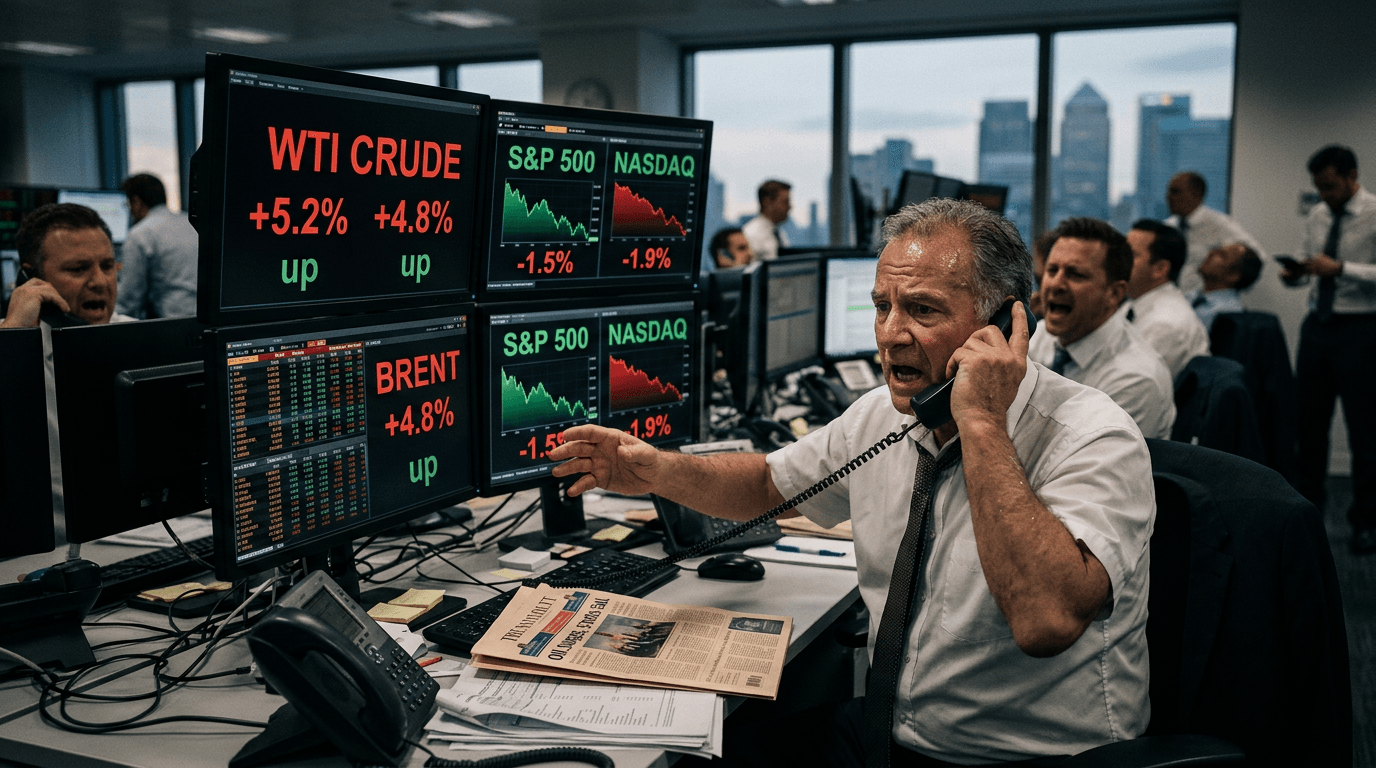
Fresh exchanges between U.S. and Iranian forces in the Gulf have pushed Brent crude futures higher and knocked major equity indices lower, reminding markets how quickly geopolitical risk can reprice assets.[7] Oil’s move is modest in percentage terms but meaningful in what it signals: investors are rebuilding a “risk premium” into energy, while rotating away from high‑beta equities and toward safe‑haven FX like the U.S. dollar.[7]
Markets React To Gulf Tensions
The immediate reaction has been classic “risk‑off.” Brent crude futures jumped as traders priced in a higher probability of supply disruption in and around the Strait of Hormuz, the narrow passageway that handles roughly one‑fifth of global oil flows.[11] At the same time, S&P 500 and Nasdaq futures slipped, reflecting concerns about both higher input costs and the broader uncertainty around Middle East stability.[7]
Safe‑haven demand is visible in FX. Historically, episodes like this tend to support the U.S. dollar, as well as defensive currencies such as the Japanese yen and Swiss franc, while pressuring high‑beta FX tied to global growth and commodities.[7] That pattern is now reasserting itself: the bid for USD strengthens, while equity‑sensitive currencies and emerging‑market FX face headwinds as investors de‑risk portfolios.
On the commodity side, it is not just crude that moves. Energy‑linked futures in natural gas and refined products often follow oil higher, while industrial commodities can trade mixed—caught between higher energy costs and worries about demand if geopolitical stress spills into growth.[2][7] For traders, the key takeaway is that Gulf headlines can quickly trigger cross‑asset repositioning, not just a simple oil spike.
Why Oil Spikes On Geopolitical Risk
Recent price action reflects a familiar dynamic: the market is well supplied, but geopolitical risk forces traders to overlay a premium on top of fundamentals.[7] The International Energy Agency and OPEC both project solid supply growth, with analysts warning of a potential surplus in the first half of 2026 as non‑OPEC producers like the U.S., Canada, Guyana and Norway ramp output.[7] Under normal conditions, that backdrop would cap rallies.
When tensions flare between the U.S. and Iran, however, the focus shifts from surplus barrels to deliverability. Disruption scenarios in the Strait of Hormuz—ranging from temporary shipping delays to a partial closure—can quickly drive modelled fair value higher.[11] Earlier this year, analysts at Citi and JPMorgan outlined how a three‑ to four‑week interruption could force Gulf producers to curb output and potentially propel Brent toward or beyond $100 per barrel.[2]
Importantly, the current move appears driven more by risk pricing than by actual physical shortages. Visible inventories remain close to historical norms, and OPEC still holds ample spare capacity.[2][7] That creates an asymmetric setup: as long as headlines stay tense, oil can trade with an elevated risk premium; if diplomacy stabilises the situation, that premium can unwind, sending crude back toward levels justified by supply and demand rather than fear.[7]
PRESSURE ON RISK ASSETS AND HIGH‑BETA FX
Higher oil is a tax on the global economy, and equity markets tend to discount that quickly. When Brent rises on geopolitical stress, investors worry about margin compression for energy‑intensive sectors, squeezed consumer purchasing power via fuel prices, and the knock‑on effects on inflation expectations.[2][10] That concern is reflected in weaker S&P 500 and Nasdaq futures as growth stocks and cyclical sectors come under pressure.[7]
Risk sentiment also suffers simply because uncertainty rises. Episodes of military exchange between major geopolitical actors reduce visibility on future policy, trade flows and regional stability. In that environment, “high‑beta” assets—equities, emerging‑market bonds and FX, and commodity‑linked currencies like AUD, CAD and NOK—are typically sold first as investors cut exposure to anything reliant on robust global growth.[7]
Meanwhile, safe‑havens benefit. The U.S. dollar tends to strengthen as global investors seek deep, liquid markets and Treasuries, even if U.S. assets also face valuation questions.[7] Defensive FX such as JPY and CHF often gain, and high‑grade sovereign bonds in core economies can catch a bid as capital rotates away from equities. For portfolio builders, the lesson is clear: geopolitics can reshuffle the relative performance of asset classes within hours.
Implications For Simulated Traders And Strategists
For traders using simulated environments like E8 Markets’ SimFi platform, Gulf tensions offer a live case study in how geopolitics transmits through prices. Because the move is driven by risk premium, not a clear structural shift in supply, it becomes a test of:
- How quickly your strategy adapts to regime changes
- Whether your models capture cross‑asset correlations under stress
- How robust your risk limits are when volatility clusters
Trend‑following strategies in crude and energy equities may benefit from the momentum, but should be explicit about exit rules if headlines suddenly turn more positive and the risk premium unwinds.[7] Mean‑reversion traders, by contrast, need to be cautious: fading geopolitically‑driven moves without a clear catalyst for de‑escalation can be costly.
On the macro side, simulated traders can use this period to stress‑test portfolios against higher energy prices: What happens to your equity book if Brent adds another $10‑15 per barrel? How do your FX positions behave under a stronger USD and weaker EM FX? Running such scenarios in a SimFi environment allows traders to refine playbooks before committing real capital.
PRACTICAL PLAYBOOK FOR GEO‑RISK EPISODES
Several practical takeaways emerge from the current escalation:
1. Watch the Strait of Hormuz Price action will be most sensitive to any indication of shipping disruption or renewed threats to commercial vessels in this corridor.[2][11] Headlines about safe passage, escorts, or temporary closures can materially change the risk premium embedded in oil.
2. Separate fundamentals from fear Track inventory data, OPEC and IEA reports, and non‑OPEC production trends alongside Gulf headlines.[2][7] When fundamentals stay loose but prices rise, you are trading sentiment and risk, not scarcity—position sizing should reflect that.
3. Monitor cross‑asset correlations Elevated oil often coincides with weaker equities, a stronger USD, and pressure on high‑beta FX.[7][10] In simulated trading, map these correlations and test how they hold—or break—under different escalation and de‑escalation paths.
4. Focus on sector and factor impacts Energy and defense names may outperform in the short term, while consumer discretionary, airlines and some industrials can underperform as fuel costs and uncertainty bite.[2][10] Factor‑based strategies (e.g., value vs growth) can behave differently in geo‑risk regimes.
5. Prioritise risk management Geo‑political events tend to produce gaps and headline‑driven spikes. Use clear stop‑losses, avoid excessive leverage into weekend risk, and be wary of thin liquidity periods when spreads widen. Simulated environments are ideal for rehearsing such discipline.
As U.S.–Iran tensions in the Gulf ebb and flow, markets will continue to toggle between complacency and fear. For traders and investors alike, the challenge is to understand how those swings ripple through oil, FX and equities—and to build strategies that respect both the data and the geopolitics driving it.