
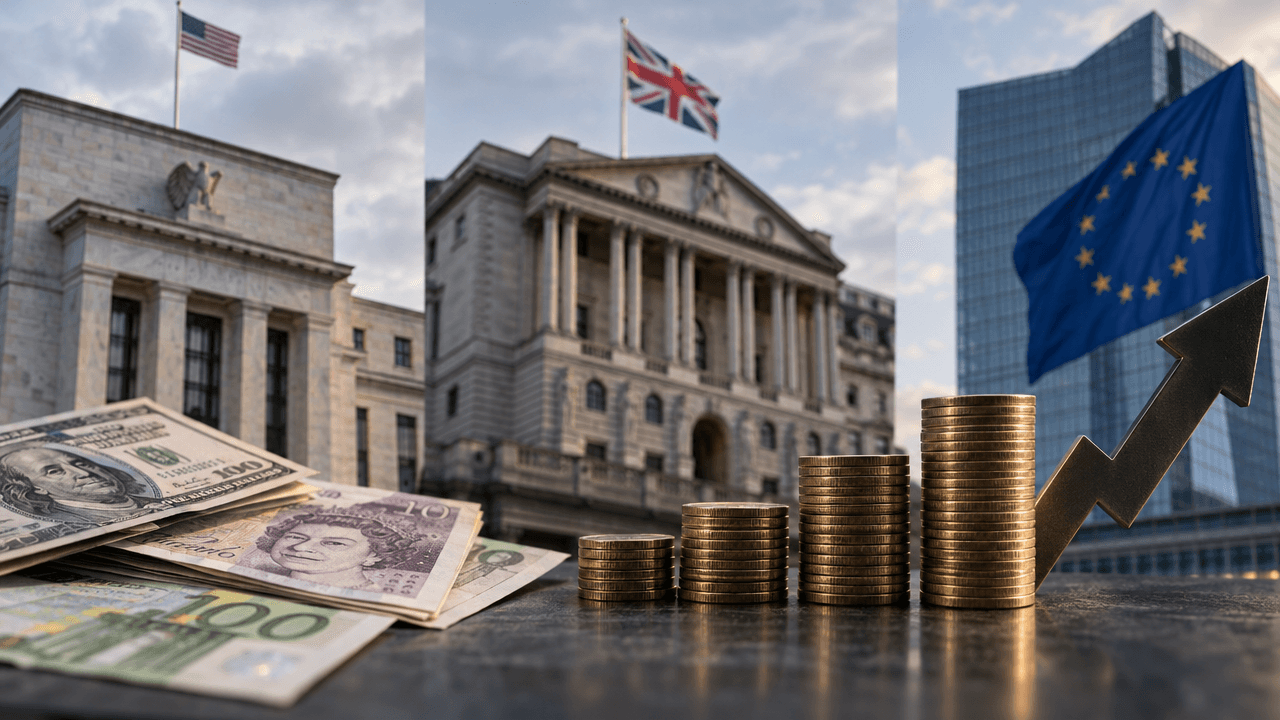
Inflation is proving harder to defeat than many investors expected, and recent comments from major central-bank officials have pushed global interest-rate expectations in a more hawkish direction. Policymakers in the United States, United Kingdom, and eurozone are signaling that borrowing costs may need to rise further if price pressures remain above target.
For traders, the message is important: the long-awaited shift toward easier monetary policy may be delayed. Instead of positioning for rapid rate cuts, markets are reassessing the possibility of additional tightening, higher bond yields, stronger currencies, and renewed pressure on interest-rate-sensitive assets.
The Global Policy Message
The Bank of England delivered the clearest immediate signal by raising Bank Rate by 0.25 percentage points to 4% in November. The decision passed by an 8–1 majority, while one policymaker supported a larger 0.5 percentage-point increase. It was the first British rate increase since August 2023. [1][6]
The decision itself was significant, but the voting pattern and accompanying communication were even more important. They suggested that policymakers are increasingly concerned about inflationary pressure moving through wages, services, and other parts of the domestic economy.
Bank of England Deputy Governor Clare Lombardelli said another increase could be justified without clear evidence that inflation pressures are weakening. Markets responded by assigning roughly a 70% probability to another quarter-point increase at the December meeting, lifting the expected policy rate to 4.25%. [3]
The United States and eurozone have also contributed to the more cautious global outlook. Federal Reserve Governor Christopher Waller indicated that a half-percentage-point increase could be needed at the next meeting if inflation remains persistent. European Central Bank Chief Economist Philip Lane similarly said that raising borrowing costs could be prudent if incoming data does not shift before December. [3]
Why Inflation Remains The Focus
Central banks are not responding only to the latest headline inflation number. They are assessing whether price increases are becoming embedded in expectations, wages, and business pricing decisions.
Energy prices can fall quickly, but services inflation and wage growth often respond more slowly. A decline in fuel costs may reduce headline inflation while leaving underlying price pressures largely intact. This creates a difficult policy environment: central banks must prevent temporary shocks from becoming permanent inflation without unnecessarily damaging employment and economic growth.
Recent survey evidence indicates that price growth remains above central-bank targets across major developed economies. Resilient economic activity has made it more difficult for policymakers to assume that inflation will naturally return to target. [7]
The Bank of England’s November assessment also emphasized that inflationary pressure in the pipeline was sufficient to justify higher rates. That wording matters because monetary policy works with a delay. Officials are effectively acting on risks they expect to influence prices several months from now, rather than waiting for every inflation indicator to confirm the trend. [2]
How Markets May Respond
A hawkish central-bank outlook typically supports short-term government bond yields because traders price a higher path for future interest rates. Longer-term yields can also rise if investors believe restrictive policy will remain in place for an extended period.
Currencies may benefit as well. Higher expected rates can attract international capital, particularly when investors believe a central bank is more willing to act aggressively than its peers. Sterling strengthened after markets priced a greater chance of additional Bank of England tightening, illustrating how policy expectations can move foreign-exchange markets before an actual rate decision. [10]
Equities face a more complicated environment. Financial companies may benefit from higher lending rates, but expensive growth stocks are often pressured because higher discount rates reduce the present value of future earnings. Real estate, highly leveraged businesses, and speculative assets can also struggle as financing becomes more expensive.
For commodities, the effect depends on the interaction between rates, currencies, and economic growth. A stronger dollar can weigh on dollar-priced commodities, while concerns about supply disruptions or energy markets may keep inflation risks elevated despite tighter policy.
Practical Takeaways For Traders
First, focus on the path of rates rather than a single policy announcement. A quarter-point increase may already be priced into markets, while a change in guidance, voting patterns, or inflation forecasts can create the larger move.
Second, monitor services inflation, wage data, and inflation expectations. These indicators may provide a clearer signal about persistent inflation than volatile food or energy prices.
Third, compare central banks with one another. A hawkish Federal Reserve can support the dollar, while a more aggressive Bank of England can support sterling. Relative policy expectations often matter more in currency markets than the absolute level of rates.
Fourth, account for volatility around central-bank speeches and economic releases. Markets can reprice rapidly when a policymaker challenges the consensus. Risk controls, smaller position sizes, and predefined exit levels are especially important when rate expectations are changing.
SimFi traders can use this environment to test macroeconomic strategies without exposing real capital. For example, they can compare the behavior of rate-sensitive equity indices, currency pairs, and bond-linked instruments before and after inflation data or central-bank commentary. The goal is not simply to predict the next rate move, but to understand how different assets react when expectations change.
The Bigger Picture
The latest statements do not guarantee that rates will continue rising indefinitely. Central banks remain dependent on incoming data, and weaker employment, deteriorating growth, or a rapid decline in underlying inflation could eventually alter the policy outlook.
For now, however, the balance of risks has shifted. Officials are prioritizing the credibility of their inflation targets and appear prepared to tolerate slower growth if necessary. Markets that had anticipated an uncomplicated transition toward lower borrowing costs must now consider a more restrictive scenario.
The central lesson is that monetary-policy cycles rarely turn in a straight line. Inflation can moderate and then reaccelerate, while policymakers can pause before deciding that another increase is necessary. Traders who track the data, compare regional policy signals, and manage risk around major announcements will be better prepared for the next phase of global rate volatility.