
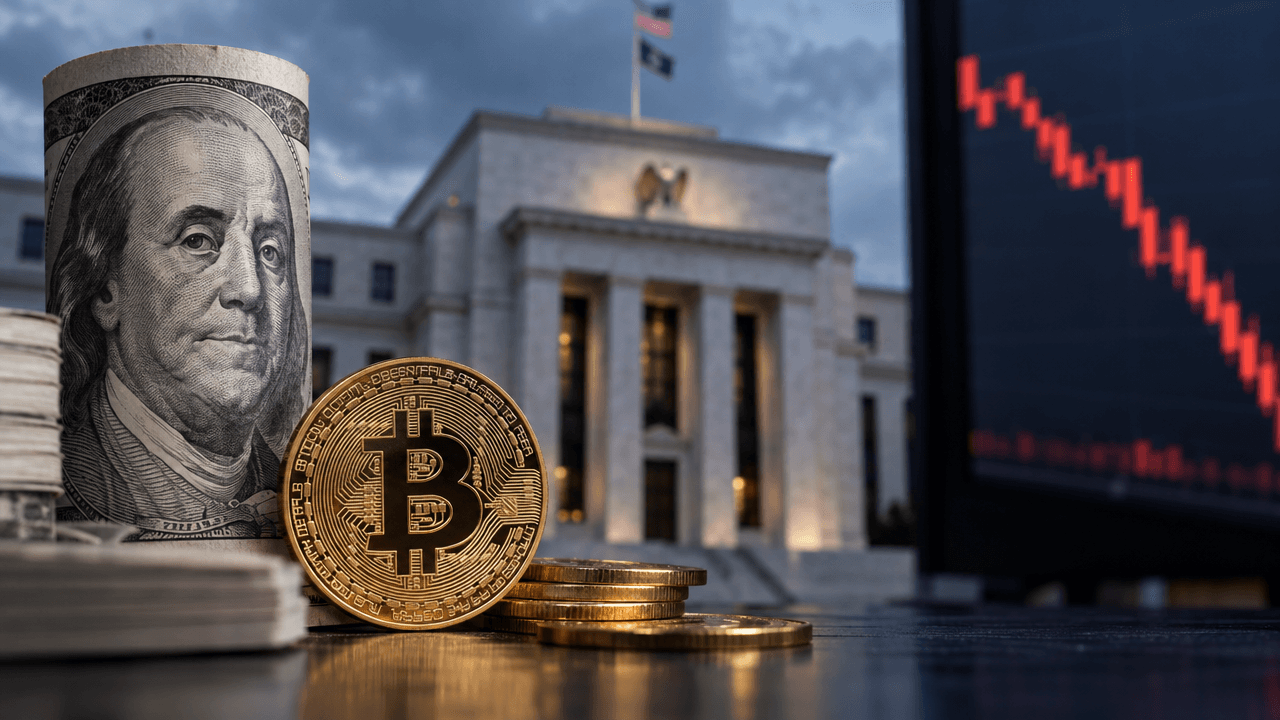
The Federal Reserve’s latest meeting minutes delivered a clear message to financial markets: the fight against inflation may not be over. Nearly all officials believed additional interest-rate increases could be appropriate to return inflation toward the central bank’s 2% objective. That hawkish signal strengthened the U.S. dollar and added pressure to Bitcoin, ether, and other risk-sensitive assets. [1]
For traders, the important development is not simply that another rate hike is possible. It is that the minutes challenged the assumption that the Fed’s previous pause marked the end of its tightening cycle. Markets are now reassessing how high rates may need to go, how long they could remain elevated, and what that means for assets that depend heavily on liquidity and investor risk appetite.
What The Fed Minutes Revealed
The minutes from the Federal Open Market Committee’s October 27–28 meeting indicated that almost all participating officials viewed further rate increases as potentially necessary under their baseline economic outlook. Policymakers linked those increases to the goal of returning inflation to 2% in a timely manner. [4]
The language was significant because it suggested broad agreement within the committee, even though officials had recently paused their rate increases. Some policymakers reportedly viewed the decision to hold rates steady as a close call, while others supported considering another increase in the months ahead. [9]
This does not guarantee that the Fed will raise rates at its next meeting. Monetary policy remains dependent on inflation, employment, consumer spending, and financial conditions. However, the minutes show that officials are not yet comfortable declaring victory over inflation.
For markets, expectations often matter as much as actual policy decisions. If investors believe rates could rise further, bond yields may increase, borrowing conditions can tighten, and valuations for speculative assets may come under pressure before any rate hike occurs.
Why Higher Rates Pressure Crypto
Cryptocurrencies do not generate interest income in the way that cash, Treasury bills, or many bonds do. When short-term rates rise, investors have more opportunities to earn relatively attractive returns from lower-risk instruments. That can reduce the appeal of holding volatile assets such as Bitcoin and ether.
Higher rates also tend to reduce available liquidity. Businesses and consumers face more expensive borrowing costs, while investors may become less willing to finance speculative projects or chase momentum trades. Crypto markets, which often respond strongly to changes in liquidity and risk appetite, can therefore react sharply to hawkish central-bank communication.
Bitcoin traded near $62,465 after the minutes were released, down nearly 3% according to market reports. [2] Ether and the broader crypto market also remained subdued as traders absorbed the possibility of additional tightening.
The reaction reflects a repricing of risk rather than a change in Bitcoin’s underlying technology. A hawkish Fed does not determine whether blockchain adoption expands or whether long-term demand for digital assets grows. It does, however, influence the financial environment in which those developments are valued.
THE DOLLAR’S ADVANTAGE
The same forces weighing on crypto can support the U.S. dollar. Higher expected interest rates can attract capital toward dollar-denominated assets because investors anticipate better returns on cash and government securities. A stronger dollar can also reflect expectations that the U.S. economy will maintain higher rates than other major economies.
The dollar’s strength matters to global markets because many commodities, loans, and financial assets are priced in U.S. dollars. When the dollar rises, non-U.S. investors generally face higher effective costs when purchasing dollar-priced assets. In crypto markets, a stronger dollar can create an additional headwind because Bitcoin and other tokens are commonly quoted in dollars.
Recent market coverage reported that the U.S. Dollar Index rose after the minutes, while higher-rate expectations also weighed on assets that do not pay interest. [14] This illustrates the broader relationship: hawkish policy can support the dollar while reducing demand for some risk assets.
Still, the relationship is not automatic. The dollar can weaken if investors interpret higher rates as damaging economic growth, or if another central bank adopts an even more aggressive stance. Traders should therefore monitor relative interest-rate expectations, not just the Fed in isolation.
What Traders Should Watch Next
The next stage of the market reaction will depend on incoming economic data and how Fed officials communicate their plans. Key indicators include inflation readings, labor-market reports, wage growth, retail sales, and measures of consumer demand.
Traders should also watch Treasury yields and the Dollar Index. If both continue to rise, financial conditions may tighten further, creating additional pressure on crypto and other speculative assets. If yields retreat despite hawkish language, markets may be signaling that investors expect economic weakness to limit the Fed’s ability to raise rates.
For SimFi traders, this is an opportunity to practice disciplined scenario planning:
Track the direction of yields and the dollar rather than reacting to headlines alone.
Separate a genuine trend from the first volatile move after a news release.
Use position sizing and predefined risk limits when trading around central-bank events.
Compare crypto performance with equities, commodities, and other risk assets.
Look for confirmation across several markets before assuming that a policy signal has created a lasting trend.
A hawkish Fed environment can produce sharp reversals. A trader who enters after an immediate decline may still face a short-covering rally, while a trader who buys a temporary bounce may be caught by renewed selling.
The Bigger Market Lesson
The Fed minutes reinforce a central principle of macro trading: liquidity and interest rates influence nearly every asset class. Crypto may be driven by adoption, network activity, regulation, and institutional flows, but it remains sensitive to the broader cost of capital.
For now, the combination of possible additional rate increases, firm Treasury yields, and a stronger dollar creates a challenging backdrop for Bitcoin and other risk assets. The pressure could ease if inflation cools convincingly or if economic data causes the Fed to reconsider its outlook. Until then, traders should treat monetary policy as a major market driver, manage exposure carefully, and avoid confusing a short-term rebound with a confirmed change in trend.