
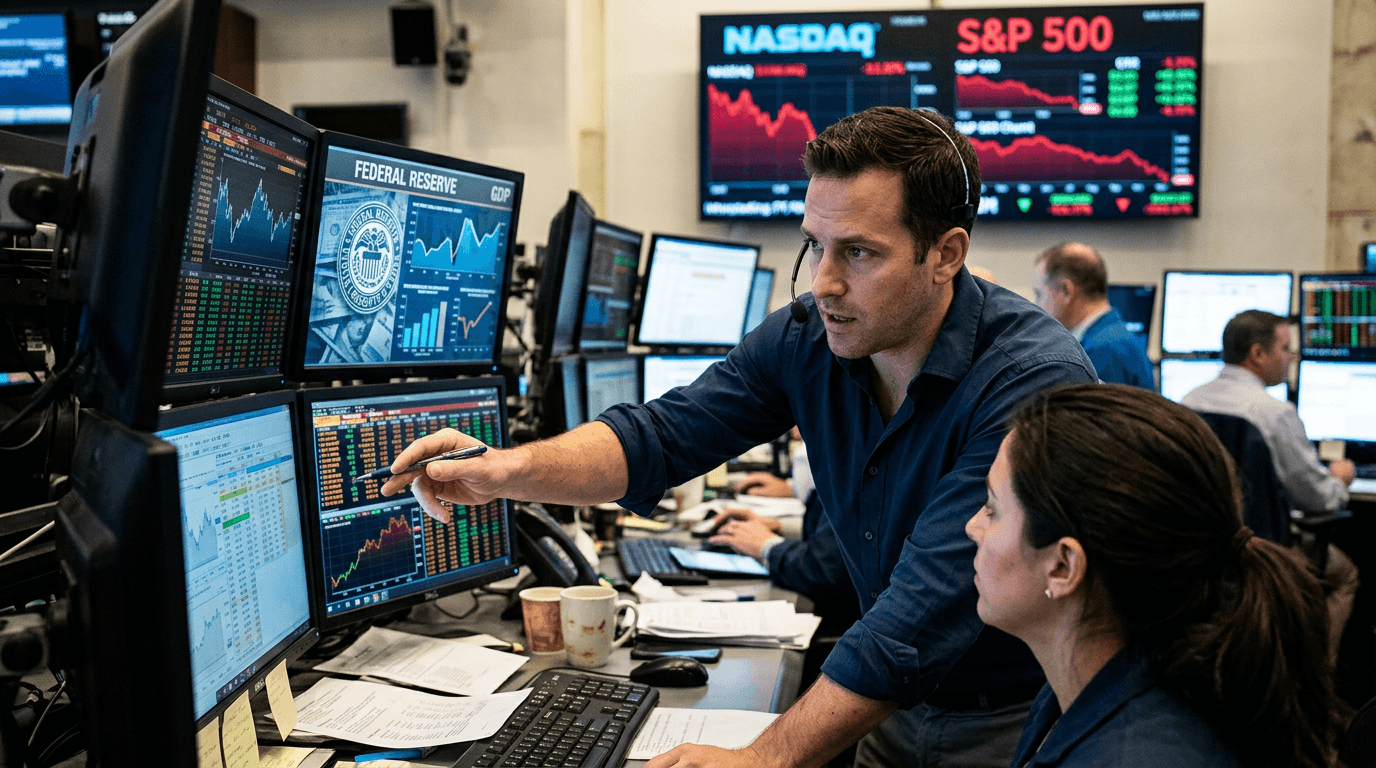
When central bankers talk, markets listen—and right now, the message from the Federal Reserve is louder and tougher than many traders had priced in. A more hawkish tone from Fed officials, combined with an upside revision to US Q1 GDP growth from 1.6% to 2.1% annualized, is forcing a fast repricing of rates, equity index, and FX futures as investors reassess how long policy might stay restrictive and how far yields can climb.
WHY THE FED’S HAWKISH TONE IS MOVING MARKETS
When the Fed is described as “hawkish,” it means policymakers are prioritizing fighting inflation, often by keeping interest rates higher for longer or signaling a bias toward additional tightening.[3][6] A hawkish stance typically implies concern that price pressures could re-accelerate, even if growth data still look healthy.[3]
Recent Fed communication has leaned in that direction. Updated projections suggest at least one more rate hike remains on the table, and several officials have emphasized that inflation is not yet comfortably back at the 2% target. In previous episodes, shifts in the Fed’s so‑called “dot plot” toward additional hikes have been enough to push yields higher and tighten financial conditions even without an immediate policy move.[1][2]
This is why tone matters almost as much as the actual rate decision. Markets are forward-looking: if Fed speakers guide investors toward a more restrictive path—fewer or later rate cuts, or even another hike—futures markets adjust quickly to reflect that new trajectory for the policy rate.[3][8]
GDP REVISION: STRONGER GROWTH, STICKIER INFLATION?
Layered on top of the Fed’s messaging is an important piece of data: US Q1 GDP growth was revised up to 2.1% annualized from an initial estimate of 1.6%. A stronger economy means demand is holding up better than expected, which is good news for growth but potentially problematic for inflation if it keeps the labor market tight and consumer spending robust.
From the Fed’s perspective, stronger growth can reduce the urgency to cut rates. When activity is soft, policymakers tend to lean more “dovish,” focusing on supporting jobs and output.[6][7] But when the economy shows resilience and inflation remains above target, the balance shifts toward maintaining or even increasing restraint—that is, staying hawkish.[3][6]
For traders, the combination of firmer GDP and hawkish Fed commentary sends a clear signal: the “higher for longer” scenario on rates is back in focus. Expectations for early or aggressive cuts tend to be priced out of futures curves, and term premiums in longer‑dated yields can rise as investors demand more compensation for holding duration in a world of persistent inflation risk.[2][9]
How Rates, Equities, And Fx Futures Are Repricing
In the rates complex, the immediate impact of a hawkish shift and stronger data is usually seen in Treasury and short‑term interest rate futures. Higher expected policy rates mean higher Treasury yields, which in turn translate into lower prices for Treasury futures contracts.[3][7] Fed funds and SOFR futures adjust as traders re-estimate the number and timing of future hikes or cuts embedded in the curve.
Equity index futures often come under pressure in a hawkish regime. Higher rates increase the discount rate used to value future cash flows, compressing price‑to‑earnings multiples and weighing most heavily on growth and high‑duration sectors.[7][9] While stronger GDP may support earnings, the market frequently reacts first to the rate shock, especially if the shift in expectations is abrupt.
In FX, a relatively more hawkish Fed tends to support the US dollar against currencies backed by more dovish or slower-moving central banks.[3][7] Higher yields make dollar assets more attractive on a relative basis, drawing capital flows and lifting USD‑denominated pairs. For FX futures traders, this can show up as a repricing of interest rate differentials, forward points, and implied volatility across major USD crosses.
Intraday and multi‑session volatility often spike when the market has to rapidly re-align with a new policy narrative. That volatility is both a risk and an opportunity for systematic and discretionary traders alike.
Implications For Futures And Simulated Traders
For traders operating in futures markets—or in a simulated finance (SimFi) environment that mirrors them—understanding this repricing dynamic is essential. Monetary policy repricing isn’t just about direction; it’s about the path and speed of adjustment.
In rates futures, a hawkish surprise and stronger GDP data may favor strategies that benefit from rising yields, such as short positions in longer‑maturity Treasury futures or curve trades that position for a bear‑flattening or bear‑steepening move, depending on where the market expects the Fed’s influence to be strongest.[2][3]
Equity index futures traders might look at sector rotation and index dispersion. Financials and value segments sometimes hold up better when yields rise, while long‑duration tech and growth names can be more sensitive to discount‑rate shocks.[7] Index futures provide a clean way to express views on broad risk sentiment around the Fed narrative without stock‑specific risk.
FX futures and currency index products can be used to trade the relative stance of central banks. A more hawkish Fed versus more dovish peers may support long‑USD positions, while any sign of a policy convergence (for example, if other central banks turn more hawkish) could drive mean reversion.[3][7]
In a SimFi setting, traders can rehearse these scenarios without capital at risk—testing how their strategies behave when dots move, when GDP surprises, or when a single hawkish speech triggers a broad repricing. This can help refine playbooks for live markets, from position sizing and leverage to hedging and intraday risk limits.
Key Takeaways For Your Trading Playbook
First, treat Fed communication as tradable data. The words, tone, and projections in speeches and press conferences often shift market expectations as much as scheduled releases. Learning to read hawkish versus dovish cues—and mapping them onto rate and futures curves—is a critical macro trading skill.[3][6]
Second, don’t overlook revisions. The move in Q1 GDP from 1.6% to 2.1% might look small at first glance, but in a late‑cycle environment where the Fed is hunting for clear signs of disinflation, that extra half‑point of growth can be the difference between cuts being imminent and cuts being delayed. Revisions can change the narrative, not just confirm it.
Third, think cross‑asset. A hawkish pivot plus stronger growth rarely stays confined to one market. Rates, equities, and FX are all linked through the discount rate, risk sentiment, and capital flows. Building a framework that tracks how shocks propagate across these assets can reveal relative‑value and hedging opportunities that a single‑asset view might miss.[3][7][9]
Finally, use periods like this to stress‑test your approach. Ask: How does my strategy perform if the market prices out another 50–75 basis points of cuts? What if the Fed delivers that extra hike? Am I overly dependent on a “soft landing with fast cuts” narrative, or can I adapt to “higher for longer”? A clear, rules‑based response to policy repricing can be the difference between being whipsawed by volatility and using it to your advantage.