
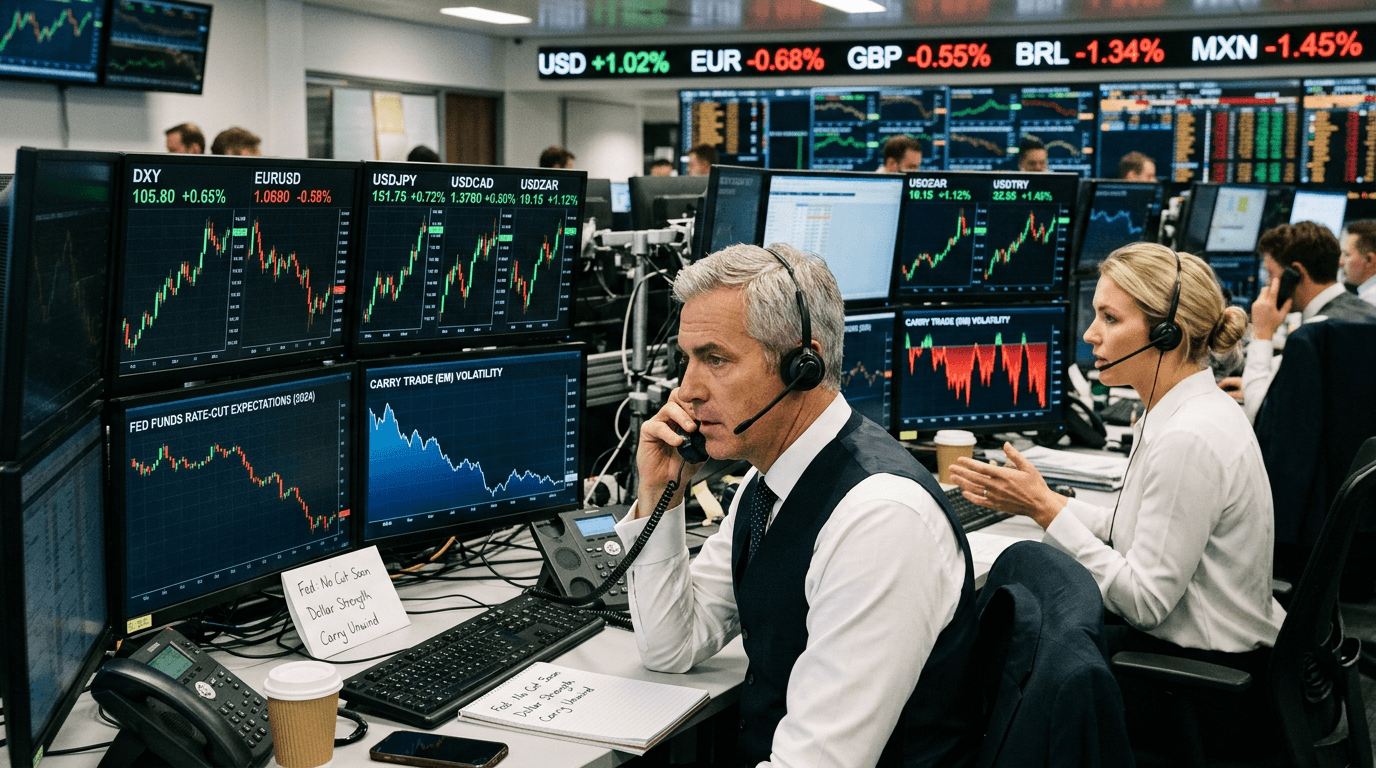
The US dollar is holding firm near recent highs as a stream of hawkish Federal Reserve rhetoric keeps hopes for imminent rate cuts firmly in check. With Fed officials stressing that inflation remains “too high” and that policy needs to stay restrictive for longer, traders have been forced to rethink how quickly the central bank will ease, supporting the greenback against both major and emerging market currencies.[6][7]
WHAT IS DRIVING THE DOLLAR’S STRENGTH?
At the core of the move is the simple relationship between interest rates and currencies: higher or more persistent yields tend to attract capital, boosting the currency. When the Fed signals a willingness to keep rates elevated, it widens or preserves the interest-rate differential between the US and economies that are closer to cutting, such as the euro area or the UK.[3][4][7]
Recent comments from Federal Reserve officials, including Cleveland Fed President Beth Hammack, have reinforced this narrative by emphasizing that inflation is still running above target and that there is “no urgency” to cut rates. That message has pushed traders to dial back expectations for the number and timing of rate cuts implied by Fed funds futures, lifting short‑term US yields and underpinning the dollar.[6][7]
The broader macro backdrop is helping, too. The US economy has remained relatively resilient, while global risk sentiment has been choppy, prompting some safe‑haven flows into the dollar.[6][8] As a result, the US Dollar Index (DXY), which tracks the greenback against a basket of major currencies, is consolidating near elevated levels after breaking higher in recent weeks.[2][3][4]
How Fed Rhetoric Shapes Rate Expectations
The Fed does not have to move rates at every meeting to influence markets; sometimes its words are enough. Hawkish rhetoric—talk that emphasizes inflation risks, data dependence, and the potential need for “higher for longer” rates—can be almost as powerful as an actual hike in driving expectations.[9]
Traders translate this rhetoric into prices via instruments like Fed funds futures and interest‑rate swaps. When officials sound more hawkish than anticipated, the implied path of rates shifts higher: fewer cuts are priced in, or they are pushed further into the future. That repricing tends to push up US two‑year and five‑year yields, which are closely watched by FX markets as proxies for the policy outlook.[3][7]
Importantly, this is not just about the Fed in isolation. What matters for currencies is the relative stance of central banks. If the European Central Bank or Bank of England are perceived to be closer to easing while the Fed holds a hawkish line, interest‑rate differentials move in favor of the dollar, pressuring EUR/USD and GBP/USD.[3][4]
PRESSURE ON EUR/USD, GBP/USD AND EM FX
The euro and pound have been squeezed as the Fed’s stance contrasts with more cautious tones from European policymakers. EUR/USD has drifted lower as rate differentials have widened, with traders increasingly comfortable selling rallies toward resistance levels as long as US yields remain supported.[1][3]
GBP/USD faces a similar dynamic. Even if UK inflation is sticky, growth concerns and a more balanced Bank of England outlook make it harder for sterling to compete with the dollar’s yield and safe‑haven appeal. The result is a market where risk‑reward often favors dollar strength on spikes higher in cable.
Emerging market currencies (EM FX) feel the pressure even more directly. Many EM economies are already easing or considering cuts to support growth. When the Fed stays hawkish, the yield advantage that previously attracted “carry trade” flows into higher‑yielding EM currencies can erode.[6][7] That encourages investors to rebalance back toward USD assets, putting depreciation pressure on EM FX pairs and raising funding costs for those economies.
What This Means For Carry Trades And Positioning
Carry trades—borrowing in a low‑yield currency to invest in a higher‑yielding one—are highly sensitive to shifts in rate expectations and volatility. A stable, predictable Fed easing path tends to support carry, as traders feel comfortable holding higher‑yield exposures in EM or high‑beta currencies.
Hawkish Fed messaging changes that calculus. If markets conclude that US rates will stay high for longer, the dollar becomes more attractive as an asset currency rather than just a funding currency. At the same time, the risk of bouts of volatility increases, as any upside surprise in US data (like inflation or jobs) can trigger fast repricing. That combination can make carry trades less appealing and more fragile.
Traders are responding by trimming leverage, shortening time horizons, and favoring pairs where the macro narrative is clearer. For some, that means rotating from long EM FX exposure into more defensive USD positions, or using options to hedge sudden spikes in the dollar.[6][7]
Practical Takeaways For Traders And Simulated Strategies
For discretionary and systematic traders alike—whether in live markets or on a SimFi platform—this environment calls for a more macro‑aware approach to FX and rates. A few practical points stand out:
First, anchor your bias to rate differentials. Track US two‑year yields, Fed funds futures, and policy commentary alongside equivalent indicators in the euro area, UK, and key EMs. When differentials move in favor of the dollar, rallies in EUR/USD or GBP/USD often present opportunities to re‑engage on the short side, provided technical levels confirm the setup.[1][3][4]
Second, respect the regime shift. A firm dollar supported by a hawkish Fed is not just a single trade; it can define a multi‑month macro regime where USD dips are shallow and often bought, and high‑beta currencies underperform.[1][6][7] Position sizing and risk limits should reflect the possibility of extended trends and sharp squeezes around major data releases.
Third, integrate scenario planning into your strategy. Ask: what would it take for the Fed to turn less hawkish—clear, sustained disinflation, a notable softening in the labor market, or financial‑stability concerns? Map out how EUR/USD, GBP/USD, USD/JPY, and key EM pairs might react under each scenario, and use that framework to guide your trade selection and hedging.
In a simulated environment, traders can test these ideas without capital at risk: exploring how portfolios behave if the dollar continues to grind higher, or if the Fed unexpectedly pivots dovish. That kind of structured experimentation helps build intuition for how central bank rhetoric, yield curves, and FX trends interact—skills that translate directly into more disciplined decision‑making when real money is on the line.
As long as Fed officials keep emphasizing persistent inflation risks and the need for restrictive policy, the burden of proof remains on the data to justify cuts. Until that changes, the path of least resistance is for the dollar to stay supported, with rate‑cut expectations capped and traders adapting to a market where “higher for longer” is once again the dominant theme.