
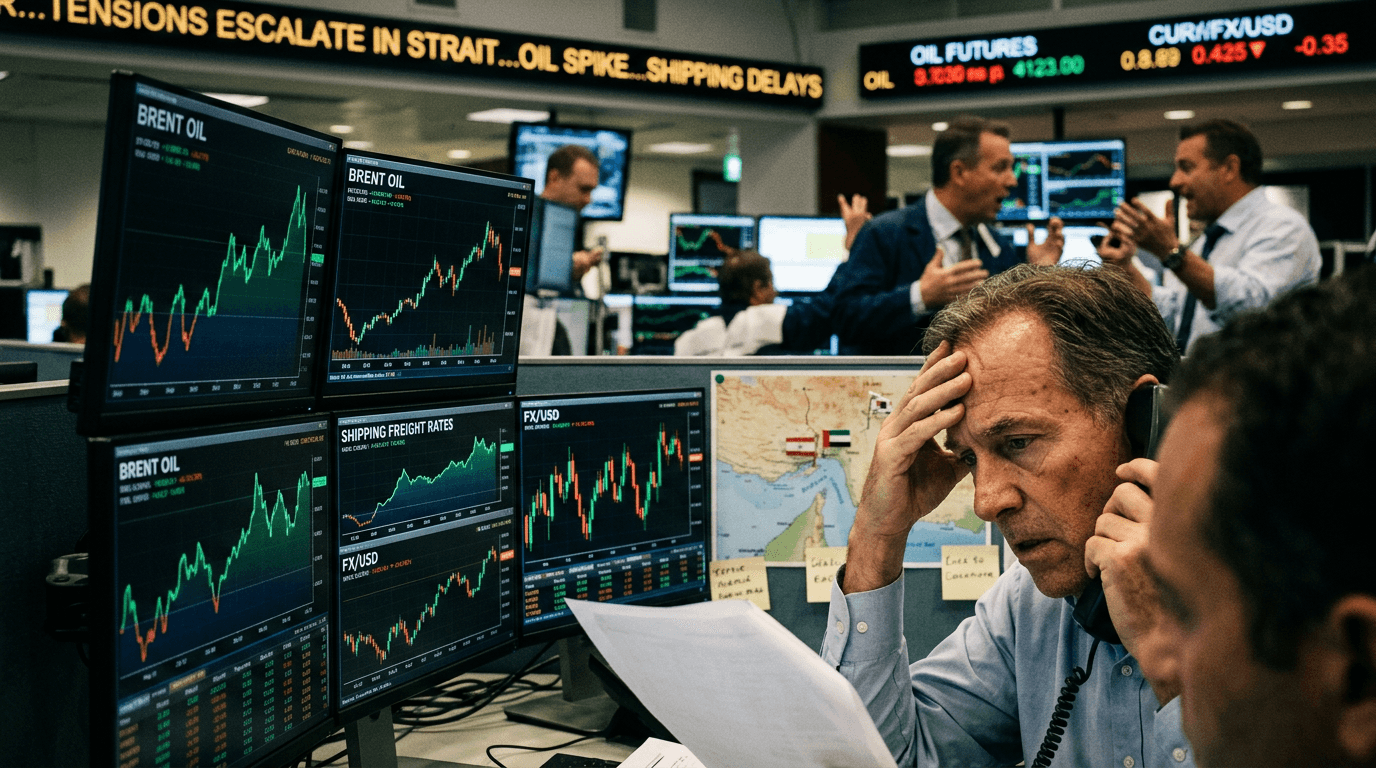
Geopolitical tension around the Strait of Hormuz has rapidly moved from background noise to a core driver of commodity volatility, forcing traders to reassess how much risk they are willing to price into oil, shipping, and related FX pairs[1][2][3]. As negotiations stall, rhetoric hardens, and shipping remains disrupted, markets are discovering that “deadlock” can be just as volatile as outright escalation[3][4][5].
Geopolitical Flashpoint: Why Hormuz Matters
The Strait of Hormuz is one of the most strategically important chokepoints on the planet, with roughly 20% of global oil and liquefied natural gas flows typically passing through its narrow waters[2]. When conflict between the United States and Iran led to a prolonged disruption and partial closure of the strait earlier this year, the impact ricocheted across energy markets almost immediately[2][6].
Recent headlines show how this deadlock has hardened. Iranian officials have signaled that Hormuz will remain closed unless Washington changes its stance and accepts Tehran’s conditions to end the war, effectively tying critical shipping flows to high-stakes political concessions[1][5]. At the same time, U.S. officials and former President Trump have floated plans and rhetoric framed around restoring “freedom of navigation” and asserting control over the waterway, adding another layer of uncertainty for traders watching for potential military or policy shifts[8][12].
This combination of entrenched demands and assertive language is what makes the current phase a true “deadlock”: neither side is signaling willingness to compromise, yet both possess levers that can materially influence global supply and risk sentiment[1][3][5]. For commodity traders, the message is clear: geopolitical risk is no longer tail risk around Hormuz—it is the base case.
Market Reaction: Oil, Shipping And Fx In Two-way Play
Price action over the past weeks has illustrated classic two-way geopolitical volatility. Oil has rallied sharply on days when negotiations stall or restrictive shipping plans emerge, with Brent crude up around 5% on multiple sessions as doubts over reopening the strait intensify[3][8][11]. Drafts of restrictive Iranian conditions for traffic and statements that Hormuz will stay shut have pushed Brent into the high 80s and towards $90 a barrel, while lifting WTI into the low 80s[4][5][14].
Yet the same market has sold off just as quickly on reports of progress toward a ceasefire or potential deals involving regional mediators, reinforcing that headlines can trigger both rallies and reversals as traders digest each new data point[6][7][13]. The International Energy Agency has even cut its 2026 oil demand forecast, noting that Hormuz-driven volatility recently sent Brent above $100 a barrel before dropping it near $70, a range that underscores the magnitude of uncertainty embedded in prices[15].
Shipping and Gulf equities have responded in kind. Attacks on vessels and persistent blockages in Hormuz have supported higher freight rates and bolstered tanker names, while broader Gulf markets trade mixed as oil gains are offset by growth and demand concerns[4][9][13]. In FX, commodity-linked currencies and traditional safe havens have seen increased intraday swings as traders position around shifts in risk appetite, with flows rotating into defensive assets when escalation risk dominates and back into risk-sensitive pairs when de-escalation headlines surface[13][15].
Risk Premia And Volatility: What The Market Is Pricing
Behind these moves lies a repricing of risk premia. The “geopolitical premium” in crude is the extra price traders are willing to pay to compensate for the probability of supply disruption, sanctions, or military confrontation[2][3]. During the Hormuz crisis, this premium has expanded materially: prompt barrels have traded richer than deferred contracts, and the curve has periodically moved into stronger backwardation, signaling elevated near-term risk[3][7][15].
Options markets add more detail. Implied volatility on crude and related energy options has climbed, reflecting the market’s expectation of larger price swings as the crisis evolves[3][15]. Skew can also widen, with traders willing to pay more for upside calls when they fear sudden supply shocks, and for downside puts when they worry that a peace deal or demand downgrades could swiftly deflate prices[6][15].
Importantly, this is not a one-direction story. The same event risk that can send Brent through $90 or $100 on escalation can pull it sharply lower if a credible reopening framework or ceasefire emerges[6][10][15]. That dynamic is what defines “two-way volatility”: traders are not just hedging against higher prices; they are also preparing for the possibility that risk premia evaporate faster than expected.
Trading Implications In A Simulated Environment
For traders using a SimFi platform like E8 Markets, the Hormuz deadlock offers a live case study in how to navigate geopolitical risk without real capital at stake. In a simulated environment, participants can test how different strategies perform under conditions of event-driven volatility, shifting risk premia, and cross-asset correlation shocks.
One practical exercise is scenario analysis. Traders can construct hypothetical paths where negotiations fail, shipping attacks intensify, and energy prices gap higher, alongside alternative paths where a surprise diplomatic breakthrough restores traffic and compresses the geopolitical premium[3][4][6]. Observing how crude futures, shipping proxies, and commodity FX pairs respond in each scenario builds intuition about how geopolitical drivers transmit through markets[13][15].
Another focus area is risk management. With daily moves of 3–5% in crude and frequent reversals, position sizing, diversification, and hedging become crucial[3][4][8]. Simulated strategies might pair directional crude positions with options, use cross-hedges in related FX or equity indices, or layer stop-loss and take-profit levels designed to respect volatility rather than fight it. Because SimFi removes the emotional pressure of real P&L, it allows traders to refine disciplined processes tailored to high-uncertainty regimes.
Practical Playbook For The Week Ahead
In the near term, traders face a landscape shaped by a few core drivers: stalled negotiations, continued Hormuz disruption, and evolving U.S. rhetoric on control and navigation rights[1][3][5][12]. Translating that into a practical playbook, several themes stand out:
1) Expect headlines to matter more than data. Oil and related assets are currently more sensitive to geopolitical updates than to routine economic releases, so intraday monitoring of news flow is essential[3][4][13].
2) Plan for gaps and reversals. The recent pattern of sharp rallies on negative news followed by rapid givebacks on de-escalation headlines suggests that mean-reversion and breakout strategies can both find opportunities, but only with strict risk controls[6][7][10][15].
3) Watch cross-asset confirmation. Moves in crude that align with shifts in tanker rates, Gulf equities, and safe-haven demand tend to be more durable than isolated price spikes, offering traders a way to filter signal from noise[4][9][13][15].
4) Treat implied volatility as information, not just a cost. Elevated option prices reflect the market’s assessment of risk; comparing implied and realized volatility can help identify periods when markets may be under- or over-pricing future swings[3][15].
Ultimately, the Hormuz deadlock is less about predicting a single outcome and more about managing a distribution of possibilities.
Thoughtful trading in this environment starts with acknowledging that geopolitics can change faster than fundamentals. The current standoff, shaped by hardened Iranian demands and assertive U.S. rhetoric around control of a vital chokepoint, has injected a durable risk premium into oil and broader commodity markets while keeping directionality highly uncertain[1][3][5][8][12][15]. For traders, especially those honing their skills in simulated settings, the priority is not to guess the next headline, but to build strategies that can survive and adapt as the story evolves. In a world where a narrow strait can swing global prices by tens of dollars, disciplined risk management and cross-market awareness are no longer optional—they are the edge.