
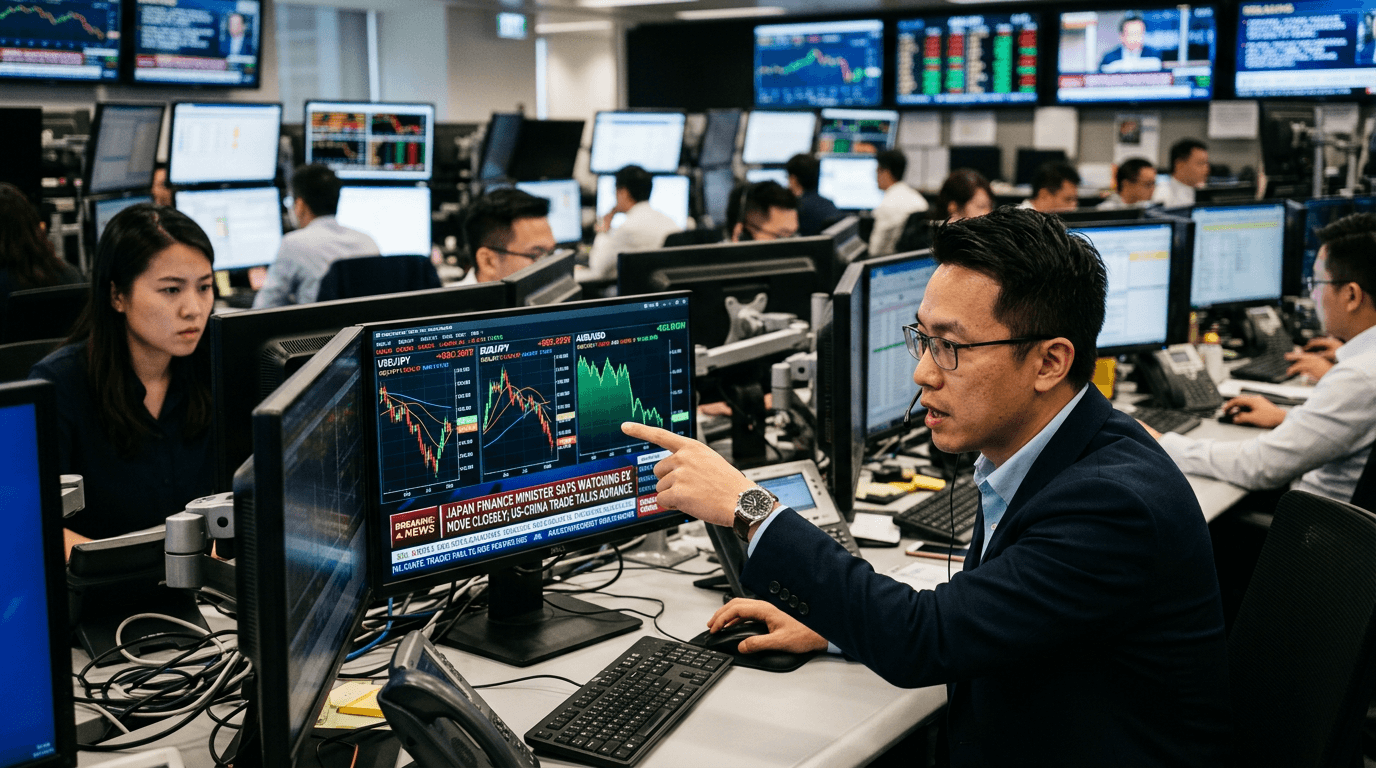
Asian currency markets are increasingly trading on headlines rather than hard data, with comments about FX intervention and shifting trade deals driving sharp, intraday moves across the region. For traders, that means price action in spot FX and related risk assets can change direction quickly as rhetoric evolves, even when fundamentals look broadly unchanged.
Intervention Rhetoric Returns To Center Stage
FX intervention is not a new tool in Asia, but the tone and frequency of official comments have become a major driver of volatility in currencies like the Japanese yen and Chinese yuan. When Japanese officials reiterate that they are “ready to respond” to excessive currency moves as the yen tests multi‑decade lows, traders immediately reassess the risk of a sudden, large‑scale intervention in the market[1][2]. More recently, Japan’s FX chief has warned of “decisive” action against speculative moves in the yen, signaling a willingness to step in more aggressively if short‑selling accelerates[8]. Officials have even shifted toward more “ambush” style tactics, avoiding predictable warning patterns to catch speculators off guard and increase the cost of betting against the yen[13]. These shifts in rhetoric alone can trigger sizeable reversals intraday, as leveraged positions rush to reduce exposure ahead of potential official action.
China’s currency management continues to rely heavily on the daily fixing of the USD/CNY midpoint, which has become another focal point for headline‑driven moves. When the People’s Bank of China sets the midpoint notably stronger or weaker than market estimates, it is interpreted as a policy signal on how much depreciation or appreciation is tolerated[12]. Even small deviations relative to expectations can ripple through regional FX, as traders adjust views on China’s growth outlook, capital flows, and competitive pressures on neighboring export economies.
Trade-deal Headlines And Diverging Currency Paths
Alongside intervention rhetoric, trade‑deal headlines are reshaping the narrative for several Asian currencies, often in divergent ways. The recent U.S.-Taiwan semiconductor agreement, which pairs large Taiwanese investment commitments in U.S. manufacturing with reduced reciprocal tariffs, has been a clear positive for Taiwan’s technology sector and broader risk sentiment[5]. Equity indices linked to chips and high‑tech manufacturing have outperformed on deal optimism, providing support to the Taiwan dollar as investors price in stronger longer‑term capital inflows and industrial demand[5].
In contrast, trade deals that combine cooperation with higher tariffs can weigh on risk sentiment and FX. The U.S.-Vietnam agreement, which introduces tariffs of 20% on Vietnamese imports and even higher levies on goods rerouted via Vietnam, has triggered more cautious trading in regional equities and FX[6]. Markets have responded tepidly, with several major Asian indices declining as investors digest the potential drag on export‑oriented sectors and supply chains[6]. Even when Wall Street indices trade at record highs, such tariff‑heavy deals can cap appetite for risk in Asian currencies viewed as tightly linked to global trade cycles[6].
Elsewhere, frameworks for trade deals such as the recent U.S.-UK arrangement, which maintains some tariffs while lowering others, have tended to support pro‑risk currencies like the Japanese yen via equity strength when they are seen as de‑escalating broader trade tensions[10]. Limited trade deals between the U.S. and Japan focused on agriculture and digital trade have also lifted Japan’s Nikkei index while leaving some uncertainty around auto tariffs in the background, contributing to mixed but generally constructive sentiment for the yen[15]. The key takeaway is that not all trade headlines are equal: market reaction depends on whether they lower or raise effective tariff burdens and how they shift expectations for future deal rounds.
How Headlines Translate Into Fx Price Action
Intervention talk and trade‑deal news tend to affect Asian currencies through three main channels: spot FX, carry and hedging flows, and broader risk sentiment.
First, spot FX prices move directly as traders reprice the probability of official action or policy shifts. A single comment about “decisive” intervention or a stronger‑than‑expected CNY fix can cause rapid repricing, with intraday swings of 1% or more in heavily traded pairs like USD/JPY and USD/CNH when positioning is stretched[8][12][13]. These moves are often amplified by stop‑loss orders and algorithmic trading strategies that key off headline feeds.
Second, expectations for future volatility and policy direction influence carry trades and hedging demand. If intervention rhetoric suggests a cap on further depreciation, investors may be more willing to hold local‑currency assets without aggressive hedging, supporting those currencies. Conversely, tariff‑heavy trade deals that raise uncertainty about export revenues typically increase demand for FX hedges and may pressure currencies linked to global manufacturing hubs[6].
Third, equities and credit markets across Asia often react quickly to trade headlines, feeding back into FX. When semiconductor shares rally on the U.S.-Taiwan deal, the Taiwan dollar benefits from portfolio inflows and improved sentiment[5]. When indexes in Hong Kong, Shanghai, Tokyo, and Sydney fall in response to tariff‑laden agreements, high‑beta currencies tied to these markets can soften, even if the immediate trade balance impact is not yet visible[6].
Practical Playbook For Simulated Fx Traders
For traders on simulated finance platforms like E8 Markets, this environment offers fertile ground to practice headline‑driven strategies without capital at risk. The first practical step is to build a routine around tracking official FX comments and trade‑deal news. Identify key policymakers in Japan, China, and other Asian economies, and note how their standard language evolves over time. When phrasing shifts from “closely monitoring” to “decisive action,” treat it as a change in the regime, not just another soundbite.
Second, experiment with scenario testing. For example, design simulated trades that express different views on the yen depending on the next intervention‑related headline: one scenario where authorities stay on the sidelines despite verbal warnings, and another where a surprise “ambush” intervention forces rapid yen appreciation[13]. Compare how spot moves, volatility, and correlated assets like equity indices behave under each scenario, and refine your risk‑management rules accordingly.
Third, link trade‑deal headlines to sector and currency performance. Test how export‑focused currencies respond when tariffs are reduced versus increased, using examples like the U.S.-Taiwan semiconductor arrangement as a template for positive spillovers[5] and the U.S.-Vietnam deal as a case study in tariff‑driven caution[6]. Build simple playbooks: which currencies tend to benefit from tech‑friendly agreements, which are most exposed to textile or manufacturing tariffs, and how quickly markets usually fade an initial reaction.
Finally, treat simulated trading as a laboratory to learn how not to overreact. Headlines can be noisy, and markets sometimes reverse within hours as details emerge. Use SimFi to rehearse waiting for fuller information, layering into positions rather than chasing the first spike, and setting predefined levels where you will reassess rather than panic‑close trades.
Conclusion: Navigating An Era Of Policy Noise
Asian currencies sit at the intersection of FX intervention rhetoric and evolving trade‑deal dynamics, making them particularly sensitive to policy‑driven headlines. Comments from officials in Japan and China, along with tariff‑shaping agreements across the region, are now central to day‑to‑day price action in spot FX and broader risk sentiment[1][5][6][12][13]. For traders, this environment demands not only technical skill but also an ability to interpret policy language and connect geopolitical developments to currency behavior. Simulated finance platforms provide an ideal space to build that skill set: learning how intervention talk may foreshadow actual action, how different trade deals can either underpin or undermine a currency, and how to structure strategies that remain resilient amid rapid, headline‑driven swings. By approaching this market as a complex but learnable ecosystem of policy signals, traders can turn volatility from a source of anxiety into a source of opportunity.