
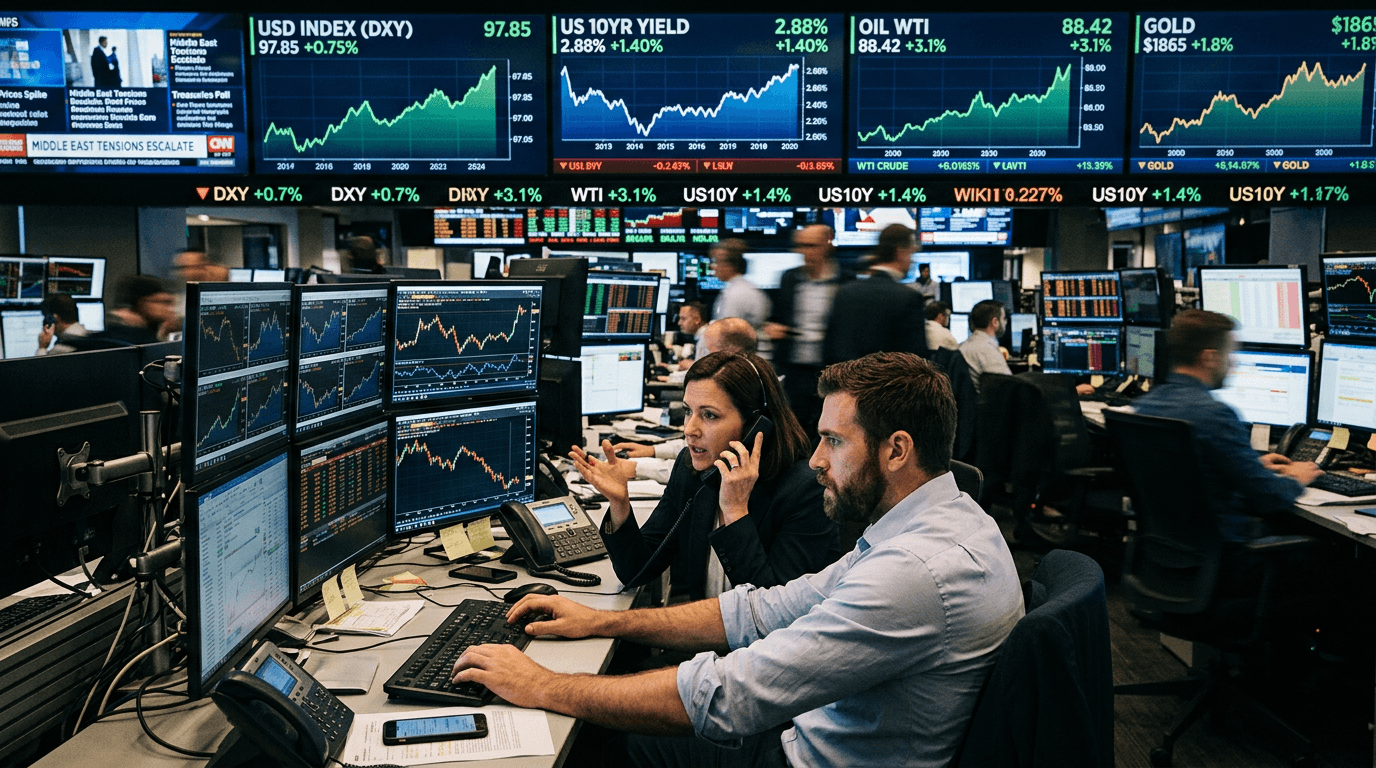
Safe-haven flows have returned to the forefront of global markets as Middle East tensions keep the dollar firm and push global bond yields to multi‑week highs, rippling across FX and commodity futures curves.[2][3][7] For traders, this environment blends geopolitical uncertainty with shifting macro expectations, creating both risk and opportunity in simulated and live markets.
Current Market Backdrop
Escalating conflict around key shipping routes and energy infrastructure has driven a renewed bid for the U.S. dollar, with the greenback trading near recent highs against a broad basket of currencies.[2][3][11] U.S. Treasury yields have climbed back toward the 4.6–4.7% area on the 10‑year, with long bonds holding above 5%, signaling a combination of safe‑haven demand and revived inflation worries from higher oil prices.[3][7][12]
The move is not limited to the U.S. curve: core European yields, including German Bunds, have pushed higher as investors demand more compensation for geopolitical and inflation risk.[4][7] Oil prices have spiked on fears of sustained supply disruption, while gold has oscillated as investors weigh its safe‑haven status against rising real yields.[8][12][14] The net result is an elevated volatility regime across FX and commodity futures, with risk assets and high‑beta currencies under pressure.[2][6][14]
Why Geopolitical Risk Lifts Dollar And Yields
Geopolitical shocks typically work through three main channels: safe‑haven flows, commodity supply shocks, and shifts in macro expectations.[6][9] The dollar benefits on two fronts: it is a traditional safe haven, and it is the global funding currency for trade and commodities, so demand for dollar liquidity tends to rise when uncertainty spikes.[2][6][11]
At the same time, oil price surges raise the prospect of stickier inflation, especially if disruptions persist or extend, pushing investors to reassess the path of central bank rate cuts.[3][5][12] That repricing shows up in higher nominal yields, particularly at the intermediate and long end of the curve, where inflation expectations and term premia are embedded.[3][7][12] As yields rise, the carry and real yield advantage of dollar assets becomes more attractive, reinforcing currency strength against lower‑yielding or higher‑risk peers.[3][11]
Global sovereign risk premia also tend to widen around major geopolitical events, especially for commodity‑importing emerging markets with weaker fiscal buffers.[9] This broad tightening in financial conditions can further support the dollar, as investors trim exposure to EM debt and FX and rotate into perceived safer assets.[9][11]
Implications For Fx: Winners, Losers, And Vol Regimes
In this environment, FX markets often split into three buckets: safe havens, commodity‑linked currencies, and high‑beta or carry‑dependent currencies.[6][14] The dollar, yen, and Swiss franc usually benefit from risk‑off flows, although the dollar currently has the clearest yield support, while Japanese yields remain low and policy settings more accommodative.[3][6][11]
Commodity exporters such as CAD and NOK can see mixed performance. Higher oil prices support their terms of trade, but if the global risk tone deteriorates sharply, broad risk‑off selling can still weigh on these currencies versus the dollar.[6][14] For EM and high‑beta FX, rising U.S. yields and wider sovereign spreads often translate into funding stress, weaker FX, and increased volatility as investors unwind carry and leverage.[9][11][14]
For simulated FX traders on platforms like E8 Markets, this backdrop is ideal for stress‑testing strategies that rely on carry, trend‑following, or volatility breakout signals. Scenario building around further escalation, partial de‑escalation, or energy supply normalization allows traders to map potential paths for USD crosses, high‑beta pairs, and safe‑haven baskets.[6][9]
Commodity Futures: Geopolitical Risk Premium And Volatility
Commodity futures exhibit a distinct geopolitical risk premium, especially in energy and some metals.[10] Periods of elevated geopolitical tension tend to see higher implied volatility and a bid into contracts most exposed to disruption risk, such as front‑month crude, refined products, and key benchmark blends.[6][10][14]
Research on the geopolitical risk premium shows that futures with higher exposure to such risks can deliver lower risk‑adjusted returns once investors crowd into them as hedges, effectively compressing expected excess returns.[10] In practice, that means traders often go long these contracts in risk‑intense periods to hedge broader portfolios, bidding up prices and shifting the entire curve.[10][14]
Gold sits at the intersection of geopolitical risk and real yield dynamics. When tension rises and real yields fall, gold typically enjoys strong safe‑haven demand; when nominal yields surge and inflation expectations stabilize, the opportunity cost of holding gold rises and its performance can become choppy.[8][12][14] The current environment—higher yields, higher oil, and persistent geopolitical headlines—naturally supports higher realized volatility in gold futures, even if direction is less one‑way.
For SimFi traders, this is a natural lab for testing cross‑asset strategies that link FX, oil, and gold—such as long USD versus high‑beta FX paired with long crude volatility or options structures that express views on the spread between gold and real yields.[6][10][14]
How Simfi Traders Can Navigate The Tensions
Simulated finance platforms allow traders to engage with these dynamics without capital at risk, making them valuable training grounds when geopolitical shocks dominate the tape. Several practical approaches stand out:
1) Build geopolitical scenarios: Construct at least three paths—continued escalation, controlled stalemate, and rapid de‑escalation—and map expected moves in dollar indices, key yield benchmarks, and front‑month crude and gold futures.[6][9]
2) Stress‑test carry and correlation assumptions: Backtest how carry trades and risk‑on correlations behaved in previous risk episodes, then apply those insights to current high‑beta FX pairs and commodity‑linked currencies.[6][9][11]
3) Focus on volatility, not just direction: Simulate strategies that trade implied versus realized volatility in oil and gold, rather than only outright directional bets, reflecting the empirical finding that geopolitical risk is often priced via volatility and premia rather than linear trends.[10][14]
4) Integrate risk management rigor: Use position limits, scenario‑based stop‑losses, and dynamic hedging (e.g., pairing FX exposure with commodity futures) to practice institutional‑style risk controls that become crucial when markets are headline‑driven.[6][9]
Conclusion
Middle East tensions have reignited classic risk‑off patterns: a stronger dollar, higher global yields, and elevated volatility across FX and commodity futures.[2][3][7] The combination of safe‑haven demand, rising energy prices, and repriced inflation risk is reshaping the opportunity set for traders who understand the transmission channels between geopolitics, macro, and market pricing.[3][6][12]
For participants in simulated environments, this period offers a timely chance to refine playbooks for geopolitical shocks, stress‑test strategies against higher‑volatility regimes, and deepen cross‑asset thinking that connects currencies, rates, and commodities.[6][9][10] Regardless of whether tensions escalate or fade, the skills built in navigating such episodes—scenario planning, disciplined risk management, and data‑driven analysis—will remain valuable long after the current headlines pass.