
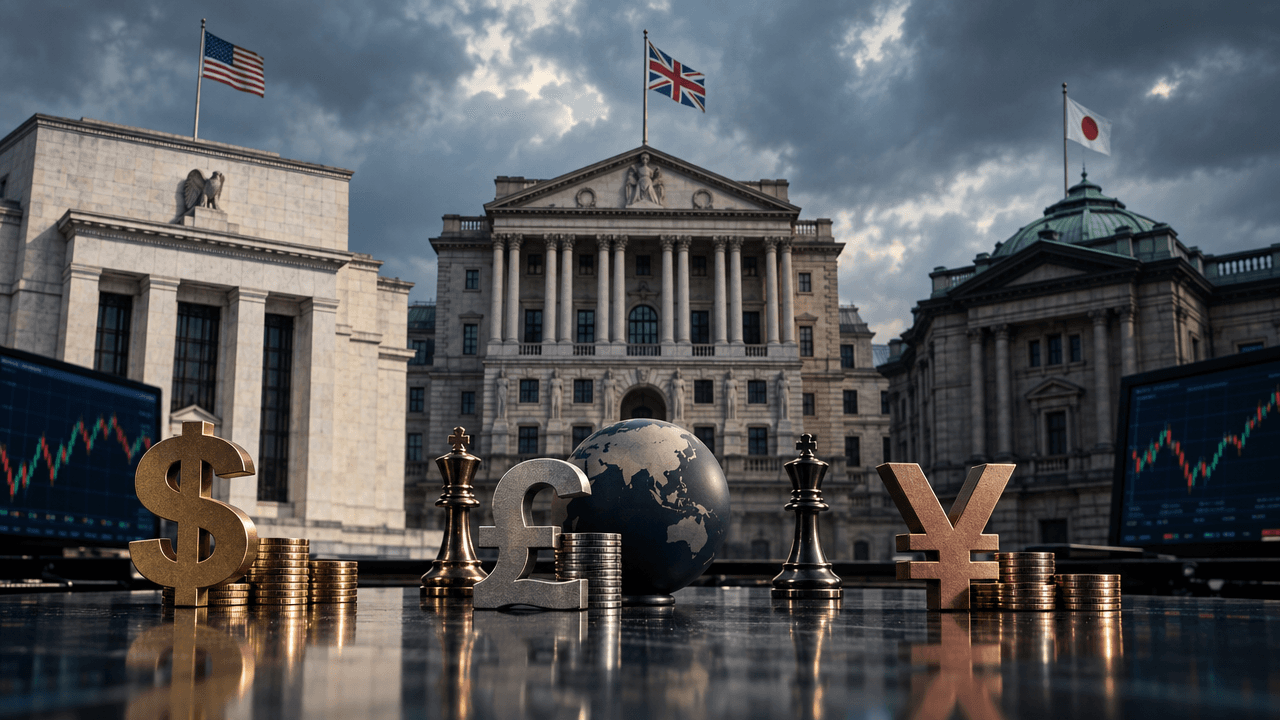
Global markets are in the middle of a regime shift as investors digest a more hawkish global interest-rate backdrop, with policy decisions from the Federal Reserve, Bank of England and Bank of Japan reshaping cross-asset dynamics. These moves are feeding directly into USD/JPY, GBP pairs, yen volatility, bond futures and overall risk sentiment, forcing traders to reassess both macro views and day-to-day positioning.
Global Central Banks Turn The Screw
The Federal Reserve has lifted the federal funds target range to 3.75%–4.00%, continuing a tightening cycle aimed squarely at cooling inflation that has proven sticky across key components of the US economy.[10] This 25 basis point move reinforces the message that policy is firmly restrictive, and that the Fed is prepared to keep rates elevated for longer if price pressures do not moderate convincingly.[10]
In contrast, the Bank of England has held its benchmark rate at 3.75% for the sixth consecutive meeting, even as UK inflation remains above the bank’s 2% target.[7][8][15] A split Monetary Policy Committee and persistent energy-driven price risks mean the BoE is signaling a hawkish bias, with future tightening still on the table if inflation re-accelerates.[8][15]
The Bank of Japan has delivered one of the most notable shifts, raising its short-term policy rate from 1.0% to 1.25%, the highest level in more than three decades.[1][2][6][12][13][14] After years of ultra-loose policy, the BoJ is responding to rising inflation, wage gains and upside risks that price growth could exceed its 2% target.[1][3][12][13] This marks another step toward “normalizing” Japanese rates and reduces the attractiveness of the yen as a funding currency for global carry trades.[3][12][13]
Diverging Policy Paths And Currency Moves
These policy decisions are not moving in lockstep, and the divergence between US, UK and Japanese rates is a key driver of major FX pairs. With the Fed maintaining a relatively high policy rate and signaling a willingness to stay restrictive, interest-rate differentials continue to support the US dollar against lower-yielding currencies, particularly the yen.[10][3] As Japan lifts rates from near zero but still sits below US yields, USD/JPY remains heavily influenced by the pace of BoJ normalization versus Fed hawkishness.[3][12][13]
For the pound, a steady BoE at 3.75% amid ongoing inflation risks creates a more nuanced picture.[7][8][15] GBP crosses are reacting not only to UK policy but also to expectations around future hikes and global growth prospects. A hawkish hold can offer some support to sterling, yet if markets doubt the BoE’s willingness to tighten further, GBP may underperform against currencies backed by more aggressive central banks.[8][15]
Yen volatility has increased as traders re-price the path of Japanese rates and unwind long-standing carry trades that relied on near-zero funding costs.[3][6][12][13] In an environment where the BoJ is gradually tightening while the Fed and BoE remain restrictive, FX markets are effectively translating rate decisions into relative growth, inflation and policy expectations over the next 12–24 months.
Implications For Bond Futures And Rates Markets
Bond futures are a natural focal point in a hawkish-rate regime. In the US, higher policy rates push yields up along the curve, particularly in the short to intermediate tenors that are most sensitive to central-bank guidance.[10] Futures on Treasury notes and bonds are pricing a prolonged period of restrictive policy, with traders watching incoming data for signals that might justify either an earlier pivot or further hikes.
In the UK, the BoE’s decision to hold at 3.75% while keeping a tightening bias has led gilt futures to balance two scenarios: a base case of steady rates and an alternative of renewed hikes if inflation surprises on the upside.[7][8][15] This duality supports volatility in front-end contracts, as small changes in inflation expectations can quickly shift the market’s view on the BoE’s next move.
Japan’s move to 1.25% has significant implications for JGB futures and global bond markets more broadly.[1][2][6][12][13][14] As the BoJ steps away from decades of ultra-low rates, it reduces downward pressure on global yields and can encourage repatriation of capital previously deployed in higher-yield foreign bonds.[3][12][13] For international investors, this raises the importance of carefully managing duration and cross-country rate exposures as traditional “safe” yield anchors like Japan become less predictable.
Navigating Risk Sentiment In A Higher-rate World
A more hawkish global backdrop typically weighs on risk assets, but the impact is far from uniform. Higher policy rates increase discount rates applied to future cash flows, which can pressure equity valuations, especially in growth and longer-duration sectors. At the same time, sectors with stronger balance sheets or direct benefits from higher yields, such as parts of financials, may prove more resilient.
Risk sentiment now hinges on whether markets see central banks as successfully curbing inflation without triggering deep recessions. The Fed’s restrictive stance, a cautious BoE, and a normalizing BoJ collectively signal a world in which cheap money is gone, but not necessarily one where demand collapses immediately.[10][7][8][15][3][12][13] This creates a more tactical environment: rallies can be sharp when data support a “soft landing” narrative, but sell-offs can accelerate when inflation or growth surprises undermine that view.
For traders, this translates into higher sensitivity of asset prices to macro releases and central-bank communication. FX, rates and equity volatility can spike around policy meetings and key data prints, reinforcing the need for disciplined risk management, scenario planning and clear position sizing.
Practical Takeaways For Simulated Finance Traders
Simulated Finance platforms like E8 Markets offer a useful environment to practice navigating this new regime without capital at risk. In a world of divergent central-bank paths, simulated traders can:
1. Build rate-differential frameworks for major FX pairs such as USD/JPY and GBP crosses, linking policy expectations to directional bias.
2. Experiment with bond futures strategies that express views on the timing and magnitude of future hikes or cuts in the US, UK and Japan.
3. Test volatility-driven approaches, including straddles or spreads in markets that tend to react strongly around central-bank events.
4. Develop macro dashboards that track inflation, growth and policy signals across regions, turning data into trade ideas rather than reacting purely to price action.
By training in a SimFi environment, traders can refine execution discipline, stress-test strategies across scenarios and gain comfort with the interplay between rates, currencies and risk assets—skills that translate directly into real-market decision-making.
Conclusion
Markets are still adjusting to the reality that the era of ultra-low interest rates is fading, replaced by a more hawkish and data-dependent global policy landscape. The Fed’s restrictive stance, the BoE’s hawkish hold and the BoJ’s historic rate hike together form a tapestry of divergent but tightening paths that drive currency moves, bond futures and risk sentiment.[10][7][8][15][3][12][13][14] For traders, the challenge and opportunity lie in understanding these dynamics, testing ideas in simulated environments, and building robust frameworks that can adapt as central banks respond to the next wave of inflation and growth data.