
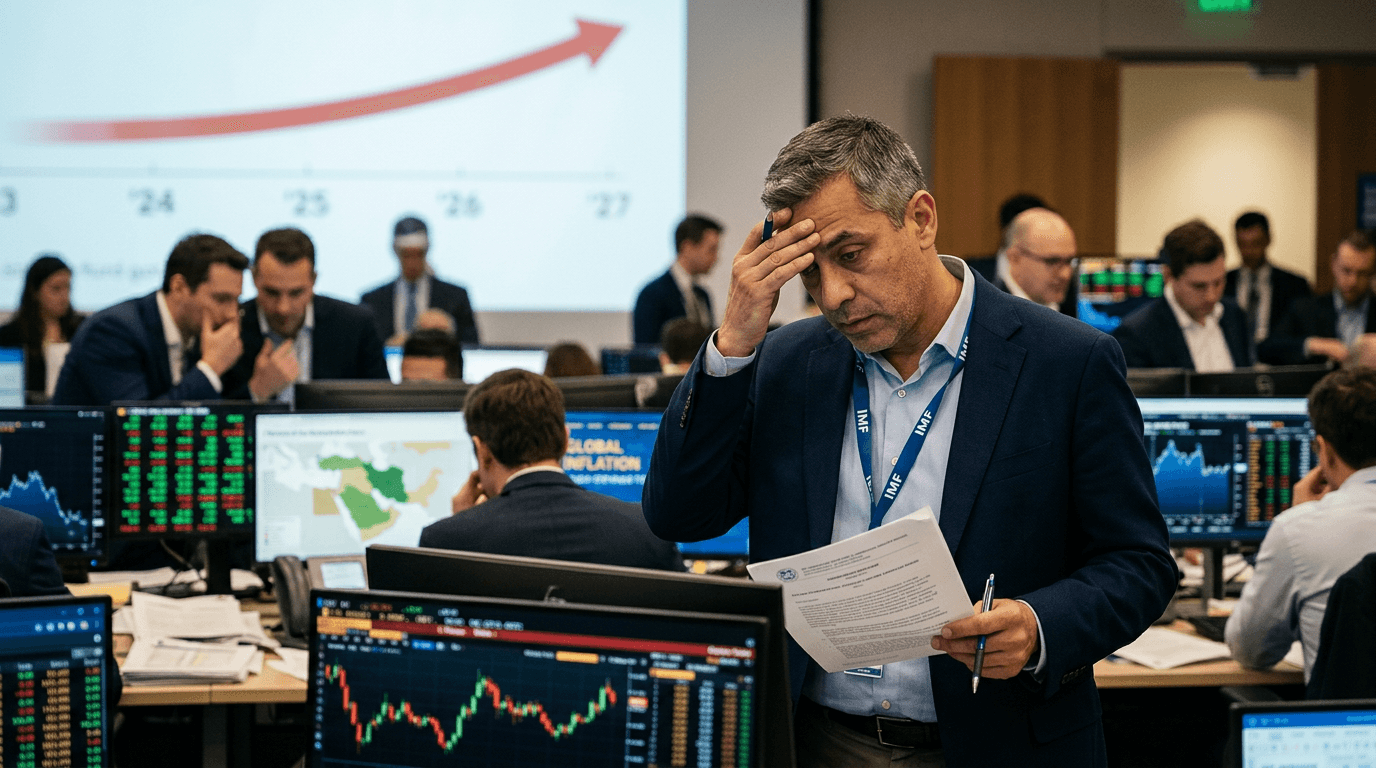
The International Monetary Fund’s latest warning that the Iran war could leave a lasting “inflation scar” on the US through 2027 is more than a headline risk. It signals a multi‑year regime shift in the macro environment: higher energy costs, stickier inflation, and a longer period of restrictive Federal Reserve policy that will shape the path of bonds, equities, and currencies tied to US growth and rates expectations.[1][3][5] For traders and investors, this is a structural story, not a short‑term shock.
THE IMF’S WARNING IN CONTEXT
In its recent outlook, the IMF argues that the Iran conflict has effectively “halted” global economic momentum and pushed inflation forecasts higher.[1] Under its baseline scenario, global growth is revised down to roughly 3.1% in 2026 and 3.2% in 2027, slower than the 3.4% pace seen in 2024.[1][8] Headline global inflation is now expected to rise to about 4.4% in 2026 before easing toward 3.7% in 2027.[1][7]
The US is central to this story. The Fund now anticipates US inflation will remain above the Federal Reserve’s 2% target for several years, averaging closer to 3% in 2026 and only gradually declining thereafter.[1] In more pessimistic scenarios—where oil prices rise further and the conflict drags on—global inflation could approach 6% and stay elevated into 2027.[1][3][5]
IMF Managing Director Kristalina Georgieva has warned that if the war continues and drives oil prices toward $125 per barrel, the outcome would be “much worse,” with inflation rising and inflation expectations potentially de‑anchoring.[3][5] That is the essence of the “scar” concept: even after the conflict ends, its impact on prices and policy could persist.
OIL SHOCK AND THE INFLATION ‘SCAR’
The mechanism is straightforward. The Iran war has disrupted trade routes and raised geopolitical risk premia, particularly around the Strait of Hormuz, a vital chokepoint for global oil flows.[2] The IMF’s reference forecast assumes about a 19% increase in energy prices in 2026, but warns that a larger, more persistent spike would significantly worsen the outlook.[6]
Higher oil prices feed directly into headline inflation via gasoline and energy bills, and indirectly via transport, production, and food costs. If the shock is temporary, central banks can often “look through” it. But if energy prices remain elevated for years, they can reshape wage negotiations, corporate pricing strategies, and household expectations.
That is what the IMF means by a lasting inflation scar: a multi‑year period during which inflation stays structurally higher than pre‑war norms, forcing monetary policy to remain tight and limiting the space for fiscal stimulus.[5][6] In that environment, both real and nominal interest rates tend to be higher, and the cost of capital rises across the economy.
Implications For Fed Policy And Us Markets
For the Federal Reserve, a durable inflation scar implies a longer “higher for longer” stance on interest rates. The IMF explicitly cautions that if medium‑ or long‑term inflation expectations begin to drift up, restoring price stability must take precedence over near‑term growth, with swift and sustained tightening.[6]
Bond markets are the most direct transmission channel:
- Short‑dated yields: Expectations of persistent inflation and a firm Fed path support elevated front‑end yields for longer, reducing the odds of rapid rate‑cut cycles.
- Yield curve shape: If growth slows but inflation stays high, the curve can remain flat or inverted, complicating traditional recession timing signals and term‑premium models.
- Credit spreads: Higher real rates, weaker growth, and more volatile inflation can widen spreads, especially for lower‑quality issuers exposed to energy and global trade dynamics.
Equities face a valuation and earnings challenge
- Valuations: Higher discount rates weigh on long‑duration growth stocks and sectors dependent on cheap capital, such as tech and speculative high‑beta names.
- Earnings: Margin pressure from higher input and labor costs, plus slower global demand, can compress earnings expectations, particularly for cyclical sectors.
That said, sector dispersion tends to rise. Energy producers, select commodities, and companies with strong pricing power may benefit, while rate‑sensitive and cost‑heavy industries struggle.
Currency markets also reprice
- US dollar: Higher US real yields and a cautious Fed can support the dollar against lower‑rate peers, though the impact is nuanced if global risk sentiment deteriorates.
- Commodity FX: Oil exporters may see currency support from stronger terms of trade, while net energy importers face pressure on trade balances and inflation.[4]
For traders, the key takeaway is that the Iran war and its inflation consequences are likely to remain embedded in macro pricing for several years, not quarters.
What Traders Should Watch
In a multi‑year inflation‑scar scenario, monitoring the right indicators becomes critical:
- Oil and energy prices: Levels, volatility, and forward curves around crude and refined products provide real‑time insight into the inflation impulse and geopolitical risk premium.[3][5]
- Inflation expectations: Breakeven inflation rates in bond markets, survey measures, and wage data show whether inflation is becoming embedded in expectations.[6]
- Fed communications: Shifts in Fed rhetoric around the inflation target, tolerance for overshoots, and reaction to energy‑driven price moves will drive front‑end rates and risk sentiment.
- Growth vs. inflation data: The balance between slowing growth and elevated inflation will shape curve dynamics and risk‑asset performance; stagflation‑like readings are particularly market moving.
- Global spillovers: The IMF notes that tightened financial conditions and higher real interest rates could strain emerging markets and highly indebted economies, creating secondary shocks.[2][6]
For discretionary and systematic traders alike, these inputs are core to scenario building, risk management, and position sizing.
Simulated Finance: A Lab For High-inflation Regimes
One of the challenges of trading in an inflation‑scar environment is that many market participants have limited live experience with sustained, multi‑year inflation and policy tightness. The 2010s were dominated by low inflation and ultra‑loose monetary policy; this regime is different.
Simulated finance (SimFi) offers a way to stress‑test strategies against this new macro landscape without risking real capital. Traders can:
- Build and test macro‑sensitive strategies that respond to oil shocks, rate repricing, and inflation‑linked instruments.
- Explore cross‑asset relationships—such as how equity sectors respond to changes in breakevens and energy prices—under different IMF‑style scenarios.
- Practice dynamic risk management, adjusting exposures as data and policy expectations evolve, mirroring the environment the IMF describes.[6]
By using realistic market conditions—including higher volatility, regime shifts in correlations, and more frequent policy surprises—simulated trading can help traders refine playbooks before deploying them in live markets.
Conclusion
The IMF’s warning that the Iran war could leave a lasting US inflation scar through 2027 is a signal that the macro backdrop is undergoing a structural shift.[1][5] Persistent energy‑driven inflation, tighter monetary policy, and slower growth together create a more complex environment for bonds, equities, and currencies than the low‑inflation decade many traders grew up with.
Rather than treating this as a single “event risk,” market participants should think in terms of regimes and scenarios: baseline vs. adverse oil paths, anchored vs. drifting inflation expectations, and gradual vs. abrupt policy responses. Those who invest time in understanding these dynamics—and in testing their strategies in realistic, simulated environments—will be better positioned to navigate whatever path the economy ultimately takes.