
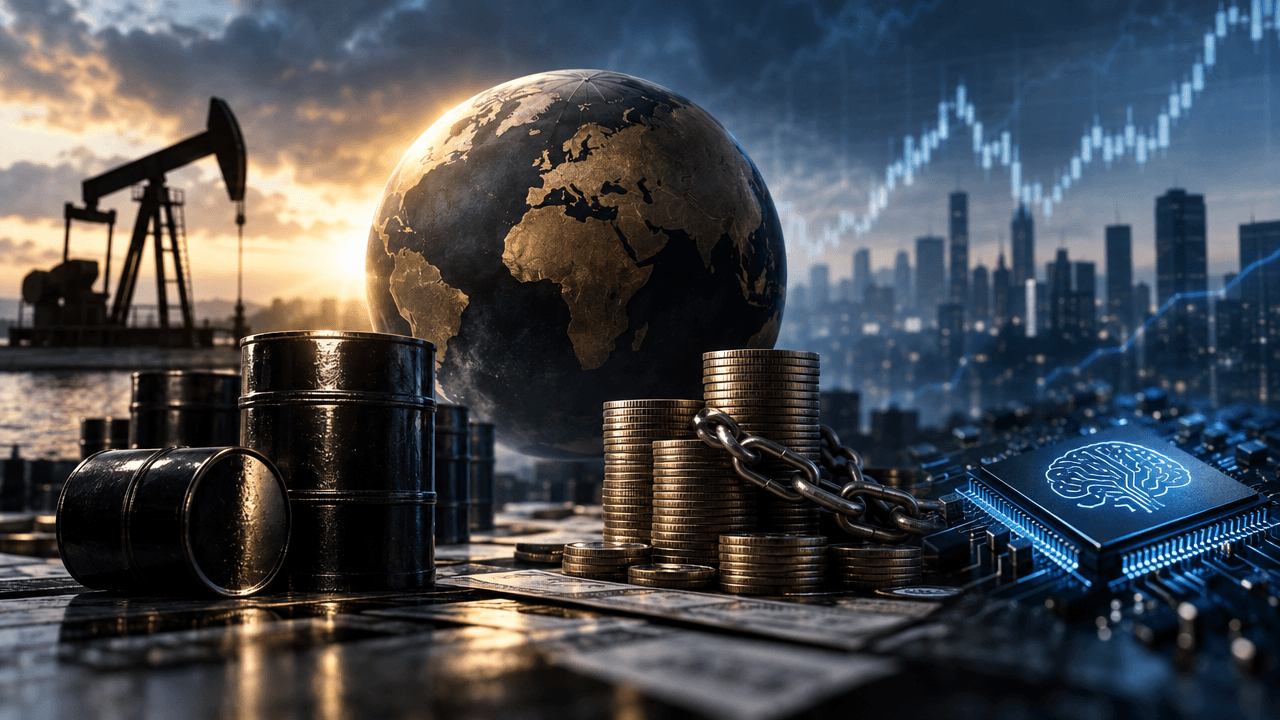
Global growth is entering a more fragile phase as the IMF warns that a “triple whammy” of energy shocks, record public debt, and risks from the AI boom is weighing on the outlook.[1][2][5][13] For traders and investors, this is not just macro theory—it is a roadmap for where volatility, opportunity, and risk are likely to cluster over the coming months.
Global Growth Under Pressure
The IMF now sees global growth running near 3% in 2026, below the average pace of recent years and with risks tilted to the downside.[6][7][9][12] Under the surface, the expansion is increasingly uneven: energy importers and highly indebted economies are feeling the squeeze, while technology-linked markets benefit from AI-driven demand.[6][7]
Geopolitical tensions, war-related supply disruptions, and tighter financial conditions all feature prominently in the IMF’s latest assessments of global risks.[6][14][15] The message is clear: this is not a single-issue slowdown, but a convergence of shocks hitting real economies, markets, and policy simultaneously.
For market participants, this environment tends to favor more defensive positioning, a premium on quality balance sheets, and greater attention to cross-asset correlations as shocks propagate across energy, rates, and equities.
Energy Shocks And Market Volatility
The IMF warns that the global economy faces a negative energy supply shock stemming from conflicts in the Middle East and the ongoing war in Ukraine, which are helping keep energy markets tight and prices elevated.[1][2][3][4][14] Higher energy prices are feeding through to broader inflation, pushing up policy rates and long-term bond yields in major economies.[1][2]
Ten-year sovereign yields in the United States, Germany, and Japan have risen to their highest levels in more than a decade, reflecting both inflation pressure and expectations of tighter financial conditions.[1] For traders, this combination of elevated yields and persistent energy risks is a recipe for heightened volatility in rates, credit, and commodities.
Energy-importing countries are especially vulnerable, facing deteriorating trade balances, weakened real incomes, and more limited policy space to cushion shocks.[6][14] In foreign exchange markets, such stress often translates into support for safe-haven currencies and pressure on those of high-deficit, energy-dependent economies.
Practically, this backdrop argues for: - Paying closer attention to energy-linked assets and their spillovers into inflation expectations. - Stress-testing portfolios for renewed spikes in oil or gas prices. - Considering hedges that benefit from higher rate volatility, rather than relying solely on directionally long duration trades.
Record Debt And Tighter Financial Conditions
Alongside the energy shock, global public debt has climbed to around its highest level since World War II and is projected to exceed 100% of GDP before 2030.[1][5] Advanced economies are described by the IMF as “worst offenders,” but many lower-income countries also face difficult trade-offs between servicing debt and funding essential social spending.[13]
High debt levels limit governments’ ability to respond to new shocks without unsettling markets, particularly in an environment of higher interest rates.[11][13][15] The IMF’s Global Financial Stability Report highlights elevated risks as tighter conditions, repricing of assets, and large borrowing needs increase the potential for stress episodes.[11][15]
For markets, this can mean: - Greater sensitivity of bond yields and credit spreads to fiscal news and rating actions. - Periodic flare-ups in sovereign risk, especially in countries with weak growth and large external financing needs. - A higher probability that central banks will have to balance inflation control with financial stability concerns.
In trading terms, that favors careful differentiation between sovereigns, more granular credit risk analysis, and scenario planning around debt sustainability, particularly in emerging markets.
Ai Boom: Productivity Promise, Disruption Risk
The third major risk flagged by the IMF is the AI investment boom, which is acting as a positive demand shock but also adding to inflation and financial vulnerabilities.[1][2][3][4][11] AI-related capital expenditure is projected to reach trillions of dollars over the next few years, potentially rivaling historic infrastructure build-outs such as railroads and power grids.[11][13]
This surge in investment is lifting growth in countries integrated into the global technology value chain, but it is also raising energy demand, contributing to higher prices for fuel, fertilizer, and related commodities.[3][13] Inflationary pressures linked to AI, energy, food, tariffs, defence spending, and debt are now central to the IMF’s warning that above-target inflation could persist.[1][3][4][10][12]
Beyond macro variables, the IMF points to substantial AI-related risks: large-scale labour market disruption, cyber threats, financial stability concerns, and the possibility that frontier models could escape effective human control.[1][4][11] Policymakers are being urged to install robust regulatory guardrails and to invest in AI preparedness to manage these perils.[1][4][13]
For traders, the AI boom is a double-edged sword: - It supports secular growth and earnings in technology and data infrastructure plays. - It may fuel bubbles or overpricing in some AI-linked assets, increasing the eventual correction risk. - It reinforces the need to analyze not just AI winners, but also potential losers in labour-intensive and easily automated sectors.
What Traders Can Do Now
Against this backdrop of energy shocks, debt overhang, and AI disruption, the IMF is calling for protective fiscal and monetary policy measures to safeguard growth and stability.[1][2][4] Markets will be highly sensitive to how governments and central banks respond—whether through consolidation, regulation, or renewed stimulus.
For active traders and portfolio managers, several practical takeaways stand out:
1. Lean into risk management, not just return forecasts. Stress-test portfolios against scenarios of renewed energy spikes, higher-for-longer rates, and sudden reassessments of AI profitability.
2. Watch sovereign and corporate balance sheets. Elevated debt and tighter conditions increase differentiation; quality and resilience matter more than ever in fixed income and equities.
3. Treat AI as both a structural theme and a cyclical risk. Position for long-term transformation, but be wary of overextended valuations and sectors exposed to rapid automation.
4. Use simulated environments and scenario analysis to rehearse portfolio responses to cross-asset shocks. In a world where the IMF sees risks “firmly to the downside,” practice can be a meaningful edge.[12][15]
Conclusion
The IMF’s warning about energy shocks, record debt, and AI risks is not a single headline—it is a framework for understanding where the next phase of global market volatility may emerge.[1][2][5][13] With growth slowing, inflation still sticky, and technology reshaping both demand and risk, complacency is a luxury traders cannot afford.[6][7][10][12]
By combining disciplined risk management, informed macro analysis, and robust scenario planning, market participants can navigate this more complex landscape with greater confidence. The shocks are real, but so are the opportunities for those prepared to adapt.