
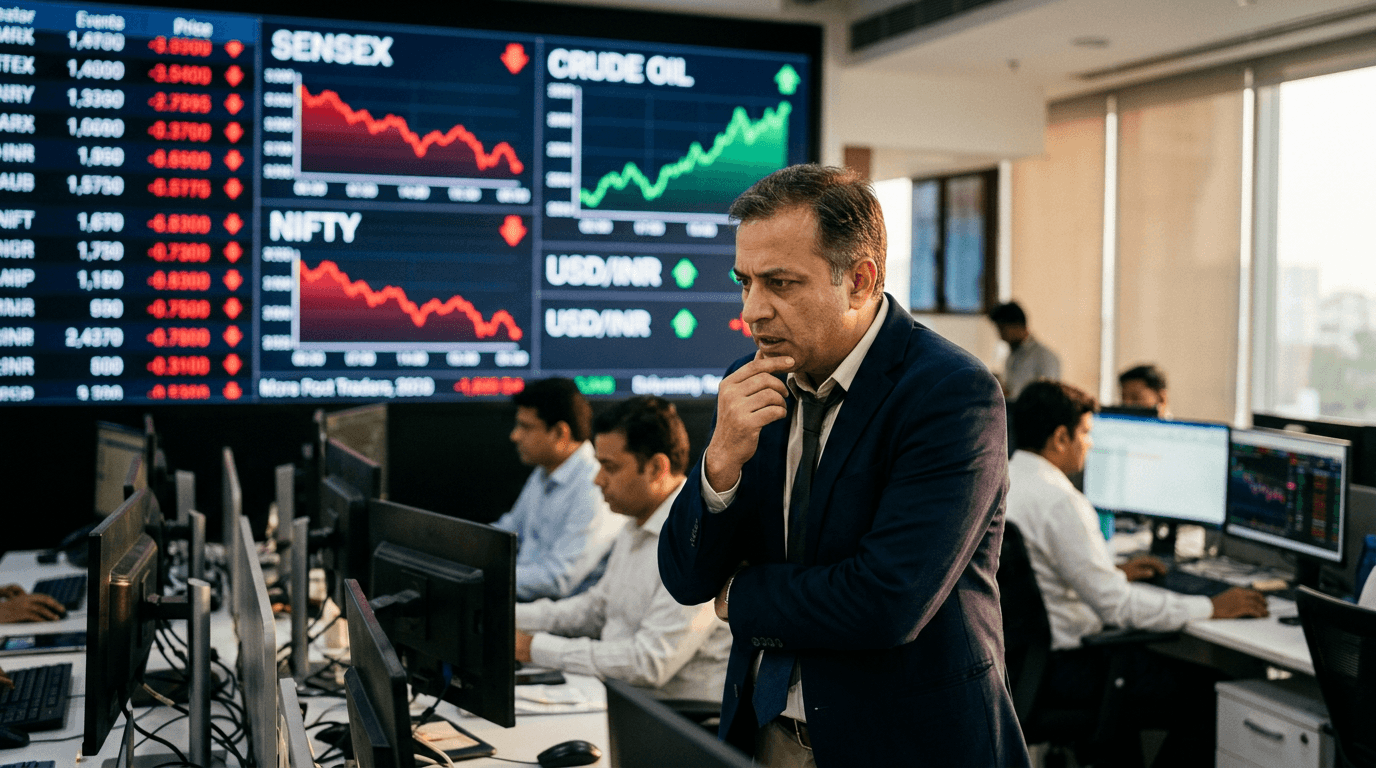
Indian equity indices eased lower today as investors reacted to a mix of weak global risk sentiment and renewed pressure from rising crude oil prices, leading to broad but orderly profit-taking across frontline stocks[5][8][11]. For traders, this kind of “soft” down day is less about panic and more about repricing expectations around growth, inflation, and foreign capital flows[5][9][11]. Understanding what is driving these moves helps distinguish routine volatility from deeper structural shifts.
Markets Under Pressure
The Sensex and Nifty have recently seen a series of sessions where early losses, driven by global cues, set the tone for the day[5][8][9]. Global equity markets have been weighed down by concerns over trade tensions, geopolitical risks, and elevated bond yields, which tend to push investors away from risk assets and into safer havens[8][9][13]. When major overseas indices are under pressure at the open, Indian benchmarks often mirror that sentiment, especially given their strong integration with global capital flows[5][9][13].
Weak global cues typically show up first in index futures and pre-market indications, with India-linked futures in offshore venues pricing in lower openings[9][10]. Simulated traders can use these signals to build scenarios: How does the cash market respond when futures point to a gap-down open? Does intraday breadth confirm the pessimism, or do domestic buyers step in? Treating each day as a case study helps sharpen pattern recognition around global-local linkages.
Why Higher Crude Weighs On Indian Equities
Higher crude prices are a recurring headwind for India because the country imports the bulk of its oil, making the economy particularly sensitive to sustained price spikes[3][7]. Rising crude raises the import bill, pressures the current account, and tends to weaken the rupee, especially when combined with risk-off sentiment in global markets[3][7][11]. That, in turn, can feed into expectations for higher inflation and tighter financial conditions, both of which are negative for equity valuations[3][7].
Sectorally, elevated oil prices squeeze margins in energy-intensive industries such as airlines, chemicals, logistics, and select manufacturing segments[3][4][7]. At the same time, they can bolster upstream energy names and some oil marketing companies, creating a more nuanced sector rotation rather than a uniform sell-off[4][7][11]. For index traders, this means moves in benchmarks can mask significant dispersion beneath the surface, as losers in rate- and energy-sensitive sectors are partly offset by gains in commodity-linked names[4][7].
Global Risk Sentiment And Foreign Flows
Foreign portfolio investors (FPIs) remain critical to Indian equity market dynamics, especially in large-cap financials and index-heavy sectors[7][11][13]. When global bond yields rise or geopolitical risks flare, FPIs often reduce exposure to emerging markets, and India, despite its structural appeal, is not immune to such de-risking[5][9][13]. Recent selloffs have seen substantial FPI outflows coinciding with spikes in crude and bouts of global equity weakness, amplifying moves in Sensex and Nifty[7][9][11].
These flows are closely watched in both cash and derivatives markets. Persistent FPI selling tends to drag down index futures, widen bid-ask spreads, and lift implied volatility, particularly when selling is concentrated in financials and large growth names[8][9][13]. Domestic institutional investors (DIIs) and retail participants frequently step in as stabilizing forces, but their absorption capacity varies with valuations and sentiment[5][8]. For traders, monitoring FPI and DII flow trends provides an important context for interpreting whether a soft session is a brief pause or part of a larger de-risking cycle.
Implications For Index Futures And The Rupee
On days when Indian benchmarks soften under the twin pressure of weak global cues and higher oil, index futures often trade at wider discounts to fair value, reflecting cautious positioning[9][10][11]. Intraday futures volumes typically rise as short-term participants hedge or speculate on follow-through moves, while options markets price in higher near-term volatility[8][9][11]. These derivative signals can be valuable leading indicators for cash market behavior, especially around key support and resistance levels.
The rupee also tends to weaken in such environments, as higher oil inflates dollar demand and global risk aversion reduces appetite for emerging-market currencies[7][11]. Episodes of sharp crude spikes have historically coincided with notable rupee depreciation, prompting the central bank to balance currency stability with broader macro objectives[7][11]. For equity traders, currency moves matter because they influence the earnings outlook of importers and exporters, alter the attractiveness of Indian assets for foreign investors, and can shift expectations for interest rates over time[3][7][11].
Actionable Takeaways For Simulated Traders
For participants using a Simulated Finance platform, sessions like these offer rich learning opportunities without the stress of real capital at risk. One practical approach is to build playbooks around specific macro triggers—such as “global risk-off plus crude spike”—and test strategies systematically in a simulated environment. Traders can experiment with tactical shorts in index futures, sector rotation trades, or options structures designed to benefit from higher volatility, then track outcomes across multiple scenarios.
Another valuable exercise is to integrate global indicators into daily prep. Tracking overnight moves in major US, European, and Asian indices, along with crude and bond yields, can help form a macro bias before the Indian open[8][9][13]. In simulation, traders can document how often their macro bias aligns with actual intraday market behavior, refining both conviction and adaptability. Over time, this fosters a disciplined process that is transferable to live trading.
Risk management can also be rigorously practiced in SimFi during soft market phases. Simulated traders can set rules for maximum intraday loss, position sizing in volatile conditions, and scenario analysis for gaps and trend days. By reviewing performance after sessions driven by external shocks—like oil spikes or global equity selloffs—traders learn to distinguish signal from noise and adjust risk accordingly.
Conclusion: Turning Volatility Into A Learning Edge
The current softening in Indian equity indices amid weak global cues and higher crude oil prices reflects a familiar combination of external pressures on a globally integrated market, rather than a purely domestic problem[5][7][11]. For traders, the key is not to predict every short-term move but to understand the economic channels—oil, currency, foreign flows, and global sentiment—that shape price action in benchmarks like Sensex and Nifty[3][7][11]. Simulated trading provides a powerful sandbox to observe these dynamics, test strategies, and refine decision-making in real time. By treating each volatile session as a structured learning opportunity, traders can build robust frameworks that stand up not just to routine market softness, but also to the more severe shocks that inevitably arise over the cycle.