
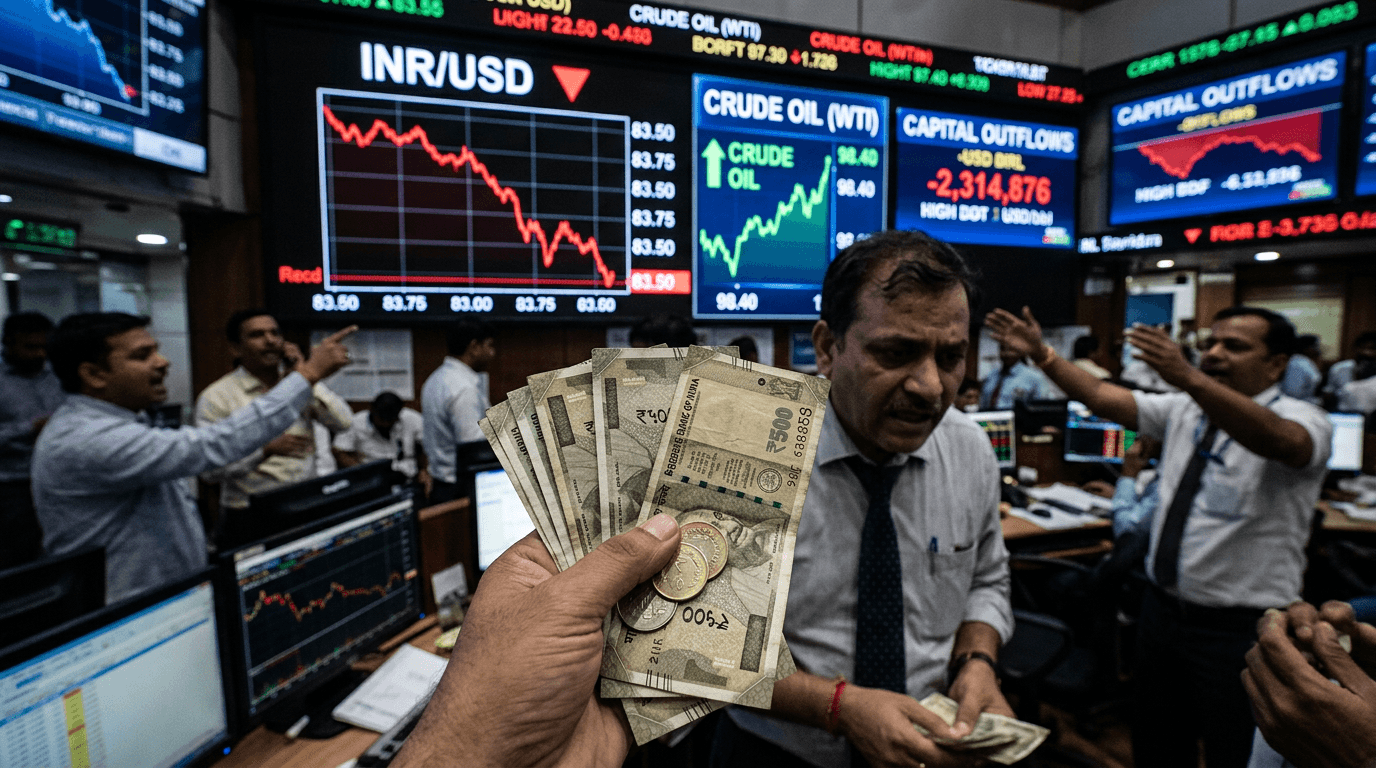
India's currency is under siege. The Indian rupee has plummeted to fresh record lows, hitting an intraday low of 95.34 against the US dollar on May 14, 2026, a milestone that underscores mounting external economic pressures threatening the world's most populous nation. What began as a gradual currency slide has accelerated into a significant economic headwind, driven by a convergence of factors that show no immediate signs of abating. For traders, investors, and ordinary Indians alike, understanding this currency crisis is essential to navigating the turbulent markets ahead.
The Perfect Storm: Multiple Pressures Converging
The rupee's collapse is not the result of a single economic event but rather the confluence of multiple adverse forces creating what can only be described as a perfect storm for emerging market currencies. Oil prices have surged past $126 per barrel amid stalled US-Iran negotiations and geopolitical tension in West Asia. Simultaneously, the US Federal Reserve has maintained a hawkish monetary policy stance, strengthening the dollar index to 98.10 and making US assets more attractive to global investors. Foreign institutional investors have been pulling capital out of India at an alarming rate, with over $20 billion in rupees sold during March and April alone as nervous investors shift money into perceived safe havens. Each of these pressures individually would create headwinds for the rupee, but together they form a formidable challenge that has left the currency reeling.
Oil Prices: The Primary Culprit
For an energy import-dependent nation like India, rising crude oil prices represent perhaps the most insidious form of economic pressure. Every dollar increase in oil prices translates directly into higher import bills, and crucially, those dollars now cost significantly more rupees to purchase. When Brent crude surged above $105 per barrel following President Trump's comments that the Iran ceasefire was on "life support," the immediate market reaction was swift and severe. The dollar-rupee exchange rate breached critical support levels, with traders warning that sustained oil prices above $125 per barrel could push the rupee toward the 97 mark. This is more than just a currency movement—it triggers a domino effect throughout the Indian economy. Higher oil prices mean increased costs for fuel, transportation, and manufacturing, which eventually feed into consumer inflation. The pressure intensifies as India's energy import bill soars, draining precious foreign exchange reserves and creating upward pressure on the rupee-dollar rate.
Foreign Capital Outflows And Dollar Strength
Currency markets are ultimately driven by flows of capital, and right now, the flows are decisively outward. Foreign institutional investors have been selling Indian stocks and bonds at an accelerating pace, forced to convert rupees into dollars to repatriate their funds. This increased demand for dollars relative to rupees has created a classic supply-demand imbalance that weakens the local currency. The situation is compounded by a broader flight to safety in global markets. When geopolitical uncertainty rises and risk appetites diminish, capital gravitates toward the perceived safety of the US dollar. The Fed's hawkish policy stance has further bolstered dollar demand, making dollar-denominated assets more attractive to global investors. For India, this means the rupee faces headwinds not just from country-specific factors but from global risk dynamics that are largely beyond its control.
Economic Fallout And Market Implications
A weakening rupee has cascading consequences throughout the Indian economy. Import costs rise sharply, pushing inflation higher. Household budgets face pressure as fuel and transportation costs increase. Foreign investor returns become less attractive, creating a negative feedback loop that deepens capital outflows. Equity markets face selling pressure as foreign investors reduce exposure. The central bank finds itself in a difficult position, forced to deploy foreign exchange reserves to stabilize the currency without addressing the underlying macroeconomic imbalances.
Rbi Response And Outlook
The Reserve Bank of India has been actively intervening, using its forex reserves to sell dollars directly into the market in an attempt to stabilize the rupee and reduce volatility. While these interventions provide temporary relief, they address symptoms rather than causes. If oil prices remain elevated and foreign investors continue exiting Indian assets, currency weakness will persist. Short-term measures like import restrictions can ease pressure marginally, but structural solutions require either a significant decline in crude prices or a reversal in capital flows. Analysts across the financial community warn that the rupee could test 97 if current conditions remain in place, though the RBI's defense mechanisms have so far prevented a complete market panic.
The Indian rupee's weakness is a critical reminder that even large emerging economies remain vulnerable to global economic currents. For traders and investors monitoring India, the path forward depends heavily on three variables: the trajectory of oil prices, the duration of US-Iran tensions, and global risk sentiment. Until these factors shift decisively, the rupee is likely to remain under pressure.