
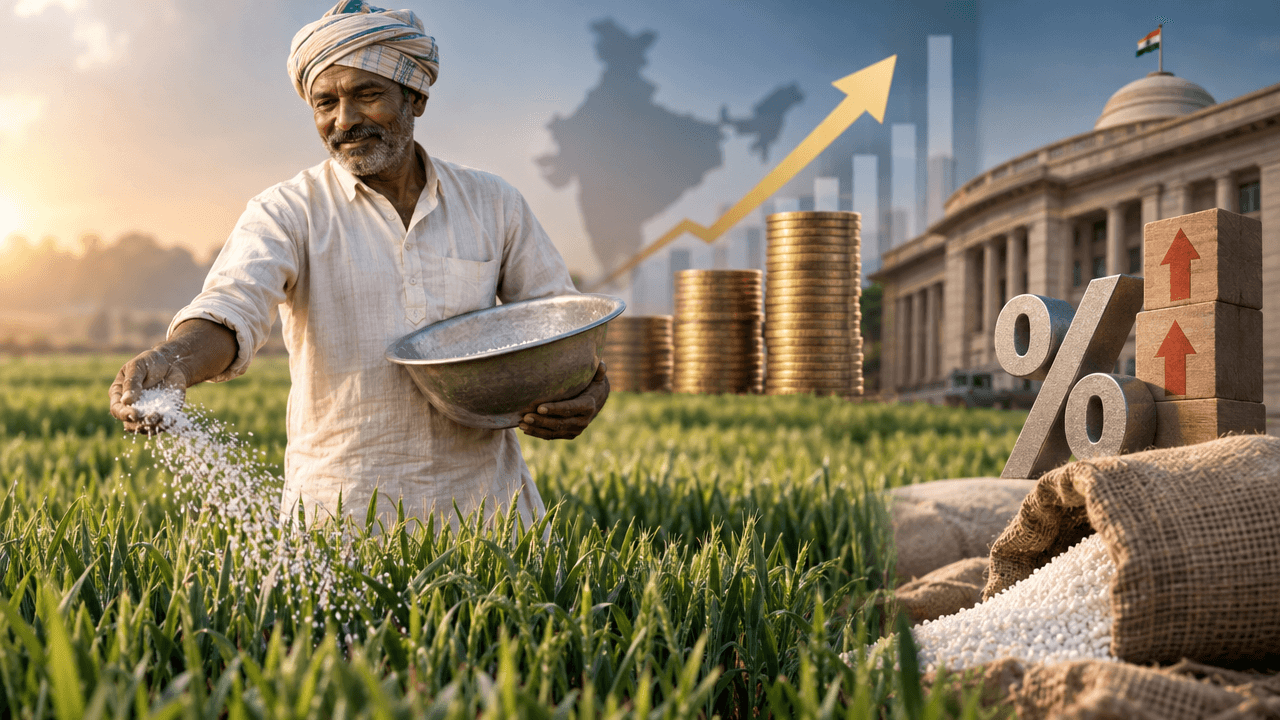
India’s economic outlook has received a dual boost: the government is increasing fertilizer support for farmers, while Moody’s Ratings has raised its growth forecast for the financial year 2026–27. The two developments point to a policy balancing act—protecting agricultural production and household purchasing power while sustaining strong economic momentum in an environment where inflation and interest rates remain important risks.
The Union Cabinet approved a fertilizer subsidy package of approximately ₹62,370 crore for the 2026–27 Rabi season. The subsidy applies to phosphatic and potassic fertilizers, including di-ammonium phosphate, or DAP, and several NPKS grades. The approved rates cover the period from October 1, 2026, through March 31, 2027. [1]
At the same time, Moody’s lifted its forecast for India’s FY27 economic growth to 7% from 6.5%. The ratings agency cited broad-based economic momentum, resilient consumption, improving investment conditions and the country’s ability to withstand an energy supply shock. [12]
Fertilizer Support And The Rural Economy
The fertilizer decision is significant because it directly addresses one of the largest cost pressures facing farmers. International fertilizer prices, energy costs and supply disruptions can quickly raise input expenses. Without government support, those increases could reduce farm profitability, discourage planting or feed into higher food prices.
The new subsidy is around 64% higher than the ₹37,952 crore allocated for the previous Rabi season. [5] That increase demonstrates the government’s willingness to absorb more of the impact from global price volatility rather than transferring the full burden to farmers.
Keeping fertilizer affordable can support winter crops such as wheat, mustard, pulses and other Rabi-season products. It may also help maintain planting intentions and stabilize agricultural output. For rural households, that matters beyond the farm gate. Stronger farm income can support spending on consumer goods, vehicles, housing improvements and services.
The policy also seeks to ensure availability. A subsidy is effective only when farmers can obtain the required products at the right time. By approving the rates for the full Rabi period, the government is providing manufacturers and distributors with greater clarity while attempting to reduce the risk of shortages.
WHY MOODY’S RAISED ITS FORECAST
Moody’s upgrade reflects confidence that India’s expansion is not dependent on a single sector. Consumption remains an important growth engine, supported by a large domestic market and continued economic formalization. Investment is also showing signs of improvement, with public infrastructure spending helping create conditions for greater private-sector participation.
The agency said India’s macroeconomic fundamentals and resilience to the energy supply shock support the possibility of growth near 7% over the medium term. [10] This is a meaningful signal for global investors because it suggests that India’s growth story remains intact despite geopolitical uncertainty and fluctuating commodity prices.
A stronger growth forecast can improve business confidence, encourage capital allocation and support equity-market sentiment. It may also strengthen the rupee if investors view India as offering comparatively attractive long-term growth. However, a forecast is not a guarantee. The quality and durability of growth will depend on inflation, household purchasing power, external energy costs and the pace of private investment.
The Inflation And Interest-rate Trade-off
The most important caution in Moody’s assessment is inflation. If higher input costs, food prices or energy disruptions keep inflation elevated, the Reserve Bank of India could face pressure to raise interest rates or maintain restrictive policy for longer.
Higher rates can help contain inflation by slowing demand and making borrowing more expensive. But they can also weigh on businesses. Companies may postpone factory expansions, reduce capital expenditure or demand a higher return before committing to new projects. Moody’s warned that tighter monetary policy could delay the recovery in private investment. [4]
This creates a policy dilemma. Fertilizer subsidies can protect farmers and help limit food-price pressure, but a larger subsidy bill can also increase the government’s fiscal burden. If global fertilizer or energy prices remain high, further support may be required. Policymakers must therefore balance rural protection with fiscal discipline.
For markets, the key question is whether the subsidy improves food supply and rural incomes without creating a broader inflation problem. The answer will depend on harvest conditions, global commodity prices and how efficiently the subsidy reaches farmers.
What This Means For Traders And Investors
The immediate market impact is likely to be concentrated in agriculture, fertilizer producers, rural-consumption companies and interest-rate-sensitive sectors. Fertilizer manufacturers may benefit from clearer pricing support and stronger demand visibility. Rural-focused businesses could gain if the policy helps farm incomes and agricultural activity.
Investors should also monitor companies exposed to imported raw materials. A higher subsidy can cushion farmers, but manufacturers may still face margin pressure if global input costs rise faster than government support. The distinction between volume growth, revenue growth and actual profitability will be important.
On the macroeconomic side, a 7% growth forecast is supportive for companies linked to infrastructure, banking, consumer spending and industrial investment. Yet traders should avoid treating the forecast as a reason to ignore monetary-policy risk. Inflation data, central-bank communication, bond yields and private-capital-expenditure figures may have a larger influence on markets than the forecast revision itself.
A practical approach is to track three indicators: food and fuel inflation, fertilizer availability during the Rabi season and evidence that private investment is accelerating. Together, they will show whether India is achieving balanced growth or simply receiving temporary support from public policy.
The Broader Economic Message
India’s latest policy decisions reveal an economy with strong momentum but meaningful vulnerabilities. The fertilizer subsidy supports agricultural stability and rural demand, while Moody’s forecast upgrade recognizes the strength of consumption and investment prospects.
The challenge is maintaining that momentum without allowing inflation to force a sharp policy reversal. If subsidies protect food production, energy pressures ease and private investment continues to recover, India may be able to sustain growth close to 7%. If inflation persists, however, higher interest rates could limit the investment cycle that Moody’s expects to strengthen.
For market participants, the takeaway is clear: India’s growth narrative remains constructive, but it is not risk-free. The next phase will depend on how effectively policymakers manage the tension between affordability, fiscal support and price stability.