
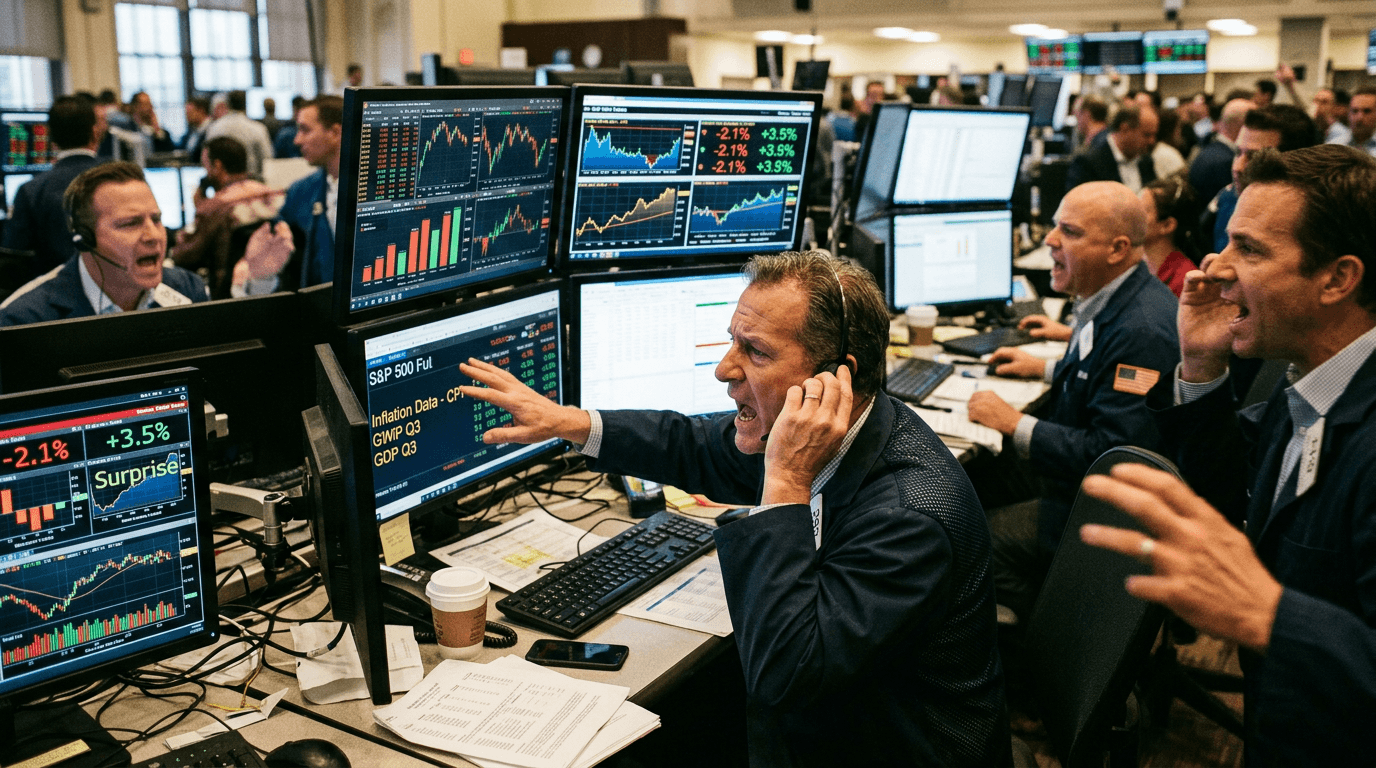
Equity-index futures are once again trading slightly higher ahead of key producer price data, but the move tells a bigger story: these contracts remain highly sensitive to both inflation surprises and corporate earnings.[1] Rather than functioning as a detached side market, index futures have become a primary transmission channel for macro news, translating each data release into rapid changes in equity risk appetite and implied valuations.[1][5] For traders, that sensitivity is both a source of opportunity and a risk that demands preparation.
Macro Data Sets The Tone
A growing body of market evidence shows that trading activity in equity-index futures tends to spike around major data releases, especially inflation prints such as CPI, core CPI, and PPI.[5][15] Studies of futures price changes around consumer and producer price announcements find that these releases systematically move index futures, confirming how tightly the contracts are wired into the macro narrative.[15] Compared with FX or interest-rate markets, equity futures show a particularly strong response to inflation surprises, reflected in both trading volume and price impact.[5]
This behavior is visible in day-to-day price action. When traders expect benign inflation and decent earnings, futures on the S&P 500, Dow Jones, and Nasdaq often edge higher in early trade, signaling a tilt toward risk-on positioning.[1] But that pricing is vulnerable: a hotter inflation print or weaker earnings can quickly reverse the move as markets reprice the path of policy rates and future profits.[7] The key takeaway is that macro data is not background noise for futures; it is a central driver of intraday direction and volatility.
Why Inflation Surprises Hit Futures First
Academic and practitioner research broadly supports a negative relationship between inflation and equity market returns in modern, inflation-targeting economies.[4][19] Rising inflation typically pushes expected policy rates and discount factors higher, compressing price-to-earnings multiples even if nominal earnings hold steady.[4][11] This is especially damaging for long-duration growth stocks, whose cash flows lie further into the future and therefore are more sensitive to changes in discount rates.[7]
At the futures level, that dynamic shows up as a statistically significant negative correlation between changes in reported inflation and global equity-index futures returns.[4] One study finds that six of the seven worst years for global equity futures since 1990 coincided with periods of rising inflation, highlighting how inflation trends can foreshadow major drawdowns.[4] Another line of research shows that inflation change signals can help mitigate or avoid large equity drawdowns by adjusting risk exposure as inflation accelerates or cools.[4][17] For traders, the practical message is clear: inflation is not just a macro variable; it is a timing tool for equity risk.
Not all inflation reports are equal. Surprises in core CPI—stripped of food and energy—tend to have a particularly strong effect on equity futures trading volumes, often twice the impact of other inflation metrics in the immediate aftermath of release.[5] Since core inflation is closely watched by central banks when setting policy, any deviation from expectations can prompt a swift repricing of rate-cut or hike probabilities, with futures reacting accordingly.[7][18] In effect, equity-index futures are the first place where the market expresses its changed view on inflation and policy.
Earnings As A Repricing Catalyst
While inflation sets the macro backdrop, corporate earnings determine whether the market’s growth story still holds together. Around earnings season, equity-index futures often move in anticipation of big-name reports, particularly in sectors that dominate index weightings such as technology, financials, and consumer discretionary.[1][9] Traders watch not just headline earnings per share, but also margins, cost pressures, and guidance—areas where inflation and growth expectations intersect directly with company performance.[9]
Sector sensitivity adds another layer. Research suggests that a sudden increase in inflation expectations tends to hurt the overall index and technology stocks in particular, while benefiting energy companies that can pass higher commodity prices through to revenues.[6] Consumer staples, by contrast, often show limited responsiveness to inflation shocks, acting as a defensive anchor when macro volatility rises.[6] As earnings roll in, index futures reprice sector leadership, favoring businesses with stronger pricing power and more resilient margins in the face of shifting inflation dynamics.[6][8]
WHAT “REPRICING” LOOKS IN INDEX FUTURES
When traders talk about “repricing” in equity-index futures, they are usually referring to a rapid adjustment in implied valuations, driven by new information about inflation, policy, or earnings.[7][13] Even small surprises can shift the market’s perception of fair value, as futures compress or expand the multiple applied to expected earnings streams.[11] Futures move first because they are highly liquid, trade nearly around the clock, and allow investors to adjust equity exposure without trading individual stocks.[5]
One key mechanism is the link between Treasury yields and equity discount rates. Hotter inflation or hawkish guidance raises yields, increasing the discount rate applied to future cash flows and pressuring index futures lower.[7][11] Long-duration sectors such as technology and high-growth consumer names tend to be hit hardest, while value and income-oriented sectors may hold up relatively better.[6][11] From a trading standpoint, repricing episodes often feature sharp, correlated moves across futures, rates, and credit—underscoring the need to monitor the full macro complex, not just the equity tape.
Practical Takeaways For Traders And Simulated Finance Users
For traders—and for participants on SimFi platforms like E8 Markets—the sensitivity of equity-index futures to inflation and earnings can be harnessed with a structured playbook.[1] First, define macro scenarios in advance of major releases: cooler-than-expected, in line, and hotter-than-expected inflation.[1][15] For each scenario, outline your directional bias in index futures, expected moves in yields and the dollar, and which sectors are likely to benefit or suffer.[4][6] This pre-planning reduces emotional decision-making when data hits.
Second, distinguish between the first reaction and the second. The initial spike in futures after an inflation or earnings release is often driven by algorithms trading the headline numbers.[1][5] The more informative move tends to come minutes later, as human traders assess details such as core versus headline inflation, revisions, earnings call commentary, and forward guidance.[1][9] Waiting for that second phase can improve trade selection and reduce whipsaw risk.
Third, think in terms of risk units, not just direction. Given how closely futures are tied to macro surprises, position sizing and scenario stress tests are essential.[4][18] Ask how your portfolio would behave under a 0.3 percentage point upside surprise in core CPI or a 10% earnings miss in a major index constituent, and adjust exposure accordingly.[5][7] In simulated environments, this kind of disciplined framework can be practiced repeatedly without capital at risk, building the muscle memory needed for live markets.
Ultimately, equity-index futures sit at the crossroads of inflation, earnings, and policy expectations. Their heightened sensitivity to macro and micro surprises makes them one of the clearest windows into how markets are repricing risk in real time.[1][5] For traders who prepare thoughtfully, that repricing is not just volatility to endure—it is information to exploit.