
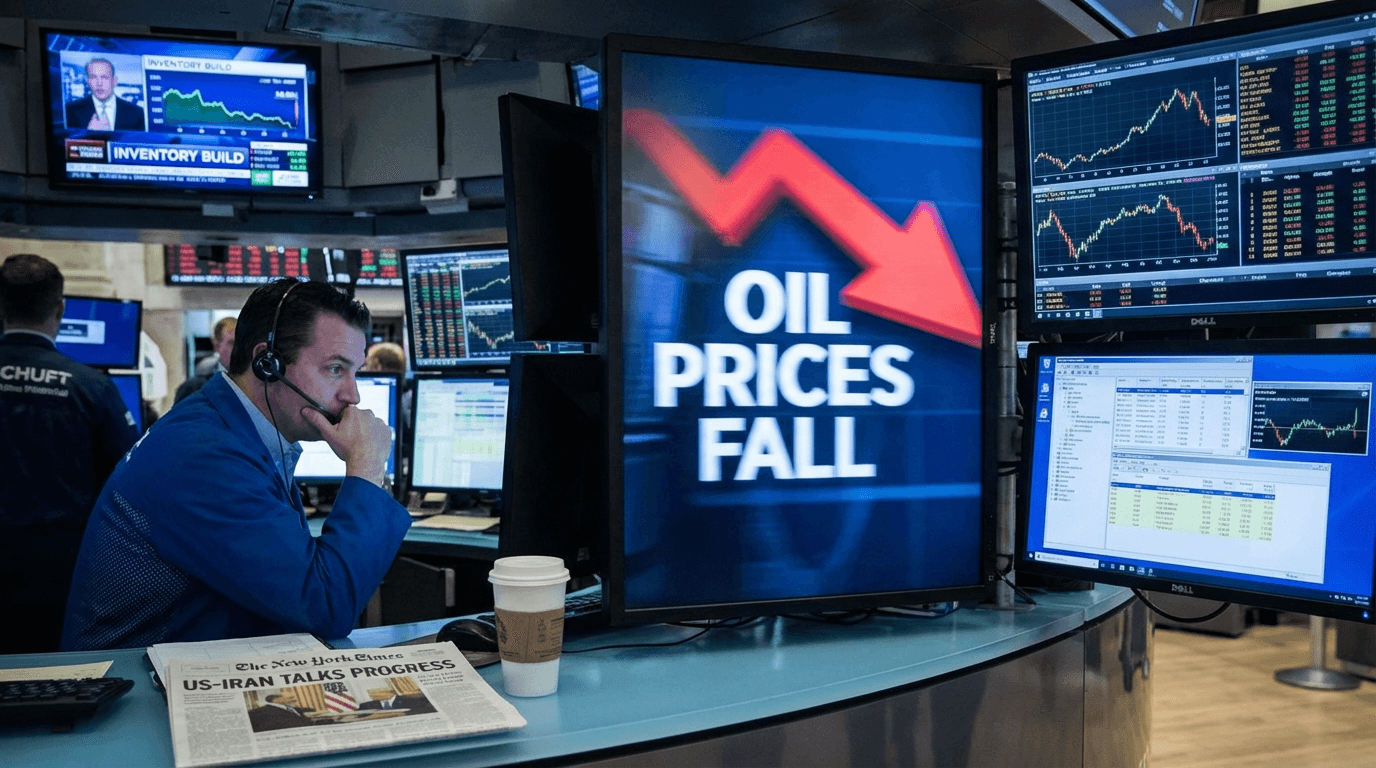
Geopolitical tensions in the Middle East have long served as a wild card for oil markets, with investors closely monitoring developments between the United States and Iran. This week, as both nations entered their third round of nuclear negotiations in Geneva, crude prices experienced a notable pullback, signaling that markets are pricing in a reduced likelihood of military conflict.[1][2] The shift underscores a critical reality for energy traders: while geopolitical risk can drive sharp rallies, credible diplomatic signals can unwind that premium just as quickly.
What Drove The Recent Price Decline
Oil prices fell sharply on February 26 as multiple factors converged to weigh on the market. Most immediately, the U.S. Energy Information Administration reported that crude inventories swelled by 16 million barrels in the week ended February 20—the largest weekly build in three years.[2] This supply-side pressure alone would have pressured prices lower. However, the more significant driver was the market's reassessment of geopolitical risk. As U.S. President Donald Trump pivoted toward emphasizing diplomacy in resolving Iran's nuclear program, rather than military threats, traders began reducing the "war premium" they had built into crude prices.[2] Brent crude fell to around $69.90, while WTI declined to $64.36, both marking material declines from earlier in the week when military posturing had elevated prices.[4]
The shift in sentiment was further reinforced by signals from both Iran and the mediating nation of Oman. A senior Iranian official characterized the talks as "serious," while Oman reported that both sides had exchanged "positive and creative ideas."[4] These comments, while cautious, suggested that negotiators saw a pathway forward rather than an imminent confrontation.
The Mechanics Of Geopolitical Risk In Oil Markets
Understanding how geopolitical risk affects oil prices is essential for traders seeking to anticipate market moves. Earlier in the week, when Trump's administration signaled military readiness and Iran faced domestic pressure from protests, oil prices rallied sharply—benchmark Brent crude had risen to around $70 per barrel partly due to concerns over potential supply disruptions.[1] The logic is straightforward: Iran is OPEC's third or fourth-largest crude producer, and any military action could disrupt its exports or even close the Strait of Hormuz, through which roughly one-fifth of globally traded oil passes.[1]
However, geopolitical risk premiums are inherently unstable. As soon as credible diplomatic signals emerged, traders began unwinding those positions. ING analysts have noted that "a constructive resolution would likely prompt the market to gradually unwind as much as a $10 per barrel risk premium,"[4] highlighting the substantial leverage that peace signals carry in energy markets. This dynamic creates opportunities for traders who can distinguish between genuine diplomatic progress and temporary posturing.
What The Negotiations Actually Entail
The ongoing talks center on Iran's nuclear enrichment program, with the two sides holding fundamentally different positions. The Trump administration demands that Iran fully dismantle its nuclear enrichment capabilities and halt all uranium enrichment, with compliance required within a tight timeframe.[3] In return, the U.S. has offered to lift sanctions and normalize relations. Iran, however, views uranium enrichment as central to its nuclear program and has resisted complete dismantlement.[3] The country also maintains that it has the right to enrich uranium and seeks to exclude discussions of its missile program and support for armed groups like Hamas and Hezbollah from the negotiations.[1]
Trump's special envoy has stated a 60-day timeline for finalizing a deal, though significant disagreements remain on critical issues such as Iran's uranium stockpile and verification mechanisms.[3] These deep structural differences mean that while diplomacy has reduced the immediate war risk, the negotiations themselves remain fragile and could collapse, potentially reigniting the geopolitical premium.
Supply Dynamics Add Another Layer
Complicating the picture is the broader supply-demand balance in crude markets. Even without geopolitical concerns, crude prices face headwinds from rising inventories and the expectation of significant global crude surplus in 2026, according to both the International Energy Agency and the U.S. Energy Information Administration.[2] Saudi Arabia, OPEC's largest producer, is already preparing to increase production and can potentially bypass the Strait of Hormuz by diverting more oil flows to export terminals on the Red Sea coast.[2] This structural oversupply means that even if geopolitical risks fully dissipate, crude prices may struggle to rally significantly.
Key Takeaways For Traders
The recent price action illustrates several critical lessons. First, geopolitical risk premiums can evaporate rapidly once credible diplomatic signals emerge, so traders should avoid becoming overcommitted to "risk-on" oil positions solely based on tension escalation. Second, oil markets are now balancing multiple competing narratives—nuclear negotiations, inventory builds, and structural supply surplus—so a single factor rarely determines price direction for long. Third, the outcome of the third round of talks on February 26 will remain critical to watch, as any failure to progress could quickly reverse the modest optimism already priced into the market. Finally, traders should monitor not just the headlines but the technical details of what each side is actually negotiating, since deep disagreements on enrichment levels and verification could remain stumbling blocks even as both sides signal willingness to talk.
As these negotiations unfold, oil market participants would be wise to expect continued volatility, with prices responding dynamically to each new signal from Geneva.