
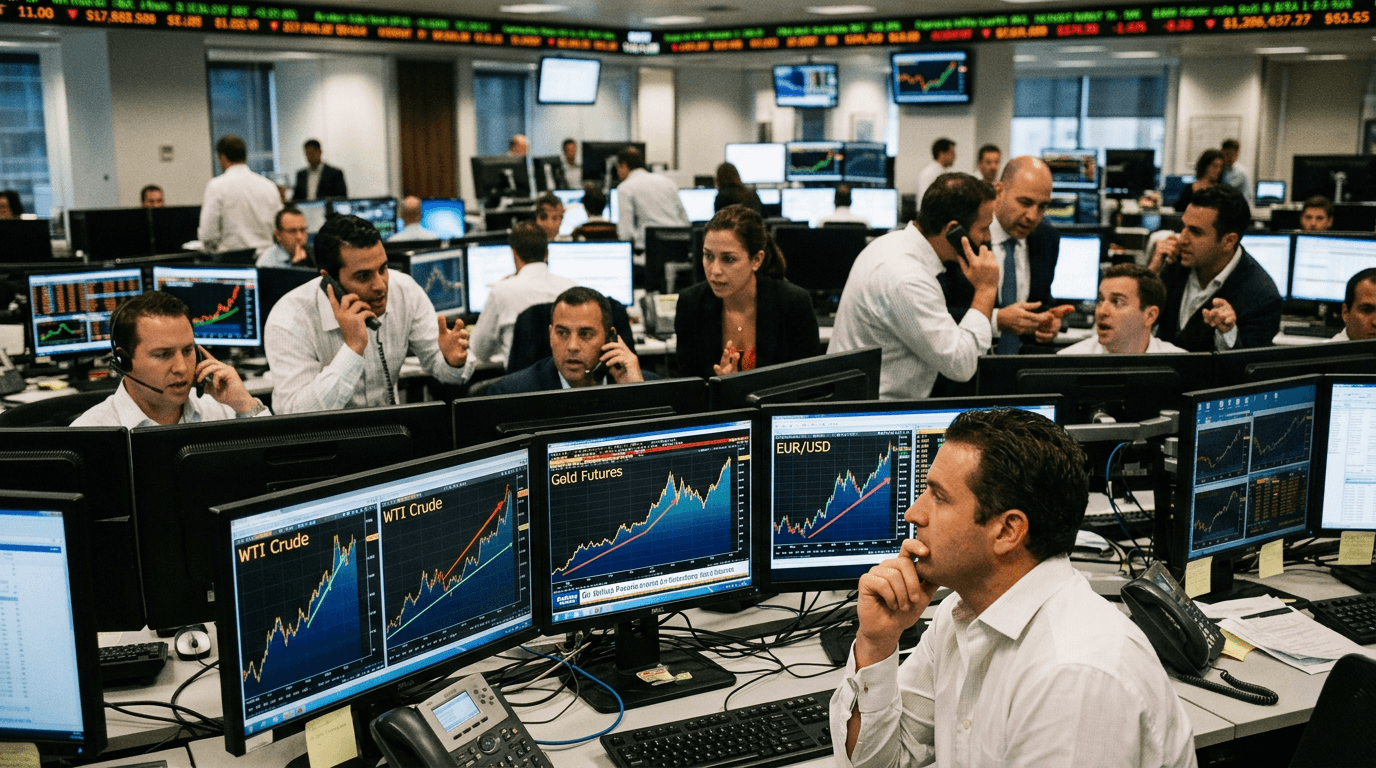
The prospect of “toughest‑ever” US sanctions on Iran, combined with Tehran’s threat to choke off oil flows through the Strait of Hormuz, has sharply raised geopolitical risk premia across energy and global markets.[5][7][9] Gold has surged to a three‑month high above $4,600 as investors seek safety, while safe‑haven currencies and long‑dated US yields move back into focus for FX and futures traders.[2][10][14]
SANCTIONS ESCALATION AND IRAN’S OIL LIFELINE
The latest sanctions push is aimed squarely at Iran’s energy and shipping ecosystem, from its “shadow fleet” of tankers to key buyers and financial intermediaries.[7][8][9] Recent US actions have targeted dozens of vessels and companies linked to clandestine crude exports, alongside warnings to foreign banks that Iran‑related transactions could trigger secondary sanctions.[7][9]
These steps come on top of an earlier campaign that has already strained Iran’s main economic lifeline: oil exports.[1][4] Tanker‑tracking data show Iranian crude loadings and arrivals have fallen notably since renewed pressure began in late 2025 and early 2026, with exports dropping sharply at times when maritime enforcement tightened.[1][4] At one point, estimates suggested an 84–89% collapse in shipments over just two months, highlighting how aggressive sanctions can disrupt flows even without a full blockade.[1]
Yet analysts caution that Iran has developed sophisticated covert channels to keep barrels moving, including ship‑to‑ship transfers and opaque trading networks.[13] This “sanctions‑resilient” export model means that legal measures alone may not eliminate supply, but they can increase costs, complexity, and tail‑risk for global energy markets.[11][13]
Strait Of Hormuz: The Critical Chokepoint
The geopolitical stakes rise dramatically when the Strait of Hormuz is brought into play. Around one‑third of the world’s seaborne oil trade—roughly 17 million barrels per day—typically passes through this narrow corridor linking the Persian Gulf to global markets.[5] The International Energy Agency recently warned that effective closure or severe disruption in Hormuz could cut as much as 14 million barrels per day of crude flows, underscoring its systemic importance.[6]
Tehran has a history of threatening to disrupt Hormuz traffic in response to sanctions, and such rhetoric can quickly translate into higher risk premia on crude benchmarks.[5][6] Historically, similar episodes have added an estimated $5–$10 per barrel to oil prices, driven by fears of supply interruption as much as by actual lost barrels.[5] More recent tanker‑tracking has shown traffic through the Strait being partially curtailed during periods of heightened tension, with daily ship counts dropping by roughly half at times.[15]
For traders, Hormuz risk is not purely binary—open or closed. Even partial disruptions, military incidents, or insurance restrictions can tighten prompt physical availability, widen calendar spreads, and amplify volatility in energy futures.[6][12][15] That makes this chokepoint a key macro variable, on par with major policy decisions or OPEC+ surprises.
Market Reaction: Oil, Gold, Fx, And Bonds
Oil prices have already responded to the renewed US‑Iran confrontation, with benchmarks posting consecutive weekly gains as supply concerns resurface.[12][15] News of sanctions threats and disrupted shipping lanes has reinforced expectations that the Gulf’s output recovery could stall, at least temporarily.[12] This backdrop supports higher forward curves and has re‑energized relative value trades across crude grades and time spreads.[11][12][15]
Gold has been one of the clearest beneficiaries of the sanctions narrative and Hormuz risk.[2][10][14] Episodes of military escalation, threatened strikes, and sanctions waves tied to Iran have repeatedly triggered safe‑haven inflows, pushing bullion to new highs or sharp multi‑day rallies.[2][10][14] In the current episode, gold holding above $4,600 and near three‑month highs reflects not only geopolitical anxiety, but also renewed hedging against potential inflation spikes if oil prices climb further.[2][10]
Safe‑haven currencies such as the Japanese yen and Swiss franc typically strengthen when geopolitical stress rises, particularly if equity markets wobble and carry trades are unwound. While recent data focus more on energy and metals, the pattern of risk‑off flows around Middle East shocks has historically favored these currencies and select reserve FX over high‑beta, commodity‑linked units.[10][14] Long‑dated US Treasury yields, meanwhile, sit at the intersection of two forces: inflation risks from higher oil and demand for safety assets. Traders are therefore watching the curve response closely as sanctions headlines evolve.[10][14]
Implications For Fx And Futures Traders
For FX and rates traders, the key dynamic is the tug‑of‑war between inflation expectations and risk aversion. A sustained oil risk premium can lift breakeven inflation and push nominal yields higher, especially at the long end, even if short‑term growth fears emerge.[5][6][12] That environment often supports the US dollar versus high‑yielding EM currencies, while creating opportunities in relative value trades across safe‑haven FX pairs.
Commodity and index futures traders face a different but related set of challenges. Elevated Hormuz risk can widen intraday ranges and gap risks in crude, refined products, and even LNG‑linked contracts.[6][12][15] At the same time, gold and other precious metals may decouple from usual macro drivers—such as real yields or the dollar—and instead trade primarily on headline risk and positioning shifts.[2][10][14] Understanding these regime changes is essential for calibrating leverage, stop‑loss levels, and position sizing.
Simulated finance platforms like E8 Markets offer a useful sandbox for exploring these cross‑asset linkages without direct capital at risk. Traders can test how shocks to oil supply, changes in sanctions intensity, and shifts in safe‑haven demand translate into FX, rates, and metals performance, refining strategies before deploying them in live markets.[11][13][15]
Practical Takeaways For E8 Markets Traders
1) Track the sanctions timeline and scope Follow official statements and enforcement actions against Iran’s energy exports, shadow fleet, and financial networks, as these can reshape medium‑term supply expectations and volatility.[7][8][9]
2) Monitor Hormuz traffic and Gulf production indicators Tanker‑tracking data, insurance developments, and IEA commentary on flows through Hormuz provide early signals of whether risk is translating into actual supply disruption.[6][12][15]
3) Use gold and safe‑haven FX as sentiment gauges Sharp moves in gold, yen, and Swiss franc pairs can confirm or challenge the risk narrative implied by oil prices, offering cross‑checks and hedge opportunities.[2][10][14]
4) Stress‑test portfolios for oil and rate shocks Scenario‑test positions assuming higher crude prices, steeper yield curves, and shifting correlations, particularly for strategies sensitive to carry, volatility, or funding costs.[5][6][12]
5) Separate headline noise from structural changes Distinguish temporary spikes driven by rhetoric or isolated incidents from sustained policy and sanctions shifts that can alter supply, trade routes, and risk premia for months.[11][13][15]
Conclusion
The looming escalation of US sanctions on Iran, coupled with Tehran’s threat over the Strait of Hormuz, has pushed energy security back to the center of global macro trading.[5][6][7] Oil risk premia, a resilient gold rally, and renewed interest in safe‑haven FX and long‑dated US yields all reflect markets repricing geopolitical uncertainty.[2][10][14] For traders—whether on live desks or simulated platforms—the challenge is to convert this uncertainty into structured, risk‑aware strategies that respect the asymmetry of tail events while remaining grounded in data and cross‑asset relationships.[11][13][15]