
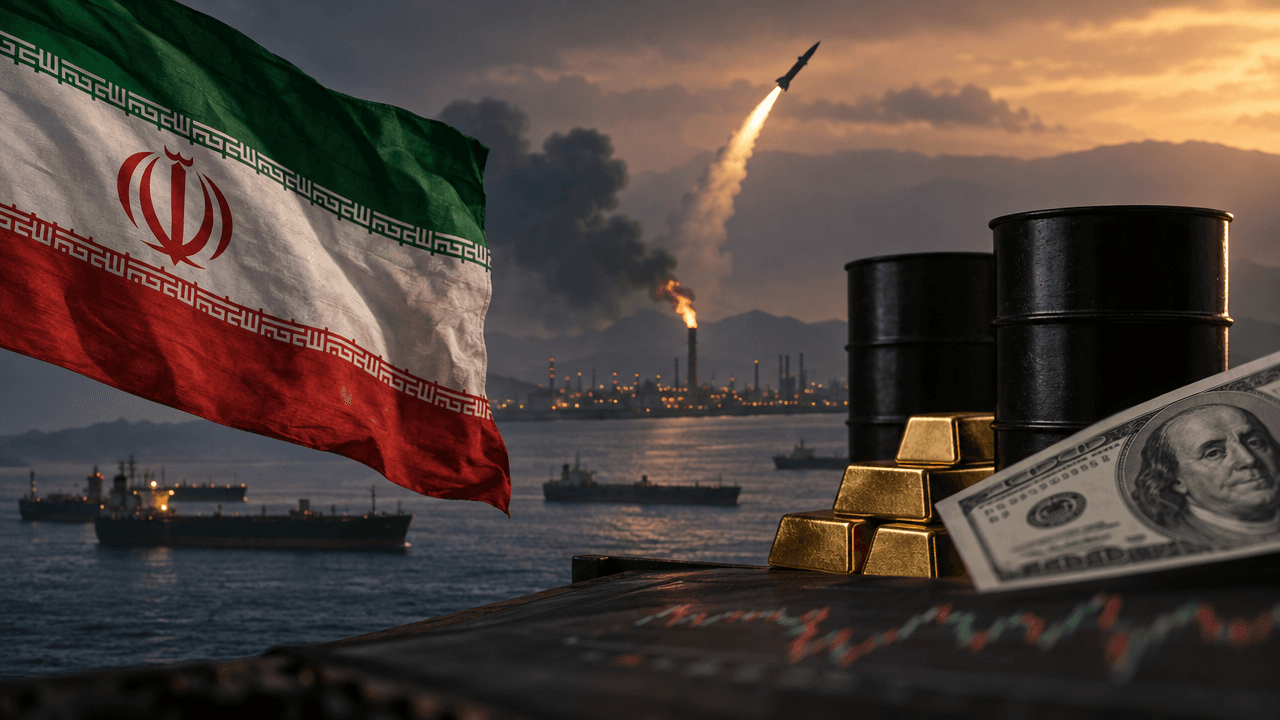
Iran’s latest statements that its armed forces are fully prepared for renewed confrontation with the United States underline how quickly geopolitical risk can return to center stage for global markets.[1][6][11] For traders, the message is clear: even in a prolonged standoff, signaling and rhetoric can shift expectations around oil, inflation, safe-haven demand and risk appetite in a matter of hours.[3][8][12]
Geopolitical Backdrop
Iranian military and Revolutionary Guard officials have repeatedly emphasized that they are ready for any new U.S. attack and prepared for a long war, warning that further strikes would trigger much heavier responses.[5][11][13] Statements from senior commanders speak of “full readiness,” “maximum deterrence” and the ability to change the “geography of the war,” suggesting not just defensive posture but an offensive capability designed to alter the conflict’s scope and theatre.[6][10][13] At the same time, hardline voices have raised the prospect of leaving nuclear treaties and strengthening missile, drone and cyber capabilities, reinforcing the perception of a drawn‑out confrontation rather than a short shock.[6]
The standoff is closely tied to control over strategic waterways, especially the Strait of Hormuz, through which a significant share of global seaborne oil flows.[1][3][10] U.S. measures including an “indefinite” maritime blockade and efforts to constrain Iran’s oil exports have been met with warnings that Tehran will not accept a situation where it cannot trade while foreign powers freely use regional routes.[1][10] This dynamic keeps the market focused not just on battlefield developments but on shipping security, energy supply chains and insurance costs for vessels transiting the Gulf.[3][8]
WHAT IRAN’S SIGNALS REALLY MEAN FOR RISK
When a state signals readiness for escalation, markets are less concerned with the rhetoric itself and more focused on what it implies about tail risks—low‑probability but high‑impact scenarios.[8][12] Iran’s warnings that any new U.S. strike would draw a significantly heavier response, potentially widening targets and theatres, raise the perceived likelihood of disruptions to energy infrastructure, shipping lanes or U.S. bases and partners in the region.[11][13] Even if no immediate action follows, traders adjust by re‑pricing volatility, insurance premia and the probability distribution of future oil prices.[8][12]
Historical episodes from this conflict show that heightened U.S.–Iran tensions typically weigh on risk appetite and support defensive positioning.[2][8][12] In previous flare‑ups, oil has spiked, gold has strengthened, and equity futures and risk‑sensitive currencies have come under pressure as investors move toward safer or more dollar‑denominated assets.[2][8][12] Over the medium term, markets can become accustomed to a conflict and partially look through it, but each new signal of potential escalation tends to revive the focus on worst‑case scenarios rather than base case forecasts.[9][15]
In the current episode, six‑hour price impact data remain inconclusive, reflecting the fact that this is an incremental development in an already tense environment rather than a shock event like a surprise attack or major sanctions announcement. That does not make the news irrelevant; it simply means traders are layering this signal onto an existing risk framework rather than building one from scratch.
Cross-asset Market Channels
For currencies, elevated geopolitical risk in the Middle East usually supports the U.S. dollar and other perceived safe havens, as global investors seek liquidity and lower volatility in times of uncertainty.[2][8] Escalation worries can pressure emerging‑market and high‑beta currencies, particularly those closely tied to global growth or dependent on imported energy, as investors demand higher risk premia.[8] The combination of stronger dollar and higher oil prices can also tighten financial conditions for oil‑importing economies, feeding back into currency performance.
In commodities, the primary channel is oil. Analysis from major banks has highlighted that prolonged conflict with Iran can drive higher crude prices, lift gasoline costs and fan consumer inflation, particularly if shipping through the Strait of Hormuz is disrupted.[3][8] Earlier phases of the war saw Brent futures gain around 20% from pre‑conflict levels, with temporary spikes above $100 per barrel as tail risks around supply intensified.[12][15] Gold has also benefited as a traditional safe haven, with strategists warning that further escalation could push prices higher as investors hedge geopolitical and inflation risks simultaneously.[8][12]
Equity markets feel the impact through risk appetite and sector rotation. Previous Iran‑related escalations have dragged major stock indices lower as technology and growth names sold off, while energy and defense shares often outperformed on higher oil prices and expectations of increased military spending.[2][9] Over time, investors may partially look through the conflict if earnings and macro data remain resilient, but each new episode of saber‑rattling can trigger short‑term de‑risking, particularly in futures and options markets where hedging flows are more visible.[2][9][15]
Implications For Simulated Traders
For traders using a SimFi environment like E8 Markets, this type of news is an opportunity to practice navigating complex, multi‑asset geopolitics without real‑world capital at stake. The first step is building scenarios rather than predictions: a baseline of continued stalemate, an upside scenario of de‑escalation and improved market sentiment, and a downside scenario in which renewed strikes or shipping incidents force a sharp repricing of oil and risk assets.[3][8]
In each scenario, traders can map out cross‑asset reactions: how crude, gold, the dollar, high‑beta FX pairs and equity indices might respond, and how correlations between them could shift. For example, a downside escalation scenario might feature a stronger dollar, higher oil and gold, weaker emerging‑market currencies, pressure on global equity futures, and outperformance of energy and defense sectors.[2][8][12] Testing strategies against these conditions—such as relative‑value trades between oil majors and broader indices, or hedging high‑beta FX exposure with safe‑haven positions—helps build intuition about how geopolitics transmits through markets.
Risk management is crucial. Simulated environments allow traders to experiment with position sizing, stop‑loss placement and diversification across assets during geopolitical stress. By tracking how hypothetical portfolios behave when newsflow turns more aggressive, traders can identify concentrations of risk—such as over‑exposure to growth stocks or carry trades vulnerable to volatility spikes—and adjust their playbook accordingly.
Key Takeaways For Active Market Participants
1. Treat geopolitical headlines as inputs to a scenario framework, not as trading signals in isolation. This reduces the temptation to overreact to rhetoric while still respecting the increase in tail risks.
2. Focus on transmission channels: energy supply, shipping routes, inflation expectations, safe‑haven demand and risk appetite. Iran–U.S. tensions primarily move markets via oil, gold, the dollar and equity sentiment.[2][3][8][12]
3. Watch correlations. In stress episodes, assets that usually diversify a portfolio can move together, as broad risk‑off flows overpower idiosyncratic fundamentals. Simulated trading is an ideal place to observe these shifts without financial consequences.
4. Use news like Iran’s readiness signal to stress‑test strategies. Ask how your portfolio would behave if oil jumped, gold rallied, the dollar strengthened and equities sold off, then build contingency plans around those answers.[2][8][12]
Conclusion
Iran’s assertion that it is fully prepared for renewed confrontation with the United States does not automatically trigger market turmoil, but it reinforces a higher‑for‑longer geopolitical risk backdrop that traders cannot ignore.[1][6][11] In a world where conflict in the Middle East has already reshaped energy markets, inflation dynamics and cross‑asset correlations, each new signal of possible escalation nudges expectations and tail risks rather than rewriting the story altogether.[3][8][15] For participants in both live and simulated markets, the edge lies in systematically translating such signals into scenarios, risk assessments and diversified strategies—turning uncertainty into a structured framework rather than a source of reactive trades.