
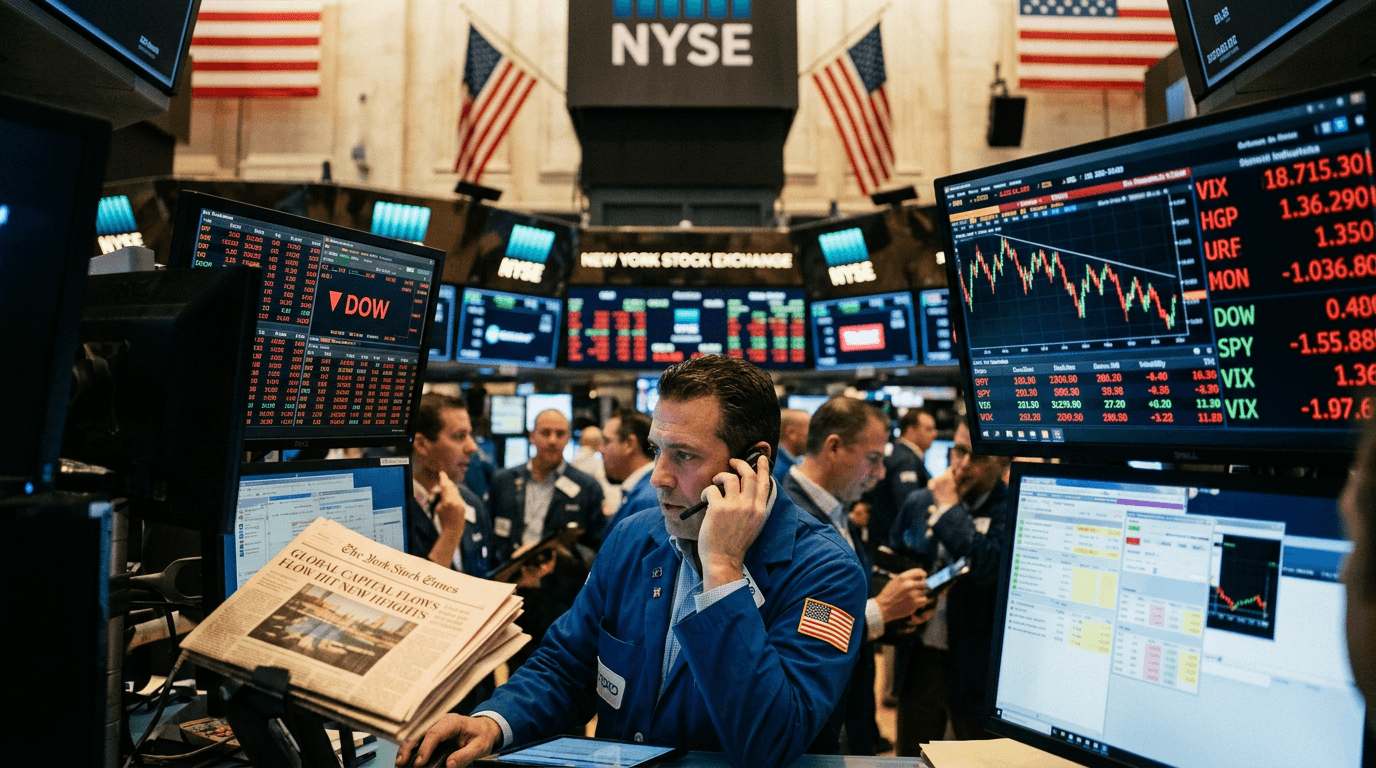
Foreign money has long been the quiet engine behind the U.S. dollar, flowing steadily into Treasuries and other debt to finance America’s external deficit with relatively low drama.[1][3] Deutsche Bank now argues that engine is changing: instead of buying U.S. bonds, foreign investors are increasingly buying U.S. stocks, a shift that could make the dollar behave less like a safe haven and more like a risk asset tied to global equity sentiment.[1][2][3][7]
What Deutsche Bank Is Warning About
Deutsche Bank’s FX strategists describe an “important long-term rotation” in how the U.S. funds its deficit: away from foreign purchases of dollar debt and toward foreign inflows into U.S. equities.[2][3][6] The gap between rising net equity flows into the U.S. and falling debt flows “has never been wider,” highlighting that the structure of capital supporting the dollar is changing, not just its size.[2][6]
Several forces sit behind this shift. Geopolitical tensions have eroded foreign official appetite for long-term U.S. debt, especially Treasuries, as some reserve managers diversify away from dollar assets.[1][2][6] At the same time, the AI and technology boom has pulled enormous foreign equity capital into U.S. markets, making the dollar more exposed to the lifecycle of a volatile, high-growth sector.[1][2][3]
How The Dollar Is Changing
Historically, the dollar has been financed largely by “sticky” reserve and debt flows: central banks and long-term investors buying U.S. Treasuries for safety and liquidity.[1][3][6] That model supported the dollar’s reputation as a defensive asset that often strengthened in global risk-off episodes, even when U.S. risk assets sold off.
Deutsche Bank’s point is that the dollar is being re-rated from a pure safe haven toward a growth-linked, risk-sensitive asset.[3][7] As more foreign money enters via equities rather than debt, the currency becomes increasingly tied to equity cycles, AI narratives and global risk appetite for U.S. stocks, rather than to stable reserve demand.[2][3][7] In other words, the world is not abandoning the dollar – it is changing how it owns it, and that changes what the dollar is.[7]
Why Equity-based Funding Is Riskier
Debt-based funding is generally predictable: coupon payments are fixed, maturities are known, and official reserve managers tend to move gradually.[1][3][6] Equity flows, by contrast, are inherently pro‑cyclical and sensitive to valuation, earnings and sentiment. When optimism about U.S. growth and technology is high, foreign equity inflows can be very strong; when that optimism fades, those flows can stall or reverse quickly.
Deutsche Bank warns that this makes the dollar “more risky and more leveraged to AI.”[2] If global risk appetite toward U.S. tech and AI fades, foreign equity inflows could slow, leaving a larger external deficit funded by more fickle capital.[1][2][3] At the extreme, a sustained foreign “buyers’ strike” across U.S. assets, which Deutsche Bank has already flagged as a risk in recent flow data, would raise questions about Treasury funding and the sustainability of America’s twin deficits.[1][4]
Emerging Signs In Capital Flows
There are already signs that foreign investors are engaging with U.S. assets differently. Deutsche Bank analysis of ETF flows shows overseas investors cutting unhedged dollar exposure at a record pace, increasingly buying U.S. stocks and bonds through dollar-hedged vehicles instead.[5][9] For the first time this decade, flows into dollar-hedged ETFs that own U.S. assets have exceeded those into unhedged funds.[5][9]
In practice, that means foreign investors may still like U.S. equities but are less willing to hold open dollar risk.[5][9] If this pattern persists, the U.S. could face a world where it relies on risk-sensitive equity inflows for funding, while those very investors systematically hedge away currency exposure – weakening one of the dollar’s traditional support pillars even as U.S. markets attract capital.
Implications For Fx, Rates And Global Portfolios
For FX markets, the core implication is that the classic “risk-off means stronger dollar” trade becomes less reliable.[3][7] If the dollar is increasingly backed by equity flows and heavily hedged foreign capital, the currency may not appreciate as consistently during global stress, especially in scenarios where U.S. equities themselves are the epicenter of the shock.[3][7] Instead, performance may hinge more on how global investors rotate across equity regions and sectors.
Longer‑dated Treasury futures are also in the firing line. Weaker foreign official demand for U.S. debt, combined with a larger role for private, risk‑sensitive capital, could increase term premium and volatility at the long end of the curve.[1][3][6] For global portfolio allocators, this suggests paying closer attention to capital flow structures, not just macro data and interest-rate differentials, when thinking about dollar exposure and duration risk.[6]
How Traders And Investors Can Adapt
For traders in both live and simulated environments, this structural shift argues for updating rule‑of‑thumb relationships. Backtests that assume a stable negative correlation between the dollar and global risk sentiment may overstate the currency’s defensive power if equity-based financing continues to grow.[3][7] Stress-testing strategies under scenarios where U.S. equities and the dollar weaken together becomes more important.
Practically, FX traders may want to incorporate equity and sector signals more directly into dollar models – for example, tracking foreign flows into U.S. tech ETFs, the performance of AI‑linked indices, and the share of hedged versus unhedged inflows.[2][3][5][9] Macro traders in rates and equity index futures can also monitor shifts in foreign Treasury holdings, ETF flow reports and commentary from large reserve managers to gauge whether the funding mix is becoming more or less fragile over time.[1][4][6]
For longer‑horizon investors, the message is to think of the dollar less as a one‑dimensional safe haven and more as a barometer of U.S. growth, technology leadership and geopolitical trust. That may argue for more active currency hedging around U.S. equity exposure, greater diversification into other major currencies that screen cheap on valuation, and more dynamic management of duration risk as foreign demand for Treasuries evolves.[4][6][7]